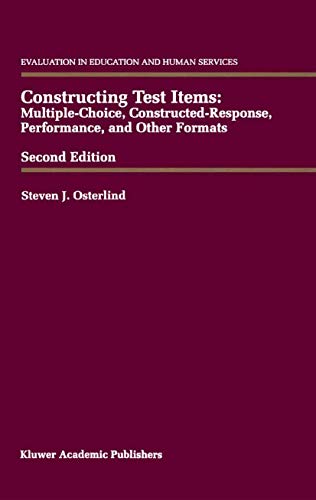

Constructing test items Steven J. Osterlind.
Series Evaluation in education and human services series | Evaluation in education and human servicesDetalles de publicación: Boston Kluwer Academic Publishers c1998.Edición: 2nd edDescripción: xv, 339 p. ill. 24 cmISBN:- 0792380770
- LB3060 .65 .O77 1998.
| Imagen de cubierta | Tipo de ítem | Biblioteca actual | Biblioteca de origen | Colección | Ubicación en estantería | Signatura topográfica | Materiales especificados | Info Vol | URL | Copia número | Estado | Notas | Fecha de vencimiento | Código de barras | Reserva de ítems | Prioridad de la cola de reserva de ejemplar | Reservas para cursos | |
|---|---|---|---|---|---|---|---|---|---|---|---|---|---|---|---|---|---|---|
| Libro | Biblioteca de Derecho Mons. Fremiot Torres Oliver Colección General biblioteca derecho | LB 3060 .65 .O77 1998 (Navegar estantería(Abre debajo)) | Disponible | 70000000454954 |
Descripciones mejoradas de Syndetics:
Constructing test items for standardized tests of achievement, ability, and aptitude is a task of enormous importance. The interpretability of a test's scores flows directly from the quality of its items and exercises. Concomitant with score interpretability is the notion that including only carefully crafted items on a test is the primary method by which the skilled test developer reduces unwanted error variance, or errors of measurement, and thereby increases a test score's reliability. The aim of this entire book is to increase the test constructor's awareness of this source of measurement error, and then to describe methods for identifying and minimizing it during item construction and later review. Persons involved in assessment are keenly aware of the increased attention given to alternative formats for test items in recent years. Yet, in many writers' zeal to be `curriculum-relevant' or `authentic' or `realistic', the items are often developed seemingly without conscious thought to the interpretations that may be garnered from them. This book argues that the format for such alternative items and exercises also requires rigor in their construction and even offers some solutions, as one chapter is devoted to these alternative formats. This book addresses major issues in constructing test items by focusing on four ideas. First, it describes the characteristics and functions of test items. A second feature of this book is the presentation of editorial guidelines for writing test items in all of the commonly used item formats, including constructed-response formats and performance tests. A third aspect of this book is the presentation of methods for determining the quality of test items. Finally, this book presents a compendium of important issues about test items, including procedures for ordering items in a test, ethical and legal concerns over using copyrighted test items, item scoring schemes, computer-generateditems and more.
Includes indexes.
Bibliography: p. [311]-325.
Tabla de contenidos provista por Syndetics
- Chapter 1 What Is Constructing Test Items?(p. 1)
- Introduction(p. 1)
- What This Book Is About(p. 6)
- Major Purposes Of This Book(p. 9)
- Why This Information Is Important(p. 11)
- Persons For Whom This Book Is Intended(p. 13)
- Overview Of The Remaining Chapters(p. 14)
- How To Approach the Chapters(p. 16)
- Chapter 2 Definition, Purpose, And Characteristics of Items(p. 17)
- Introduction(p. 17)
- Defining A Test Item(p. 19)
- Test Item Nomenclature(p. 21)
- Purpose For Test Items(p. 36)
- Criteria For Good Test Items(p. 40)
- Assumptions For Test Items(p. 44)
- Classification Of Items(p. 54)
- Conclusion(p. 57)
- Chapter 3 Determining the Content For Items: Validity(p. 59)
- Introduction(p. 59)
- Basic Concepts of Validity(p. 61)
- The Relationship Between Constructing Test Items and Validity(p. 65)
- Conditions For Items To Contribute To Validity(p. 67)
- Initial Considerations When Selecting Content For Items(p. 69)
- Achieving Clarity In A Test's Content(p. 71)
- Melding Cognitive Processing Levels With Items Content(p. 83)
- Test Item Specifications(p. 88)
- Making An Item Consistent With Its Specification(p. 98)
- Conclusion(p. 105)
- Chapter 4 Starting To Write Items: Practical Considerations(p. 107)
- Introduction(p. 107)
- The Importance Of Good Writing In Test Items(p. 109)
- Sources For Information On Writing Style(p. 113)
- The Computer and Writing Items(p. 115)
- Using Taxonomies In Writing Items(p. 116)
- Distinctness Between Stem and Response Alternatives(p. 132)
- Importance Of An Interrogative Stem(p. 136)
- Determining The Correct Response For Test Items(p. 139)
- Positive Working in the Stem Rather than Negative(p. 145)
- Determining The Optimal Number Of Response Alternatives(p. 146)
- Making Response Alternatives Plausible(p. 148)
- Use Of All Of The Above Or None Of The Above As Response Alternatives(p. 151)
- Using Specific Determiners In Test Items(p. 155)
- Constructing Complex Response Alternatives(p. 156)
- Time Examinees Need To Respond To Items(p. 158)
- Conclusion(p. 158)
- Chapter 5 Style, Editorial, and Publication Guidelines For Items in the Multiple-Choice Format(p. 161)
- Introduction(p. 161)
- Understanding The Multiple-Choice Item Format(p. 162)
- Advantages and Criticisms Of Items In The Multiple-Choice Format(p. 163)
- Editorial Format For Items(p. 165)
- Using Directions Correctly(p. 169)
- Specialized Style Rules For Multiple-Choice Items(p. 174)
- Type Characteristics and Page Layout(p. 193)
- Conclusion(p. 202)
- Chapter 6 Style, Editorial, and Publication Guidelines For Items in Constructed-Response and Performance Formats(p. 203)
- Introduction(p. 203)
- Types of Constructed-Response and Performance(p. 205)
- Validity in Constructed-Response(p. 206)
- Precision in Wording, Again(p. 208)
- Conclusion(p. 214)
- Chapter 7 Style, Editorial, and Publication Guidelines For Items in Other Common Formats(p. 215)
- Introduction(p. 215)
- Precision In Wording, Again(p. 216)
- Understanding Items In The True-False Format(p. 219)
- Understanding Items In The Matching Format(p. 234)
- Understanding Short-Answer And Sentence-Completion Items(p. 237)
- Understanding Cloze-Procedure(p. 242)
- Conclusion(p. 251)
- Chapter 8 Judging the Quality Of Test Items: Item Analysis(p. 253)
- Introduction(p. 253)
- Measurement Error(p. 254)
- Understanding Item Analysis(p. 257)
- Validating The Content Of Items(p. 258)
- Using Leading Questions In Item Analysis(p. 265)
- Item Statistics(p. 266)
- Item Parameters(p. 284)
- Item Bias(p. 289)
- Conclusion(p. 298)
- Chapter 9 Ethical, Legal Considerations, and Final Remarks for Item Writers(p. 301)
- Introduction(p. 301)
- Ethical Concerns For Item Writers(p. 302)
- Concluding Comments About Constructing Test Items(p. 308)
- References(p. 311)
- Author Index(p. 327)
- Subject Index(p. 331)