Imagen de portada de Amazon
Imagen de Amazon.com
Imagen de cubierta Syndetics
Portada de Syndetics
Imagen de OpenLibrary

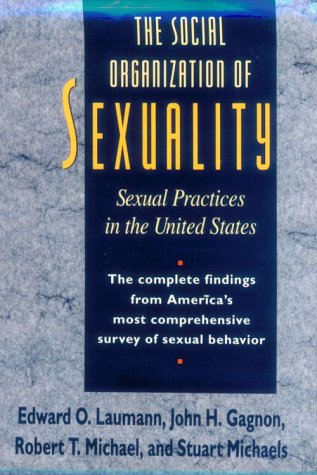
The social organization of sexuality sexual practices in the United States Edward O. Laumann ... [et al.].

Colaborador(es): Detalles de publicación: Chicago University of Chicago Press 1994.Descripción: xxxii, 718 p. ill. 24 cmISBN:
  • 0226469573 (cloth : alk. paper)
Tema(s): Clasificación CDD:
  • 306.7/0973 20
Clasificación LoC:
  • HQ18.U5 S59 1994
Valoración
    Valoración media: 0.0 (0 votos)
Existencias
Imagen de cubierta Tipo de ítem Biblioteca actual Biblioteca de origen Colección Ubicación en estantería Signatura topográfica Materiales especificados Info Vol URL Copia número Estado Notas Fecha de vencimiento Código de barras Reserva de ítems Prioridad de la cola de reserva de ejemplar Reservas para cursos
Libro Biblioteca Encarnación Valdés Colección General bev 306.70973 S678 (Navegar estantería(Abre debajo)) Disponible 80000001998163
Total de reservas: 0

Descripciones mejoradas de Syndetics:

The Social Organization of Sexuality reports the complete results of the nation's most comprehensive representative survey of sexual practices in the general adult population of the United States. This highly detailed portrait of sex in America and its social context and implications has established a new and original scientific orientation to the study of sexual behavior.

"The most comprehensive U.S. sex survey ever." -- USA Today

"The findings from this survey, the first in decades to provide detailed insights about the sexual behavior of a representative sample of Americans, will have a profound impact on how policy makers tackle a number of pressing health problems." --Alison Bass, The Boston Globe

"A fat, sophisticated, and sperm-freezingly serious volume. . . . This book is not in the business of giving us a good time. It is in the business of asking three thousand four hundred and thirty-two other people whether they had a good time, and exactly what they did to make it so good." --Anthony Lane, The New Yorker

New York Times Book Review Notable Book of the Year

Includes bibliographical references (p. 679-706) and indexes.

Tabla de contenidos provista por Syndetics

  • List of Illustrations
  • List of Tables
  • Acknowledgments
  • Prologue
  • 1 Theoretical Background
  • 2 The Study Design
  • 3 Sexual Practices and Profiles of Sexual Expression
  • 4 The Social Organization of Subjective Sexual Preferences
  • 5 The Number of Partners
  • 6 Sexual Networks
  • 7 Epidemiological Implications of Sexual Networks
  • 8 Homosexuality
  • 9 Formative Sexual Experiences
  • 10 Sex, Health, and Happiness
  • 11 Sexually Transmitted Infections
  • 12 Sex and Fertility
  • 13 Sex, Cohabitation, and Marriage
  • 14 Normative Orientations toward Sexuality
  • Epilogue
  • Appendix A Sampling Procedures and Data Quality
  • Appendix B Comparisons of the NHSLS with Other Data Sets
  • Appendix C Text of the NHSLS Questionnaire
  • References
  • Author Index
  • Subject Index

Reseñas proporcionadas por Syndetics

Library Journal Review

Based on the National Health and Social Life Survey, a 1992 nationwide survey of 3432 American men and women between the ages of 18 and 59, this is one of two books reporting on the findings. This book is intended for professional social scientists, counselors, and health professionals, while Robert T. Michael and others' Sex in America, just published by Little, Brown, anticipates a more general audience. Beginning with the theoretical foundations, rationale for, and design of the methodology, the authors put the work in historical context as they assert its accuracy and generalizations, urging caution about interpretation and implications of their sometimes surprising findings. Though the study was designed largely to "fill significant gaps in our knowledge of sexual behavior associated with the acquisition of the AIDS virus," this book achieves a refreshingly readable examination of masturbation, sexually transmitted infections, cohabitation and marriage, fertility, and homosexuality. The text throughout is buttressed by graphs, charts, tables, diagrams, appendixes, bibliographic references, and author and subject indexes (not seen). For academic collections.-James E. Van Buskirk, San Francisco P.L. (c) Copyright 2010. Library Journals LLC, a wholly owned subsidiary of Media Source, Inc. No redistribution permitted.

CHOICE Review

Although it is not the first major study of American sexual behavior since Kinsey, the National Opinion Research Center (NORC) survey, whose findings are presented in these two books, is probably the most comprehensive and theoretically informed. Funded privately, budgetary restrictions kept the sample to 3,432, limiting subgroup analysis. Size notwithstanding, the refusal rate was kept to a minimum, reducing distortions created by nonresponses. The authors attempted to move beyond mere statistical reporting by grounding their findings in script, choice, and network theories. Although the results of the survey are difficult to review briefly, it can be said that in general they defy conventional wisdom on American sexual behavior. The emerging picture is hardly one of licentiousness. Certainly premarital sexual behavior among adolescents has risen substantially since Kinsey's times, but most married people seem to take their vows quite seriously (more than 90 percent of women and 75 percent of the men report having been faithful). Within the context of marriage the two activities most frequently listed as "very appealing" were vaginal intercourse and watching one's partner undress. In line with the findings of several other recent studies, the NORC survey reports markedly lower rates of gay and lesbian behavior than those found in Kinsey. Nevertheless, Laumann et al. insist on the complexity of this issue, arguing that desire, behavior, and identity do not always hang together. More than four percent of the women and nine percent of men report some same-gender sexual behavior since puberty but when the measure turns to the last 12 months, figures are roughly 1.3 percent and 2.8 percent. The authors make an effort to analyze all sexual behavior, not only in terms of "master status" categories such as sex, age, race, education, and religion, but also in terms of relational context. There is chapter-length discussion of the study's implications for sexually transmitted infections. Social Organization of Sexuality is a fairly dense academic monograph, replete with charts, graphs, and technical discussions of sample and survey design. It is meant for an academic and professional audience. Sex in America does a very good job of summarizing the main findings of the survey for general readers. M. Gordon; University of Connecticut
Compartir
logopucpr-y-vive

Contáctanos

¡Queremos saber de ti!

Tel. 787.841.2000 Ext. 1801

bibliotecavaldes@pucpr.edu

⁣Búscanos en las redes

© 2026 Desarrollado por Ignite Online • All Rights Reserved • Powered by Koha.