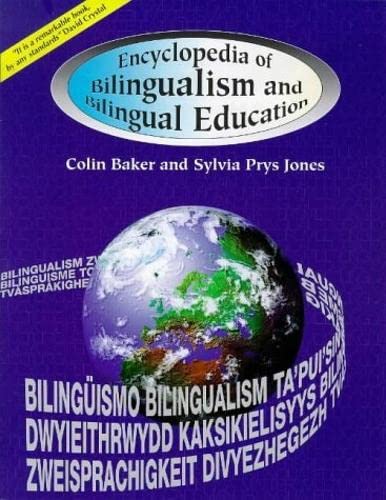

Encyclopedia of bilingualism and bilingual education edited by Colin Baker.
Detalles de publicación: Clevedon Philadelphia Multilingual Matters 1997.Descripción: p. cmISBN:- 1853593621
- 371.97/003 20
- LC3707 .E53 1997
| Imagen de cubierta | Tipo de ítem | Biblioteca actual | Biblioteca de origen | Colección | Ubicación en estantería | Signatura topográfica | Materiales especificados | Info Vol | URL | Copia número | Estado | Notas | Fecha de vencimiento | Código de barras | Reserva de ítems | Prioridad de la cola de reserva de ejemplar | Reservas para cursos | |
|---|---|---|---|---|---|---|---|---|---|---|---|---|---|---|---|---|---|---|
| Referencia | Biblioteca Encarnación Valdés Sala de Referencia bev | 371.97003 E56 (Navegar estantería(Abre debajo)) | Disponible | 80000002044322 |
Descripciones mejoradas de Syndetics:
This superbly illustrated Encyclopedia comprises the most comprehensive work yet available on bilingualism. Written in a concise and comprehensive style, it includes: - 117 main topics - 390 textboxes to illustrate the main topics - 228 profiles of languages in all countries of the world - 340 pictures, 35 maps, 98 graphs, 14 diagrams and over half a million words - one of the most up-to-date and extensive bibliographies on bilingualism - over 2,000 references - extensive glossary of 375 terms - plentiful examples and illustrations from around the world New areas and topics e.g. Information Technology and Bilingualism, Bilingualism and the Internet, Bilingualism and the Economy, Bilingual Professions, Religion and Bilingualism, Bilingualism and Tourism, Language Marketing.
Includes bibliographical references and index.
Tabla de contenidos provista por Syndetics
- Foreword(p. vi)
- Preface(p. vii)
- Acknowledgements(p. viii)
- Section 1 Individual Bilingualism
- Who is a Bilingual?
- 1 Defining Bilingualism(p. 2)
- 2 The Advantages and Disadvantages of Bilingualism(p. 6)
- 3 Two Views of Bilinguals: Two Halves or One Whole?(p. 9)
- 4 Balanced Bilinguals(p. 12)
- 5 Double 'Semilingualism'(p. 14)
- 6 Prestigious Bilingualism(p. 15)
- 7 Multilingualism(p. 17)
- 8 Personality, Social Development, Identity and Bilingualism(p. 22)
- Bilingualism and the Family
- 1 Types of Bilingual Family(p. 28)
- 2 The Development of Bilingualism in Children(p. 36)
- 3 Bilingualism and Marriage(p. 44)
- 4 Mother Tongue(p. 47)
- The Everyday Language Use of Bilinguals
- 1 Language Choice(p. 51)
- 2 Bilingualism and Sensitivity in Communication(p. 54)
- 3 Codeswitching(p. 58)
- Bilingualism and Thinking
- 1 Bilingualism and Intelligence(p. 62)
- 2 Bilingualism and Creative Thinking(p. 66)
- 3 Field Dependency and Independency and Bilingualism(p. 69)
- 4 Piaget and Bilingualism(p. 70)
- 5 Bilingualism and Metalinguistic Awareness(p. 71)
- 6 Thresholds Theory(p. 74)
- 7 Common Underlying Proficiency and Separate Underlying Proficiency(p. 81)
- 8 Bilingualism and the Brain(p. 83)
- The Measurement of Bilingualism
- 1 Measuring Bilinguals(p. 86)
- 2 Bilingual Proficiency(p. 90)
- Section 2 Languages in Society
- Bilingualism in Communities
- 1 Language Communities(p. 96)
- 2 Types of Language Minority(p. 99)
- 3 Immigration, Emigration and Language(p. 104)
- 4 Ethnic Identity(p. 112)
- 5 Diglossia(p. 117)
- 6 Languages of Wider Communication(p. 122)
- Language Change
- 1 The Origins of Language and Language Families(p. 127)
- 2 The Origins of Bilingualism(p. 133)
- 3 Dialects and Language Boundaries(p. 135)
- 4 Pidgins and Creoles(p. 142)
- 5 Language Shift, Language Decline and Language Death(p. 150)
- 6 Language Borrowings(p. 164)
- 7 Language Vitality(p. 170)
- 8 Attitudes to Languages(p. 174)
- Language Maintenance and Planning
- 1 Language Maintenance(p. 181)
- 2 Language Revival and Reversal(p. 186)
- 3 Two Cases of Language Revival: Maori and Hebrew(p. 195)
- 4 Language Planning(p. 203)
- 5 Language Standardization(p. 210)
- 6 Linguistic Purism(p. 217)
- 7 Language Marketing(p. 221)
- Bilingualism in the Modern World
- 1 Information Technology and Bilingualism(p. 228)
- 2 Bilingualism and the Internet(p. 231)
- 3 Translation and Interpretation(p. 234)
- 4 Religion and Bilingualism(p. 245)
- 5 Bilingualism and the Economy(p. 250)
- 6 Language Strategies for Business(p. 258)
- 7 Bilingual Professions(p. 263)
- 8 Bilingualism and the Mass Media(p. 269)
- 9 Bilingualism and Tourism(p. 272)
- Bilingualism and Language Policies
- 1 Language as a Problem, a Right, and a Resource(p. 276)
- 2 The Assimilation of Language Minorities(p. 287)
- 3 Integration and Language Minorities(p. 296)
- 4 Multiculturalism(p. 299)
- 5 Major World Languages(p. 302)
- 6 Hispanics in the United States(p. 307)
- 7 World Englishes(p. 311)
- 8 Language Imperialism(p. 319)
- 9 Colonialism and Languages(p. 324)
- 10 Language and Nationalism(p. 327)
- 11 Conflict and Equilibrium(p. 333)
- 12 Language Activism(p. 336)
- 13 The Question of Languages in the European Union(p. 339)
- Section 3 Languages in Contact in the World
- Introduction(p. 346)
- Africa(p. 354)
- Asia(p. 370)
- Australia and New Zealand(p. 385)
- Caribbean(p. 387)
- Central America(p. 393)
- Europe(p. 398)
- Middle East(p. 426)
- North America(p. 431)
- Oceania(p. 448)
- South America(p. 455)
- Section 4 Bilingual Education
- The Aims of Bilingual Education
- 1 The Nature and Aims of Bilingual Education(p. 464)
- 2 Types of Bilingual Education(p. 469)
- 3 A Bilingual Education Model(p. 473)
- 'Weak' Forms of Bilingual Education
- 1 Submersion Education(p. 476)
- 2 Transitional Bilingual Education(p. 479)
- 3 Withdrawal Classes(p. 483)
- 'Strong' Forms of Bilingual Education
- 1 Bilingual Nursery Education(p. 486)
- 2 Immersion Bilingual Education(p. 496)
- 3 Language Maintenance Bilingual Education(p. 508)
- 4 Dual Language Schools(p. 518)
- 5 Dual Majority Language Bilingual Education(p. 525)
- 6 European Schools(p. 527)
- 7 International Schools(p. 533)
- Bilingual Education and the Community
- 1 Home and School Relationships(p. 537)
- 2 A Framework for Language Minority Student Empowerment(p. 540)
- Bilingual Education in the United States
- 1 A Brief History of Bilingual Education in the United States(p. 545)
- 2 Research on the Effectiveness of Bilingual Education(p. 550)
- 3 The Debate in the United States over Bilingual Education(p. 555)
- Bilingual Education for Deaf and Hearing Impaired People
- 1 Deaf and Partially Hearing Bilingual People(p. 563)
- 2 Deaf Students and Bilingual Education(p. 567)
- Bilingual Education for Students with Special Needs
- 1 Explanations of Under-Achievement in Bilinguals(p. 570)
- 2 Bilingualism and Learning Difficulties(p. 572)
- 3 Assessment and Bilingual Children(p. 575)
- 4 Bilingual Special Education(p. 580)
- 5 Language and Speech Therapy in a Bilingual Context(p. 584)
- The Bilingual Classroom
- 1 Language Allocation in Bilingual Methodology(p. 586)
- 2 Bilingual Methodology in Welsh Classrooms(p. 592)
- 3 Literacy among Bilingual Students(p. 596)
- 4 The Development of Biliteracy(p. 607)
- Multiculturalism in Education
- 1 Multicultural Education(p. 614)
- 2 Visits and Exchanges to Other Countries and Cultures(p. 624)
- 3 Language Awareness: Knowledge About Language(p. 628)
- 4 A Critical Awareness of Language(p. 633)
- Bilingualism and Second Language Acquisition
- 1 An Introduction to Second Language Acquisition(p. 635)
- 2 A Framework of Second Language Acquisition(p. 637)
- 3 Theories of Second Language Acquisition and Learning(p. 642)
- 4 Krashen's Monitor Model(p. 649)
- 5 Instrumental and Integrative Motivation and Language Acquisition(p. 651)
- 6 Aptitude and Becoming Bilingual(p. 655)
- 7 Age and Becoming Bilingual(p. 658)
- 8 Second Language Retention(p. 663)
- Second Language Learning in Education
- 1 Ten Dimensions of Classroom Language Learning(p. 665)
- 2 Foreign and Second Language Learning(p. 667)
- 3 Foreign and Second Language Teaching Approaches(p. 670)
- 4 The Communicative Approach(p. 674)
- 5 Different Modern Language Teaching Approaches(p. 681)
- 6 The Cultural Syllabus and the Multidimensional Language Curriculum(p. 683)
- 7 Modern Language Learning and Special Educational Needs Students(p. 685)
- 8 Adult Language Learning(p. 688)
- 9 The Ulpan Experience: From Israel to Wales and the Basque Country(p. 693)
- Appendices
- Glossary(p. 698)
- Bibliography(p. 708)
- Photographic Credits(p. 748)
- Index(p. 751)
Reseñas proporcionadas por Syndetics
Library Journal Review
Just about anything anyone would want to know (and then some) about bilingualism around the world can be found in this 500,000-word encyclopedia. Noting that approximately two-thirds of the world's inhabitants are bilingual, Baker (education, Univ. of Wales) and coauthor Jones attempt to raise awareness about language diversity and help reduce the prejudice and stereotyping that surround language minorities. The encyclopedia is broken into four sections discussing individual bilingualism, languages in society, languages in contact in the world, and bilingual education. Each section offers numerous textboxes, photographs, and graphics. Cross-referencing allows the reader to access other information in the encyclopedia, while "Further Reading" sections at the end of each topic and a bibliography at the end of the encyclopedia lead the reader to information elsewhere. Though the scope is worldwide, interest will be limited owing to its cost and narrow focus. For academic libraries and larger public libraries.ÄTerry A. Christner, Hutchinson P.L., Kansas (c) Copyright 2010. Library Journals LLC, a wholly owned subsidiary of Media Source, Inc. No redistribution permitted.CHOICE Review
Davis and Jones (Univ. of Wales, Bangor) convincingly demonstrate that great encyclopedists are still with us. Their 118 brief articles (three to five pages), vetted by an international team of scholars, define key terms, describe the work of leading theorists and researchers, cite substantive critical responses, and most importantly, raise more questions than they attempt to answer. The work is a distillation for nonspecialists, who will find it very palatable. Each entry is enhanced by text boxes (e.g., photographs, charts, and biographical sketches of leading scholars like Joshua Fishman) that occasionally overwhelm shorter pieces but on the whole add appeal. Where else can one find a description of a "Welsh Not" stick, worn by hapless students who dared speak their mother tongue in school? The articles are ordered rather arbitrarily within three sections (a fourth is devoted to the linguistic situation in various countries, with accompanying maps), but this is a work meant to be browsed. The tone is informal, even chatty, and the writing style sometimes hackneyed but never dry. Some topics are too condensed: one dealing with foreign and second language teaching summarizes four popular approaches but fails to mention either the natural approach or the communicative approach. The excellent bibliography contains some 2,000 references to Continental and US books and journal articles. This set is a prodigious treatise and although not without minor editorial faults should be in every academic library. C. B. Thurston; University of Texas at San AntonioBooklist Review
Language is more than a means of communication. It is tightly bound to culture, politics, and ethnic identity. With increasing migration and globalization, the need to function in more than one language is becoming more important. Bilingual education, the topic of many heated discussions in political and educational circles, is not easy to understand. The authors, bilingual scholars at the School of Education, University of Wales, Bangor, want to "promote the subject of bilingualism in an attractive, comprehensible and comprehensive manner . . . to be academically sound while being accessible to as wide an audience as possible." This encyclopedia has four major sections: "Individual Bilingualism," "Languages in Society," "Languages in Contact in the World," and "Bilingual Education" . Each section contains broad topical articles on subjects such as "Who Is Bilingual?" "Aims of Bilingual Education," and "Multiculturalism in Education." These articles are broken down into shorter sections that cover individual aspects of the subjects, such as immersion in bilingual education, bilingual education for deaf students, and second-language acquisition. Section 3, "Languages in Contact in the World," discusses bilingualism in specific countries. Most articles have short lists of sources for further reading. Graphs, maps, charts, and photographs accompany the articles. Sidebars present extra material such as brief biographies of scholars working in the field, portraits of bilingual families, current educational and linguistic theories, and contemporary events such as the controversy about Ebonics in the Oakland, California, public schools. Cross-references direct users to related articles. A bibliography of more than 2,000 sources and author and subject indexes complete the work. Although much of the material presented here deals with complex theories in the areas of linguistics, psychology, sociology, and education, the authors discuss things like language acquisition, cognition, and social and ethnic identity in terms that are easy for all readers to understand. They also offer a great deal of practical information about the implementation of bilingual and multicultural education. This is an interesting and useful source for academic and large public libraries.Notas de autor provistas por Syndetics
Colin Baker was educated at the University of Wales, successively being an undergraduate, postgraduate, lecturer and senior lecturer at Bangor. He holds a Personal Chair of the University of Wales and is currently Professor of Education at Bangor.Sylvia Prys Jones was educated at Oxford University and the University of Wales. Fluent in English, Welsh, French and Breton, she lectures on Language in Education, Second Language Methodology, Multilingualism and Bilingual Education.