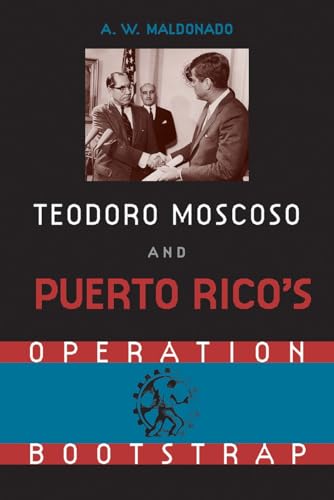

Teodoro Moscoso and Puerto Rico's Operation Bootstrap A.W. Maldonado.
Detalles de publicación: Gainesville University Press of Florida 1997.Descripción: xiv, 262 p. ill. 24 cmISBN:- 0813015014 (alk. paper)
- 338.97295 21
- HC154.5 .M34 1997
| Imagen de cubierta | Tipo de ítem | Biblioteca actual | Biblioteca de origen | Colección | Ubicación en estantería | Signatura topográfica | Materiales especificados | Info Vol | URL | Copia número | Estado | Notas | Fecha de vencimiento | Código de barras | Reserva de ítems | Prioridad de la cola de reserva de ejemplar | Reservas para cursos | |
|---|---|---|---|---|---|---|---|---|---|---|---|---|---|---|---|---|---|---|
| Libro | Biblioteca Encarnación Valdés Colección de Puerto Rico | 338.97295 M896zm (Navegar estantería(Abre debajo)) | Disponible | 80000002010877 |
Descripciones mejoradas de Syndetics:
A. W. Maldonado tells the story of Puerto Rico's extraordinary climb from poverty to economic success. Operation Bootstrap, a program conceived, promoted, and implemented by Teodoro Moscoso (1910-1992), succeeded in attracting worldwide capital investment that by the mid-1950s had transformed the island from an economic backwater into a bustling industrial society. Though much of the credit went to Puerto Rico's governor, Luis Muñoz Marín, Maldonado focuses on Moscoso to describe how and why the economic miracle took place.
Moscoso was deeply involved in all aspects of the Puerto Rican economy and culture, and Maldonado follows his relationships and battles on a number of fronts, from his initial differences with Rexford Tugwell, the last American governor of the island, to conflicts with Governor Muñoz, who was constantly concerned that Moscoso was pushing change too quickly. In the worlds of business and culture, Maldonado shows how Moscoso employed advertising guru David Ogilvy to propagate the image of a people engaged in a cultural renaissance. He also highlights Moscoso's decisive actions at critical junctures (such as his success in pushing tax exemptions and tourism in the late 1940s) and his personal persuasiveness, as with Pablo Casals, who at the age of eighty was persuaded to establish his Casals Festival at San Juan.
Maldonado shows that Moscoso was the architect of the "economic miracle" that economists and presidents believed could not happen in Puerto Rico. His account sheds new light on the man who provided U.S. administrations with a democratic success story to counter the allure of the Cuban revolution and who was called on by President John F. Kennedy to organize and head the Alliance for Progress.
Includes bibliographical references (p. 232-245) and index.
Tabla de contenidos provista por Syndetics
- Acknowledgments(p. ix)
- Prologue(p. x)
- Part 1. Liberation(p. 1)
- 1 Moscoso's Conversion(p. 3)
- 2 Rexford Tugwell's Call(p. 12)
- Part 2. The Fomentarian Revolution(p. 23)
- 3 The Idea of Fomento(p. 25)
- 4 Industrialize Puerto Rico?(p. 32)
- 5 Despite the Odds(p. 37)
- 6 Munoz's Conversion(p. 46)
- 7 From Public to Private Ownership(p. 61)
- 8 From Operation Bootstrap to Operation Serenity(p. 69)
- Part 3. How To Perform a Miracle(p. 79)
- 9 Industrial Promotion and Economic Research(p. 81)
- 10 How to Change an Abysmal Image(p. 103)
- 11 Tourism: The Fighting Word(p. 119)
- Part 4. The Soul and Muscle of Bootstrap(p. 135)
- 12 The Price and Wages of Success(p. 137)
- 13 Migration: To New York and Brazil(p. 144)
- 14 Winds of Change(p. 155)
- Part 5. The Battle for Democracy in Latin America(p. 161)
- 15 Moscoso in Venezuela(p. 163)
- 16 The Alliance for Progress(p. 173)
- Part 6. The Age of Section 936(p. 187)
- 17 A Superport and a Confession(p. 189)
- 18 From 931 to 936(p. 203)
- 19 Bootstrap under Siege(p. 214)
- 20 Summing Up(p. 222)
- Epilogue(p. 230)
- Notes(p. 232)
- Bibliography(p. 239)
- Index(p. 247)