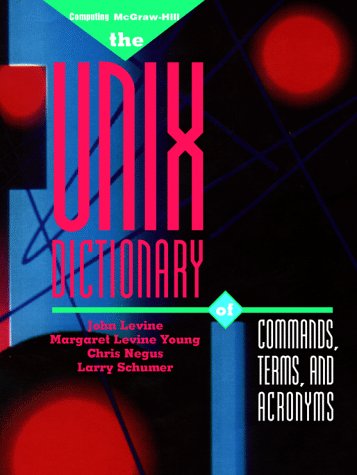
Imagen de portada de Amazon
Imagen de Amazon.com
Imagen de cubierta Syndetics
Portada de Syndetics
Imagen de OpenLibrary

The UNIX dictionary of commands, terms, and acronyms / by John Levine ... [et al.].

Colaborador(es): Detalles de publicación: New York ; McGraw-Hill c1996.Descripción: x, 314 p. 25 cmTipo de contenido:
Tipo de medio:
Tipo de soporte:
ISBN:
  • 0070376433 (hc.)
  • 0070376441 (pbk.)
Tema(s): Clasificación CDD:
  • 005.4/3 20
Clasificación LoC:
  • QA76.76.O63 U545134 1996
Valoración
    Valoración media: 0.0 (0 votos)
Existencias
Imagen de cubierta Tipo de ítem Biblioteca actual Biblioteca de origen Colección Ubicación en estantería Signatura topográfica Materiales especificados Info Vol URL Copia número Estado Notas Fecha de vencimiento Código de barras Reserva de ítems Prioridad de la cola de reserva de ejemplar Reservas para cursos
Libro Biblioteca de Mayagüez Sala de Referencia mb QA76.76 .O63 U545 1996 (Navegar estantería(Abre debajo)) Disponible 50000002074358
Referencia Biblioteca Encarnación Valdés Sala de Referencia bev 005.43 U58 (Navegar estantería(Abre debajo)) Disponible 80000002008772
Total de reservas: 0

Descripciones mejoradas de Syndetics:

A reference containing over 2,000 definitions of UNIX computer operating system terms. The entries concisely define UNIX commands, utilities distributed with UNIX, file formats, communication protocols, and systems calls. Terms are cross-referenced and include common acronyms. Annotation c. by Book News, Inc., Portland, Or.

Reseñas proporcionadas por Syndetics

Booklist Review

UNIX is a multiuser, multitasking operating system originally developed at AT & T Bell Laboratories in 1969 for use on minicomputers but it is now available for desktop workstations, too. In the world of designers, engineers, architects, computer animators, and others requiring high-end computers, UNIX workstations are preferred over larger computers because they facilitate team projects and cost much less to own and operate. UNIX has its own jargon. This dictionary defines more than 4,500 of these terms, commands, and acronyms. The compilers begin with definitions for symbols and then continue with a straightforward alphabetical arrangement. See references, where necessary, are used to refer from a common term (e.g., Point-to-Point-Protocol) to the proper computer term ( PPP). The terms range from the UNIX specific, such as getutid, OK, svc_unreg, ps, and uname, to general computer concepts such as print, reboot, UPS, and user interface. There are definitions for terms used in EMACS, the primary UNIX editor, and for most important UNIX commands. For example, svc_destroy refers to a library routine that destroys the RPC service transport handler. For those unsure about what RPC stands for, it is also defined. Since this is primarily a dictionary, there are no examples of where or in what context to use this command in a program. However, in some definitions (e.g., rn), there are comparisons between the use of the command and similar ones. Each definition is well written. The more complicated the term, the longer the definition. In the past few years, most colleges have placed UNIX workstations throughout their campuses for use of faculty and students. Many academic librarians are being brought into the UNIX world through their use of e-mail or the Internet and because some new online catalogs run in the UNIX environment. How many times have you spoken to a systems administrator or programmer and not understood what was said? Although there are many online manuals and guides for UNIX, they are all written for people who have a solid understanding of this operating system. This dictionary is an excellent source to solve the problem of understanding the programmer, online manuals, or terms found in the literature.
Compartir
logopucpr-y-vive

Contáctanos

¡Queremos saber de ti!

Tel. 787.841.2000 Ext. 1801

bibliotecavaldes@pucpr.edu

⁣Búscanos en las redes

© 2026 Desarrollado por Ignite Online • All Rights Reserved • Powered by Koha.