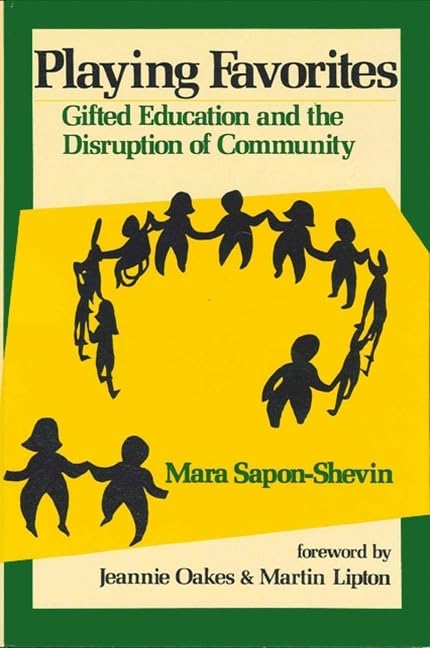

Playing favorites gifted education and the disruption of community Mara Sapon-Shevin ; [foreword by Jeannie Oakes & Martin Lipton].
Detalles de publicación: Albany, N.Y. State University of New York Press c1994.Descripción: xxx, 275 p. 23 cmISBN:- 0791419797
- 0791419800 (pbk.)
- 371.95/0973 20
- LC3993.9 .S27 1994
| Imagen de cubierta | Tipo de ítem | Biblioteca actual | Biblioteca de origen | Colección | Ubicación en estantería | Signatura topográfica | Materiales especificados | Info Vol | URL | Copia número | Estado | Notas | Fecha de vencimiento | Código de barras | Reserva de ítems | Prioridad de la cola de reserva de ejemplar | Reservas para cursos | |
|---|---|---|---|---|---|---|---|---|---|---|---|---|---|---|---|---|---|---|
| Libro | Biblioteca Encarnación Valdés Colección General bev | 371.950973 S241p (Navegar estantería(Abre debajo)) | Disponible | 80000002014812 |
Descripciones mejoradas de Syndetics:
Playing Favorites examines the ways in which gifted education disrupts the classroom community, deskills regular classroom teachers, limits their ability and willingness to meet individual needs, and impairs the creation of a climate of inclusion and acceptance of difference. Sapon-Shevin shows here that current models of gifted education are elitist and meritocratic, treating some children, not just differently than others, but better; and that in large urban districts, gifted education programs are often racist as well. By creating and funding gifted programs, the author contends, schools engage in a form of "educational triage," serving those children for whom inadequate programming and educational failure would not be acceptable while maintaining the status quo for the majority of the school population.
This book provides support for teachers, parents, and administrators who have found themselves caught in the struggle of insuring an appropriate education for some children without sacrificing the good of all. Incorporating the words of teachers, parents, and students, as well as related research and theory, this book analyzes the relationship between diversity, community, and social justice. Sapon-Shevin challenges the reader to reconsider ways in which schools can meet individual educational needs while preserving communities of learners as well as the commitment to the education of all children. Finally, the book extends the challenge and assurance that we need not choose between quality education for some and mediocre education for all.
Includes bibliographical references (p. 259-267) and index.
Tabla de contenidos provista por Syndetics
- Foreword
- Acknowledgments
- Preface
- Introduction: Schools as Communities
- 1 Underserved and Over-Deserving: Rationales for the Support of Gifted Education
- 2 They're Good, They Don't Ask: Silence and Voice on Gifted Education
- 3 It Takes a Special Person to Work with Those Kids: Teachers and the Gifted Category
- 4 These Kids Really Show Themselves Early: Choosing Children for the Enrichment Program
- 5 I Only Want What's Best for My Child: Parents and Gifted Education
- 6 The Kids with Disposable Incomes: Meritocracy and Gifted Education
- 7 Visions of an Inclusive Future
- References
- Index