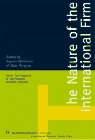

The nature of the international firm Nordic contributions to international business research edited by Ingmar Björkman and Mats Forsgren.
Series Series A--Copenhagen studies in economics and management ; no. 11Detalles de publicación: Copenhagen Handelshøjskolens Forlag Distribution, Munksgaard International Publishers c1997.Descripción: 500 p. ill. 24 cmISBN:- 8716133595
| Imagen de cubierta | Tipo de ítem | Biblioteca actual | Biblioteca de origen | Colección | Ubicación en estantería | Signatura topográfica | Materiales especificados | Info Vol | URL | Copia número | Estado | Notas | Fecha de vencimiento | Código de barras | Reserva de ítems | Prioridad de la cola de reserva de ejemplar | Reservas para cursos | |
|---|---|---|---|---|---|---|---|---|---|---|---|---|---|---|---|---|---|---|
| Libro | Biblioteca Encarnación Valdés Colección General bev | 338.88 N285 (Navegar estantería(Abre debajo)) | Disponible | 80000001955445 |
Descripciones mejoradas de Syndetics:
Internationalization of firms and management of international operations are important objects of research at universities and business schools in the Nordic countries and Nordic scholars have made considerable contributions to the present knowledge of international business. This book presents the on-going research of twenty-nine Nordic scholars in this area. It covers topics like: the competitive advantage of being multinational, the influence of cultural differences, the internationalization of sub-contractors, human resource management in international joint ventures, divestment of foreign subsidiaries, cross-border buyer-supplier relationships and the international firm as an interorganizational network.
Includes bibliographical references.
Tabla de contenidos provista por Syndetics
- 1. Nordic Contributions to International Business Research(p. 11)
- Part I Perspectives on the International Firm
- 2. International Business Enterprise(p. 33)
- 3. Comparative Institutional Advantage. - Assessing the Impact of International Differences in Corporate Governance(p. 51)
- 4. The Advantage Paradox of the Multinational Corporation(p. 69)
- Part II Driving Forces Behind Internationalisation
- The Internationalisation Process
- 5. The Oscillating Multinational Firm - Alfa Laval in the period 1890-1990(p. 89)
- 6. Twenty Years After - Support and Critique of the Uppsala Internationalisation model(p. 117)
- 7. The Influence of Cultural Differences on Internationalisation Processes of Firms - An Introduction to a Semiotic and Intercultural Perspective(p. 135)
- 8. Managerial Influences and SME Internationalisation(p. 165)
- 9. The Role of Learning in the Evolution of Business Networks in Estonia: Four Finnish Case Studies(p. 189)
- 10. Generic Routes to Subcontractors' Internationalisation(p. 231)
- Explaining Foreign Direct Investments and Divestments
- 11. Towards a Firm-Based Model of Foreign Direct Investment(p. 257)
- 12. Ownership Structures of Finnish Firm's Foreign Subsidiaries in EU Countries(p. 281)
- 13. Why are Foreign Subsidiaries Divested? A Conceptual Framework(p. 309)
- Part III Managing the International Firm
- Managing Inter-Organisational Relationships
- 14. Towards Explaining Human Resource Management Practises in International Joint Ventures -- The Case of Chinese-Western Joint Ventures(p. 337)
- 15. Internal Management of Sino-Swedish Joint Ventures(p. 363)
- 16. Cross-Border Buyer-Supplier Development Collaborations(p. 391)
- 17. Business Network Connections and the Atmosphere of International Business Relationships(p. 411)
- Management Control
- 18. Dimensions of Less-Hierarchical Structures in Multinationals(p. 433)
- 19. Cultural Differences and Problems in HQ-Subsidiary Relationships in MNCs(p. 451)
- 20. Network Infusion in the Multinational Corporation(p. 475)
- The Authors(p. 495)