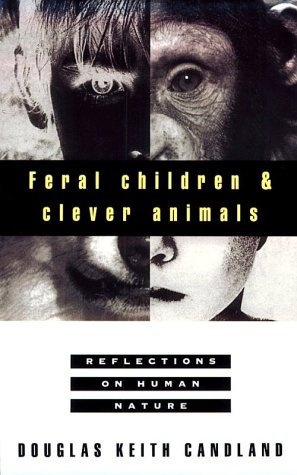

Feral children and clever animals reflections on human nature Douglas Keith Candland.
Detalles de publicación: New York Oxford University Press 1993.Descripción: xx, 411 p. ill. 24 cmISBN:- 0195074688
- 150/.9 20
- BF95 .C36 1993
| Imagen de cubierta | Tipo de ítem | Biblioteca actual | Biblioteca de origen | Colección | Ubicación en estantería | Signatura topográfica | Materiales especificados | Info Vol | URL | Copia número | Estado | Notas | Fecha de vencimiento | Código de barras | Reserva de ítems | Prioridad de la cola de reserva de ejemplar | Reservas para cursos | |
|---|---|---|---|---|---|---|---|---|---|---|---|---|---|---|---|---|---|---|
| Libro | Biblioteca Encarnación Valdés Colección General bev | 150.9 C218f (Navegar estantería(Abre debajo)) | Disponible | 80000001939837 |
Descripciones mejoradas de Syndetics:
What is it that sets us apart from the rest of the animal kingdom? What makes us unique? What makes us human? In this provocative book, Douglas Candland shows that as we begin to understand the way animals and non-speaking humans "think," we hold up a mirror of sorts to our own mental world, and gain profound insights into human nature.
Weaving together diaries, contemporary newspaper accounts, and his own enlightening commentary, Candland brings to life a series of extraordinary stories. He begins with a look at past efforts to civilize feral children. We meet Victor, the Wild Boy of Aveyron, now famous as the subject of a Truffaut film; Kaspar Hauser, raised in a cell, civilized, and then assassinated; and the Wolf Girls of India, found early this century huddled among wolf pups in a forest den (they were originally believed to be ghosts by superstitious villagers, who nearly shot them as they were being captured). In each case, it was hoped that the study of these children would help clarify the age-old nature/nurture debate, but, as Candland shows, so much of the information "revealed" was really only a projection of beliefs previously held by the investigating scientists.
Candland then turns to "clever animals." We learn how the investigation of "Clever Hans," the German horse who could calculate square roots, proved to be a first step in the direction of behaviorism (researchers found that Hans was being tipped off by the subtle and unwitting body language of his owner and other observers, who would bend almost imperceptibly at the waist with every hoof beat, and stand erect when the correct count was reached). And Candland discusses the many attempts to communicate with our closest neighbor, the apes. We read of Richard Lynch Garner's 1892 experiment living with chimpanzees in Gabon (he taught one to say the French word "feu"), and of Gua, raised by W.N. and L.A. Kellogg alongside their own son Donald, and of the latest successes of teaching sign language to such precocious apes as Sarah, Sherman, Austin, and Koko. Throughout, Candland illuminates the boldest and most intriguing efforts yet to extend our world to that of our fellow creatures. And he shows that, in the end, our effort to "make contact" is a reflection of the way in which we as a species create and order our universe.
Humans have long shown a wish to connect with the silent minds around them. In assembling and interpreting the compelling tales in this book, Candland offers us a new understanding not only of the animal kingdom, but of the very nature of humanity, and our place in the great chain of being.
Includes bibliographical references (p. 371-394) and index.
Tabla de contenidos provista por Syndetics
- Acknowledgments(p. vii)
- Chronology(p. xv)
- Prelude(p. 2)
- Introduction(p. 3)
- Part I What Feral Children Tell Us(p. 7)
- 1 Nature and Nurture: Children Without Human Parenting(p. 9)
- 2 Kaspar Hauser and the Wolf-Children(p. 38)
- 4 Psychologies Part II(p. 71)
- Thinking About the Mind 3(p. 73)
- 4 The Psychology of Psychoanalysis: Freud and Little Hans(p. 94)
- 5 The Psychology of Experimentalism and Behaviorism: Clever Hans and Lady Wonder(p. 111)
- 6 Experimentation and the Experimenter: Clever Hans's Companions(p. 134)
- 7 The Psychologies of Perceiving: Phenomenology and Ethology(p. 156)
- The Mental Ladder Part III(p. 189)
- 8 Peter and Moses: Chimpanzees Who Write(p. 191)
- 9 Exploiting the Missing Link(p. 227)
- Part IV People and Apes Communicating(p. 265)
- 10 Raising Human Babies with Chimps: Donald, Gua, and Viki(p. 267)
- 11 Human and Ape Communication: Washoe, Koko, and Nim(p. 291)
- 12 Language and Meaning: Sarah 12 and Lana, Sherman and Austin, Kanzi and Ai(p. 320)
- Principles and Myths Part V(p. 353)
- 13 What Feral Children and Clever Animals Tell Us(p. 355)
- Notes(p. 371)
- References(p. 389)
- Illustration Credits(p. 395)
- Text Credits(p. 397)
- Index(p. 399)
Reseñas proporcionadas por Syndetics
Publishers Weekly Review
In analyzing the rare, documented cases of children raised by animals and of animals that seem to exhibit thought, Candland, professor of psychology and animal behavior at Bucknell University, takes an unusual and thoughtful tack. Though arresting in themselves, these cases serve to provoke his reflections on what they say about the scientists and experimenters, and about their ramifications for psychoanalysis, behaviorism and phenomenology. From studies of feral children, Candland observes that lack of early education can cripple learning. He traces the source of the ``Mental Ladder'' of animal intelligence, and, after examining cases of chimpanzees that seemed to learn writing, concludes that animals don't learn by imitation but repeat behavior that produces pleasure. Though apes have been shown to communicate with their experimenters, scientists, according to Candland, have concentrated on that act and have not tried to map what it really means to the apes. His observations provoke much thought about the nature of experimentation and of knowledge. Illustrations not seen by PW. (Sept.) (c) Copyright PWxyz, LLC. All rights reservedCHOICE Review
Although not labeled as such, Candland provides a semi-chronological treatment of how the methodologies of psychology have changed through time by examining how our perceptions of humanness have changed through time. In a series of anecdotal accounts, the author analyzes the methodological approach and reflects on how each study changed the perception of human nature. Part 1 deals with studies of children who apparently spend their early years in wild, rather than human, environments. The remainder examines studies of animals that observers felt to be clever, i.e., animals who showed "human" qualities: awareness of self and surroundings. Much of this section deals with the language/communication abilities of primates. In many ways, Candland's book is a biological/psychological examination of Heisenberg's principle of uncertainty, as Candland shows that with each study, no matter how careful one is, the very presence of an observer changes the nature of the situation. Candland's final observation, that "we must deny the arrogance of thinking that we are objective" and thereby reflect on the "power and weakness of our human natures," relates to the central theme of Donald R. Griffin's Animal Minds (CH, Mar'93). Both authors believe that as we come to know more about animal awareness, we must as a species change our value system to include them as coequals. Candland's prose is clear and precise. Psychologists, biologists, and the general public will be enlightened. L. T. Spencer; Plymouth State CollegeBooklist Review
Small (but readable) type, many pages, and a formal style create some problems, but Candland delivers satisfying chunks of original commentary on dehumanized humans, asks powerful questions, and provides an enlightening analysis of language, intelligence, and learning. A sixteenth-century wild boy, the astounding wolf children of nineteenth-century India; each case demonstrates Candland's thesis that the study of intelligence can tell us more about human inquiry into various fields of knowledge than about any other subject. The sciences of behaviorism, phenomenology, and psychiatry now guide the study of intelligence. These yield thought-provoking insights, increasingly intricate questions, and new ethical concerns. The old nature versus nurture question seems null, our mastery verified, but yet our arrogance checked. Scholarly and sensitive, this is absorbing reading. ~--Virginia DwyerNotas de autor provistas por Syndetics
About the Author:Douglas Keith Candland is Professor of Psychology and Animal Behavior at Bucknell University. He has written for publications as diverse as The New Yorker and American Psychologist, and is the author of Psychology: The Experimental Approach (Second Edition, 1978), Emotion (1977), and Psychology (1962).