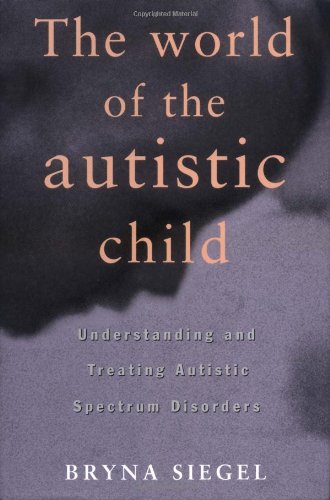

The world of the autistic child understanding and treating autistic spectrum disorders Bryna Siegel.
Detalles de publicación: Oxford New York Oxford University Press 1996.Descripción: xiii, 351 pISBN:- 0195076672
- 618.92/8982 20
- RJ506.A9 S53 1995
| Imagen de cubierta | Tipo de ítem | Biblioteca actual | Biblioteca de origen | Colección | Ubicación en estantería | Signatura topográfica | Materiales especificados | Info Vol | URL | Copia número | Estado | Notas | Fecha de vencimiento | Código de barras | Reserva de ítems | Prioridad de la cola de reserva de ejemplar | Reservas para cursos | |
|---|---|---|---|---|---|---|---|---|---|---|---|---|---|---|---|---|---|---|
| Libro | Biblioteca Encarnación Valdés Colección General bev | 618.928982 S571w (Navegar estantería(Abre debajo)) | Disponible | 80000001939829 |
Descripciones mejoradas de Syndetics:
For thousands of loving and concerned parents of autistic children, the suspicion that something may be wrong comes long before the clinical diagnosis of autism, PDD (pervasive developmental disorder), or Asperger's syndrome. When rounds of testing and consultations confirm parents' worst fears, their emotional turmoil is matched by an overriding practical concern: What do we do next? The World of the Autistic Child is by far the most complete and comprehensive book ever written for the parents of autistic children, and for the teachers, child specialists, and other professionals that care for them. Written by Dr. Bryna Siegel, a developmental psychologist and director of a large university clinic for autistic children, it provides help and hope not only for the children, but for their families--the parents, grandparents, siblings, and other caregivers who must come to grips with their own grief and confusion following a diagnosis of autism or other related disorder. Dr. Siegel believes that parents' best defense is to acquire, as early as possible, the knowledge and the parenting skills they will need to work with professionals to help their child fulfill his or her potential. This book, therefore, is about understanding the diagnosis of autism, the available treatments, and how to decide what is best for a particular child with autism or PDD. Straightforward and sympathetic, Dr. Siegel guides readers through the thicket of symptoms and labels, explaining the crucial importance of intensive early education, and how to find the resources and help that are available. Behavior modification, the development of daily living skills, guidelines for selecting and designing schooling, mainstreaming, the role for traditional academics in educating higher functioning children and young people, building effective parent-teacher relationships, psychoactive medications, and dealing with the possibility of residential placement are all covered. Dr. Siegel teaches parents and professionals to use their own common sense and personal observations in evaluating the many highly publicized but unorthodox and often untested treatments for autism, including the much-touted facilitated communication (F/C), holding therapy, auditory training, "Options" therapy, allergy treatments, and special diets. Pulling together a wealth of long-needed information on the latest educational and medical advances, The World of the Autistic Child is a superb guide and resource that no one who cares about autistic or developmentally disabled young people will want to be without.
Includes index.
Tabla de contenidos provista por Syndetics
- Foreword(p. vii)
- Acknowledgments(p. ix)
- Introduction(p. 3)
- Part I What It Means to Have Autism(p. 7)
- Chapter 1 Defining Autism, PDD, and Other Autistic Spectrum Disorders(p. 24)
- Chapter 2 Social Development in Autism and PDD(p. 42)
- Chapter 3 Communication Skills in Autism and PDD(p. 59)
- Chapter 4 Autism, PDD, and the Child's Activities and Interests(p. 81)
- Chapter 5 Getting a Diagnosis(p. 120)
- Chapter 6 After the Diagnosis: Coping with a Sense of Loss(p. 135)
- Chapter 7 Family Issues(p. 162)
- Part II Treatment Resources(p. 163)
- Chapter 8 Finding Resources(p. 195)
- Chapter 9 The Importance of Very Early Intervention(p. 208)
- Chapter 10 Selecting a Classroom: Assessing Teachers, Aides, and Student Composition(p. 230)
- Chapter 11 Behavior Management and Teaching Methods for Children with Autism and PDD(p. 252)
- Chapter 12 Teaching Communication Skills to Children with Autism and PDD(p. 273)
- Chapter 13 Forks in the Road: The Elementary School Years and Beyond(p. 300)
- Chapter 14 Psychoactive Medications(p. 320)
- Chapter 15 Non-Mainstream Treatments for Autism(p. 332)
- Afterword(p. 333)
- Index(p. 335)