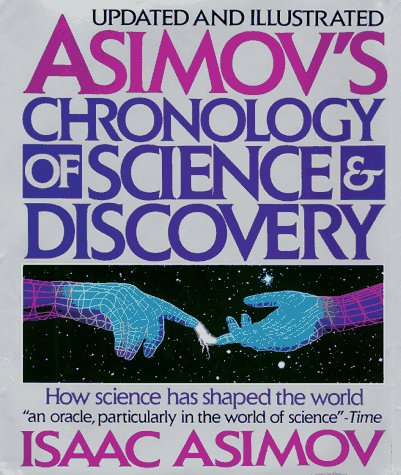

Updated and illustrated Asimov's chronology of science & discovery / Isaac Asimov.
Detalles de publicación: New york Harper and Row c1994.Descripción: 791 p. ill. 25 cmTipo de contenido:- 0062701134
| Imagen de cubierta | Tipo de ítem | Biblioteca actual | Biblioteca de origen | Colección | Ubicación en estantería | Signatura topográfica | Materiales especificados | Info Vol | URL | Copia número | Estado | Notas | Fecha de vencimiento | Código de barras | Reserva de ítems | Prioridad de la cola de reserva de ejemplar | Reservas para cursos | |
|---|---|---|---|---|---|---|---|---|---|---|---|---|---|---|---|---|---|---|
| Libro | Biblioteca de Mayagüez Sala de Referencia mb | QA125 .A765 1994 (Navegar estantería(Abre debajo)) | Disponible | 50000001835882 |
Descripciones mejoradas de Syndetics:
Outlines scientific developments and discoveries made from 1784 to 1900.
Includes index.
Reseñas proporcionadas por Syndetics
CHOICE Review
Although some excellent books have been produced on the history of science, this book is not among them. It is a chronologically arranged collection of short entries (two or three paragraphs) on myriad topics sometimes only vaguely related to science and discovery. The entry on helicopters that includes a statement listing their "uses in tracking traffic, rescue work, and intra-urban transportation" is an example of the questionable value of much of the material. This example, along with an entry on monotheism and another on bipedality, illustrates a lack of focus (and the resultant difficulty of use of such a book). There are no references to invite further study, making the book useless as a tool for educational institutions. The dust jacket states how the author included brief passages on history to show the interconnected nature of history and science, yet those passages often have no relationship to the other entries from that history period. Billy Joel's song "We Didn't Start the Fire," a chronological listing of historical events giving a feel for the ups and downs of history, does more for history than this book does. -J. W. Green, University of South CarolinaBooklist Review
The prolific Asimov's latest provides short entries on the major events in science and technology from four million B.C., when the first hominid debuted, to the present. Each chapter includes one year's happenings and a pendant, "In Addition," noting the same annum's big political events. Good browsing for science enthusiasts and congenital researchers. To be indexed. --George HamptonNotas de autor provistas por Syndetics
Isaac Asimov was born in Petrovichi, Russia, on January 2, 1920. His family emigrated to the United States in 1923 and settled in Brooklyn, New York, where they owned and operated a candy store. Asimov became a naturalized U.S. citizen at the age of eight. As a youngster he discovered his talent for writing, producing his first original fiction at the age of eleven. He went on to become one of the world's most prolific writers, publishing nearly 500 books in his lifetime.Asimov was not only a writer; he also was a biochemist and an educator. He studied chemistry at Columbia University, earning a B.S., M.A. and Ph.D. In 1951, Asimov accepted a position as an instructor of biochemistry at Boston University's School of Medicine even though he had no practical experience in the field. His exceptional intelligence enabled him to master new systems rapidly, and he soon became a successful and distinguished professor at Columbia and even co-authored a biochemistry textbook within a few years.
Asimov won numerous awards and honors for his books and stories, and he is considered to be a leading writer of the Golden Age of science fiction. While he did not invent science fiction, he helped to legitimize it by adding the narrative structure that had been missing from the traditional science fiction books of the period. He also introduced several innovative concepts, including the thematic concern for technological progress and its impact on humanity.
Asimov is probably best known for his Foundation series, which includes Foundation, Foundation and Empire, and Second Foundation. In 1966, this trilogy won the Hugo award for best all-time science fiction series. In 1983, Asimov wrote an additional Foundation novel, Foundation's Edge, which won the Hugo for best novel of that year. Asimov also wrote a series of robot books that included I, Robot, and eventually he tied the two series together. He won three additional Hugos, including one awarded posthumously for the best non-fiction book of 1995, I. Asimov. "Nightfall" was chosen the best science fiction story of all time by the Science Fiction Writers of America.
In 1979, Asimov wrote his autobiography, In Memory Yet Green. He continued writing until just a few years before his death from heart and kidney failure on April 6, 1992.
(Bowker Author Biography)