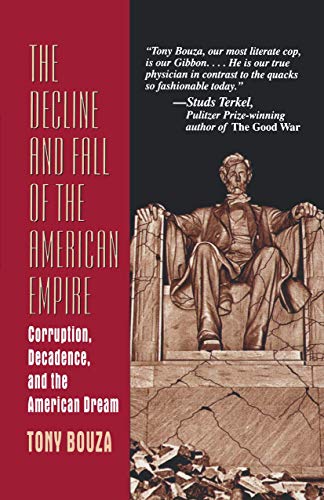
Imagen de portada de Amazon
Imagen de Amazon.com
Imagen de cubierta Syndetics
Portada de Syndetics
Imagen de OpenLibrary

The decline and fall of the American empire corruption, decadence, and the American dream Tony Bouza.

Por: Detalles de publicación: New York Plenum Press 1996.Descripción: p. cmISBN:
  • 0306454076
Tema(s): Clasificación CDD:
  • 306/.0973 20
Clasificación LoC:
  • HN90.M6 B68 1996
Valoración
    Valoración media: 0.0 (0 votos)
Existencias
Imagen de cubierta Tipo de ítem Biblioteca actual Biblioteca de origen Colección Ubicación en estantería Signatura topográfica Materiales especificados Info Vol URL Copia número Estado Notas Fecha de vencimiento Código de barras Reserva de ítems Prioridad de la cola de reserva de ejemplar Reservas para cursos
Libro Biblioteca Encarnación Valdés Colección General bev 306.0973 B782d (Navegar estantería(Abre debajo)) Disponible 80000001930513
Total de reservas: 0

Descripciones mejoradas de Syndetics:

No segment of American society is spared from Bouza's critical gaze in exposing the systemic excesses that are poisoning the heart of our nation. He spotlights the white-collar criminals, who quietly take pennies from each of us to create their own pots of gold. He unmasks the politicians, on both ends of the political spectrum, whose arrogance and hypocrisy speak volumes. He demonstrates how organized crime, while catering to our sinful, illicit cravings, affects our daily lives from buying a fresh dinner to building a house. He uncloaks the televalgelists and other fraudulent religious leaders who have transformed the ministry from a shepherd's leading the flock into a huckster's fleecing the gullible. Moreover, he reveals the abuses that have permeated the medical and other "helping" professions.

Includes bibliographical references (p. ) and index.

Tabla de contenidos provista por Syndetics

  • Acknowledgments(p. vii)
  • Introduction(p. 1)
  • 1 White Collar Crime(p. 19)
  • 2 Capitallsm(p. 37)
  • 3 Whom Can You Trust?(p. 61)
  • 4 Politics(p. 81)
  • 5 Organized Crime(p. 111)
  • 6 Terrorism(p. 137)
  • 7 Religion, Sects, Cults, and Other Searches(p. 169)
  • 8 The Custodians(p. 191)
  • 9 Street Crime(p. 205)
  • 10 The System's Response(p. 233)
  • 11 The Culture(p. 243)
  • 12 The End?(p. 255)
  • Notes(p. 299)
  • Index(p. 313)

Reseñas proporcionadas por Syndetics

Publishers Weekly Review

In a slashing jeremiad, Bouza (The Police Mystique) presents a hard-hitting analysis of the moral rot that sustains political and institutional corruption, greed, crime, hedonism, racism‘forces that he says threaten to destroy the fabric of American society. A police reformer who has headed the NYPD's Bronx division and the Minneapolis Police Department, he looks unflinchingly at the Mafia's stranglehold on several industries; urges that drug enforcement efforts focus on top-level operators rather than on street criminals; and outlines a tough program to combat domestic terrorism. Examining the savings-and-loan scandal, white-collar crimes, Wall Street profiteering and venal politicians, Bouza calls for corporate democracy, a vigilant, muckraking media, tighter government regulations to ensure fiscal integrity and rewarding of whistle-blowers. With crusading zeal and a scattershot approach, he links the decline in values to mind-numbing TV and video game violence, exploitative religious cults and money-hungry televangelists, rappers' misogynist lyrics, a welfare system that fails to demand recipient accountability and a popular culture that exalts sports and entertainment heroes but discards teachers and sages. His call for moral renewal is buttressed by practical strategies. (Oct.) (c) Copyright PWxyz, LLC. All rights reserved

Booklist Review

Bouza, former head of the Minneapolis Police Department and the NYPD's Bronx forces and author of a half-dozen previous books, including The Police Mystique (1990), has always been an iconoclast, rejecting oversimplifications for a big picture full of complexity and context. Here, he examines the current state of the U.S., taking as standard the conviction that a "healthy society is altruistic; a sick one, hedonistic." Bouza watches "tipping factors": "What is occurring faster, rot or renewal?" He applies this question to crime (of the white collar, street, and organized varieties) and punishment, to unbridled capitalism, to professions no longer restrained by ethics, to a political system that inspires more cynicism than confidence, to religion, cults, and terrorists, to American culture, and to the shortsighted denial-based "solutions" we have so far devised. Although his sometimes overwritten prose is duly critical of venal pols and greedy, unfeeling CEOs, Bouza is unusual in insisting that readers recognize how their selfishness and hedonism contribute to a more general social devolution. A thought-provoking jeremiad. --Mary Carroll
Compartir
logopucpr-y-vive

Contáctanos

¡Queremos saber de ti!

Tel. 787.841.2000 Ext. 1801

bibliotecavaldes@pucpr.edu

⁣Búscanos en las redes

© 2026 Desarrollado por Ignite Online • All Rights Reserved • Powered by Koha.