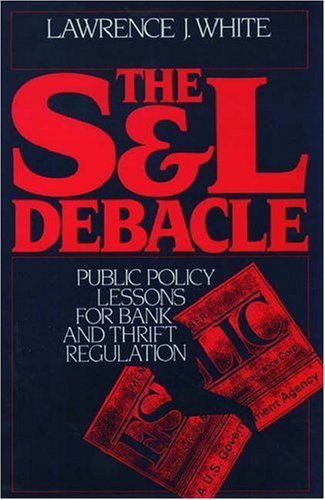

The S&L debacle public policy lessons for bank and thrift regulation Lawrence J. White.
Detalles de publicación: New York Oxford University Press 1991.Descripción: xiv, 287 p. 25 cmISBN:- 0195067339 (alk. paper)
- 332.3/2/0973 20
- HG2151 .W47 1991
| Imagen de cubierta | Tipo de ítem | Biblioteca actual | Biblioteca de origen | Colección | Ubicación en estantería | Signatura topográfica | Materiales especificados | Info Vol | URL | Copia número | Estado | Notas | Fecha de vencimiento | Código de barras | Reserva de ítems | Prioridad de la cola de reserva de ejemplar | Reservas para cursos | |
|---|---|---|---|---|---|---|---|---|---|---|---|---|---|---|---|---|---|---|
| Libro | Biblioteca Encarnación Valdés Colección General bev | 332.32 W585s (Navegar estantería(Abre debajo)) | Disponible | 80000001931529 |
Descripciones mejoradas de Syndetics:
Many Americans have viewed the SandL crisis as the ultimate example of greed's pervasiveness in our society. Yet the personalities that have dominated the news have obscured the real issues behind the worst debacle in our nation's financial history. Surveying the modern course of the thrift industry, from the Federal Home Loan Bank Act of 1932 to the current efforts at restructuring, Lawrence J. White addresses the essential questions of the SandL crisis: what happened, how it happened, why it happened, and what must be done so that it never happens again. White, who from November 1986 to August 1989 was a Board Member of the Federal Home Loan Bank Board--the government agency that regulated SandLs and insured their deposits through the FSLIC--combines his knowledge as an insider with the insights of an economist to bring a much-needed fresh perspective on the SandL mess. He shows that, rather than the result of widespread fraud, the crisis was rooted in the highly unusual economic conditions of the early 1980s, poorly thought-out deregulatory policies, and flawed accounting practices. The SandL Debacle reveals that the banking system of the late 1970s was anachronistic. Tightly regulated thrifts were locked into portfolios of long-term mortgages and limited in the interest rates that they could pay to depositors. When interest rates soared, the thrifts experienced heavy losses. Clearly, adjustment in the industry was necessary, and the economic deregulatory policies implemented in the early 1980s were long overdue. But White points out that these policies should have been accompanied by strengthened safety-and-soundness regulations. Instead, safety-and-soundness rules were also deregulated, bringing a deadly combination of opportunities, capabilities, and incentives for risk-taking that spelled disaster for hundreds of thrifts--and ultimately for the FSLIC insurance fund and the U.S. taxpayer. White offers far-reaching recommendations for reform, such as better methods of gathering information about thrifts before they become insolvent, risk-related net worth requirements, risk-based insurance premiums--so that deposit insurance is treated more like other forms of insurance--and stronger powers of early intervention by regulators. With its comprehensive overview, incisive analysis, and clear, nontechnical language, this book is important reading for anyone hoping to understand the SandL crisis and will be an essential guide for economists and policymakers of the future.
Spine title: The S & L debacle.
Includes bibliographical references (p. 265-275) and index.
Tabla de contenidos provista por Syndetics
- Preface(p. vii)
- A Brief Glossary(p. xiii)
- Chapter 1 Introduction(p. 3)
- Notes(p. 9)
- Part 1 Background(p. 11)
- Chapter 2 The Thrift Industry: a Recent Picture(p. 13)
- Notes(p. 23)
- Chapter 3 The Regulatory Framework and the Importance of Accounting(p. 25)
- Notes(p. 46)
- Part 2 Prelude, Deregulation, and the Debacle(p. 51)
- Chapter 4 Developments Before 1980(p. 53)
- Notes(p. 65)
- Chapter 5 The Interest Rate Squeeze and the Policy Responses, 1979-1982(p. 67)
- Notes(p. 95)
- Chapter 6 The Debacle, 1983-1985(p. 99)
- Notes(p. 119)
- Part 3 Regulatory Response and Cleanup(p. 123)
- Chapter 7 Tightening the Regulations and Recapitalizing the Fslic, 1985-1987(p. 125)
- Notes(p. 142)
- Chapter 8 Beginning the Cleanup, 1988(p. 147)
- Notes(p. 170)
- Chapter 9 The Firrea, 1989(p. 175)
- Notes(p. 200)
- Part 4 Reforming Deposit Insurance and Bank and Thrift Regulation(p. 205)
- Chapter 10 Regulation, Deposit Insurance, and the Lessons and Analogies from Other Types of Insurance(p. 207)
- Notes(p. 219)
- Chapter 11 Fundamental Reforms for Bank and Thrift Regulation and for Deposit Insurance(p. 223)
- Notes(p. 246)
- Chapter 12 Conclusion(p. 251)
- Notes(p. 264)
- Bibliography(p. 265)
- Index(p. 277)