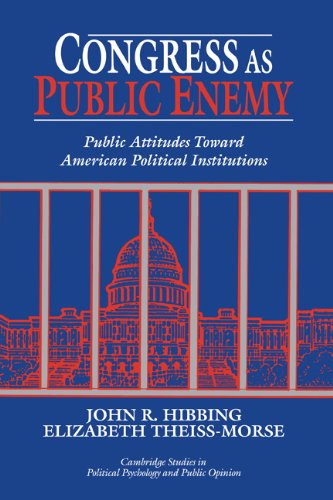
Imagen de portada de Amazon
Imagen de Amazon.com
Imagen de cubierta Syndetics
Portada de Syndetics
Imagen de OpenLibrary

Congress as public enemy public attitudes toward American political institutions John R. Hibbing, Elizabeth Theiss-Morse.

Por: Colaborador(es): Series Cambridge studies in political psychology and public opinionDetalles de publicación: Cambridge New York Cambridge University Press 1995.Descripción: p. cmISBN:
  • 0521482992 (hc)
  • 0521483360 (pbk.)
Tema(s): Clasificación CDD:
  • 328.7307 20
Clasificación LoC:
  • JK1041 .H53 1995
Valoración
    Valoración media: 0.0 (0 votos)
Existencias
Imagen de cubierta Tipo de ítem Biblioteca actual Biblioteca de origen Colección Ubicación en estantería Signatura topográfica Materiales especificados Info Vol URL Copia número Estado Notas Fecha de vencimiento Código de barras Reserva de ítems Prioridad de la cola de reserva de ejemplar Reservas para cursos
Libro Biblioteca Encarnación Valdés Colección General bev 328.7307 H624c (Navegar estantería(Abre debajo)) Disponible 80000001928384
Total de reservas: 0

Descripciones mejoradas de Syndetics:

This timely book describes and explains the American people's alleged hatred of their own branch of government, the US Congress. Intensive focus group sessions held across the country and a specially designed national survey indicate that much of the negativity is generated by popular perceptions of the processes of governing visible in Congress. John Hibbing and Elizabeth Theiss-Morse argue that, although the public is deeply disturbed by debate, compromise, delicate pace, the presence of interest groups, and the professionalization of politics, many of these traits are actually endemic to modern democratic government. Congress is an enemy of the public partially because it is so public. Calls for reform, such as term limitations, reflect the public's desire to attack these disliked features. But the authors conclude, the public's unwitting desire to reform democracy out of a democratic legislature is a cure more dangerous than the disease.

Includes bibliographical references and index.

Tabla de contenidos provista por Syndetics

  • List of figures
  • List of tables
  • Preface
  • 1 Introduction: what is wrong with the American political system?
  • 2 Changing levels of support for individual institutions
  • 3 Perceptions of political institutions
  • 4 Perceptions of congressional features and reforms
  • 5 Focus groups and perceptions of the Washington system
  • 6 Who approves of congress?
  • 7 Support for democratic processes
  • 8 Conclusion: the people and their political system
  • Appendix
  • References
  • Index

Reseñas proporcionadas por Syndetics

Library Journal Review

Congress, the people's branch of government, is passionately ridiculed with great regularity by the people. But why? Does everyone really despise Congress, and what about it do they hate? These questions have finally been posed in a major research project conducted by two political scientists at the University of Nebraska. Blending the findings of a 1400-person national telephone survey and eight two-hour focus group meetings of average Americans at sites around the country, the authors discovered that most people dislike the legislative process (e.g., lengthy debate, compromise, interest group activity) and not the institution. From their wealth of original data, Hibbing and Theiss-Morse compare public support for each branch of government as an institution and public support for the people who hold office in each branch. The public, they contend, draws a reasonably clear distinction between the constitutional system, which they favor, and the contemporary Washington political system, which they loathe. This is an important book for students of Congress, public opinion, and American politics generally. A major contribution to our understanding of contemporary American politics, it should be widely quoted and cited.-Thomas J. Baldino, Wilkes Univ., Wilkes-Barre, Pa. (c) Copyright 2010. Library Journals LLC, a wholly owned subsidiary of Media Source, Inc. No redistribution permitted.

Publishers Weekly Review

Despite a sensationalistic title, this highly theoretical explication of public attitudes toward all three branches of federal government offers no hard evidence of any citizen revolts in the making; nor is it likely to incite any. Based on findings drawn in 1992 from 1400 30-minute telephone interviews with a nationwide sample of voting-age residents, plus eight two-hour focus-group sessions of 10 participants each at locations across the country, the book is a densely written, abstruse work likely to appeal mostly to political scientists. Readers not familiar with the scholarly sources cited will have to accept the authors' summaries‘and debunkings ‘of previous research on faith, there being scant explanation of prior research. The authors examine at length the difference between people's feelings toward the various institutions of government and toward the members of those bodies. Perhaps most disturbing is their view that the American people, while supporting the notion of a democratic government, have little patience for the actual workings of democracy, its unruly debates and inevitable compromises. (Sept.) (c) Copyright PWxyz, LLC. All rights reserved

CHOICE Review

In a word, Congress is unpopular. The authors suggest that Americans are dissatisfied with their national legislature because they are dissatisfied with the processes of government--with the lack of both procedural efficiency and equity. Arguing that "Americans want stealth democracy," they offer new proof of the old saw that if you cherish either sausages or the law, you don't want to witness either one being made. Congress embodies everything Americans dislike about politics: it is large and slow; it is open and plays out its battles in public; it is an institution based on compromise; and it appears subject to undue interest group influences. The president and the Supreme Court rank higher in public esteem than Congress because the operations of those two branches are mostly carried out behind closed doors, not in full public view. The public is not only unhappy with the institution but also with its members, though not so unhappy as to defeat large numbers of them at the polls. Relying on both public opinion polls as well as focus groups to explore the public's views of Congress and its members, the authors cite a number of recent congressional missteps as instrumental in leading Americans to view Congress as public enemy. This excellent piece of research and analysis gives much to think about as we focus on maintaining public support of our political institutions. General and academic readers, all levels. W. K. Hall Bradley University
Compartir
logopucpr-y-vive

Contáctanos

¡Queremos saber de ti!

Tel. 787.841.2000 Ext. 1801

bibliotecavaldes@pucpr.edu

⁣Búscanos en las redes

© 2026 Desarrollado por Ignite Online • All Rights Reserved • Powered by Koha.