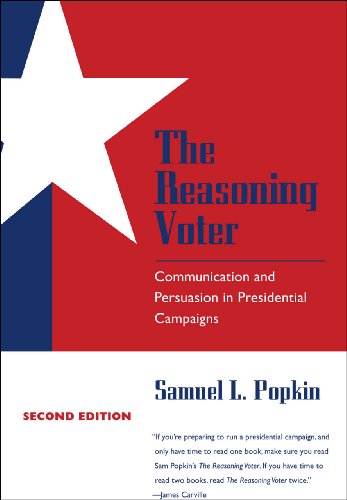

The reasoning voter communication and persuasion in presidential campaigns Samuel L. Popkin.
Detalles de publicación: Chicago University of Chicago Press c1994.Edición: 2nd edDescripción: x, 323 p. 23 cmISBN:- 0226675459 (pbk. : alk. paper)
- 324.973 20
- JK524 .P64 1994
| Imagen de cubierta | Tipo de ítem | Biblioteca actual | Biblioteca de origen | Colección | Ubicación en estantería | Signatura topográfica | Materiales especificados | Info Vol | URL | Copia número | Estado | Notas | Fecha de vencimiento | Código de barras | Reserva de ítems | Prioridad de la cola de reserva de ejemplar | Reservas para cursos | |
|---|---|---|---|---|---|---|---|---|---|---|---|---|---|---|---|---|---|---|
| Libro | Biblioteca de Mayagüez Colección General mb | JK524 .P64 1994 (Navegar estantería(Abre debajo)) | Disponible | 50000001830255 |
Descripciones mejoradas de Syndetics:
The Reasoning Voter is an insider's look at campaigns, candidates, media, and voters that convincingly argues that voters make informed logical choices. Samuel L. Popkin analyzes three primary campaigns--Carter in 1976; Bush and Reagan in 1980; and Hart, Mondale, and Jackson in 1984--to arrive at a new model of the way voters sort through commercials and sound bites to choose a candidate. Drawing on insights from economics and cognitive psychology, he convincingly demonstrates that, as trivial as campaigns often appear, they provide voters with a surprising amount of information on a candidate's views and skills. For all their shortcomings, campaigns do matter.
"If you're preparing to run a presidential campaign, and only have time to read one book, make sure to read Sam Popkin's The Reasoning Voter . If you have time to read two books, read The Reasoning Voter twice."--James Carville, Senior Stategist, Clinton/Gore '92
"A fresh and subtle analysis of voter behavior."--Thomas Byrne Edsall, New York Review of Books
"Professor Popkin has brought V.O. Key's contention that voters are rational into the media age. This book is a useful rebuttal to the cynical view that politics is a wholly contrived business, in which unscrupulous operatives manipulate the emotions of distrustful but gullible citizens. The reality, he shows, is both more complex and more hopeful than that."--David S. Broder, The Washington Post
Includes bibliographical references (p. 293-312) and index.