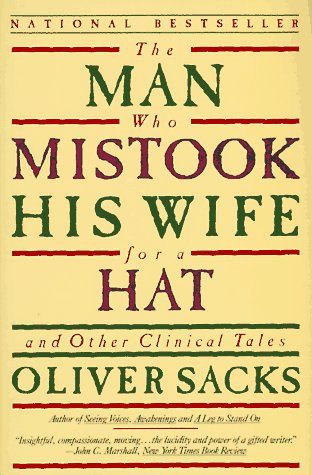

The man who mistook his wife for a hat and other clinical tales Oliver Sacks.
Detalles de publicación: New York Perennial Library 1987, c1985.Edición: 1st Perennial Library edDescripción: x, 243 p. 22 cmISBN:- 0060970790 (pbk.)
- 616.8 19
- RC351 .S195 1987
| Imagen de cubierta | Tipo de ítem | Biblioteca actual | Biblioteca de origen | Colección | Ubicación en estantería | Signatura topográfica | Materiales especificados | Info Vol | URL | Copia número | Estado | Notas | Fecha de vencimiento | Código de barras | Reserva de ítems | Prioridad de la cola de reserva de ejemplar | Reservas para cursos | |
|---|---|---|---|---|---|---|---|---|---|---|---|---|---|---|---|---|---|---|
| Libro | Biblioteca Encarnación Valdés Colección General bev | 616.8 S121m (Navegar estantería(Abre debajo)) | Disponible | 80000001874190 |
Descripciones mejoradas de Syndetics:
In his most extraordinary book, "one of the great clinical writers of the 20th century"(The New York Times)recounts the case histories of patients lost in the bizarre, apparently inescapable world of neurological disorders. Oliver Sacks'sThe Man Who Mistook His Wife for a Hattells the stories of individuals afflicted with fantastic perceptual and intellectual aberrations: patients who have lost their memories and with them the greater part of their pasts; who are no longer able to recognize people and common objects; who are stricken with violent tics and grimaces or who shout involuntary obscenities; whose limbs have become alien; who have been dismissed as retarded yet are gifted with uncanny artistic or mathematical talents.If inconceivably strange, these brilliant tales remain, in Dr. Sacks's splendid and sympathetic telling, deeply human. They are studies of life struggling against incredible adversity, and they enable us to enter the world of the neurologically impaired, to imagine with our hearts what it must be to live and feel as they do. A great healer, Sacks never loses sight of medicine's ultimate responsibility: "the suffering, afflicted, fighting human subject."
Bibliography: p. 234-243.
Reseñas proporcionadas por Syndetics
Library Journal Review
Neurologist Sacks, author of Awakenings and A Leg To Stand On , presents a series of clinical tales drawn from fascinating and unusual cases encountered during his years of medical practice. Dividing his text into four parts``losses'' of neurological function; ``excesses''; ``transports'' involving reminiscence, altered perception, and imagination; and ``the simple,'' or the world of the retardedSacks introduces the reader to real people who suffer from a variety of neurological syndromes which include symptoms such as amnesia, uncontrolled movements, and musical hallucinations. Sacks recounts their stories in a riveting, compassionate, and thoughtful manner. Written on a somewhat scholarly level, the book is highly recommended for larger collections. Debra Berlanstein, Towson State Univ. Lib., Baltimore (c) Copyright 2010. Library Journals LLC, a wholly owned subsidiary of Media Source, Inc. No redistribution permitted.Publishers Weekly Review
A neurologist who claims to be equally interested in disease and people, Sacks (Awakenings, etc.) explores neurological disorders with a novelist's skill and an appreciation of his patients as human beings. These cases, some of which have appeared in literary or medical publications, illustrate the tragedy of losing neurological facultiesmemory, powers of visualization, word-recognitionor the also-devastating fate of those suffering an excess of neurological functions causing such hyper states as chorea, tics, Tourette's syndrome and Parkinsonism. Still other patients experience organically based hallucinations, transports, visions, etc., usually deemed to be psychic in nature. The science of neurology, Sacks charges, stresses the abstract and computerized at the expense of judgment and emotional depthsin his view, the most important human qualities. Therapy for brain-damaged patients (by medication, accommodation, music or art) should, he asserts, be designed to help restore the essentially personal quality of the individual. First serial to New York Review of Books, The Sciences and Science; Reader's Subscription alternate. January (c) Copyright PWxyz, LLC. All rights reservedBooklist Review
Descriptions of extreme and sensational neurological disorders are tempered through Dr. Sacks' compassionate case studies that effectively humanize the sufferers' bizarre behavior.Notas de autor provistas por Syndetics
Oliver Sacks was born in London, England on July 9, 1933. He received a medical degree from Queen's College, Oxford University and performed his internship at Middlesex Hospital in London and Mount Zion Hospital in San Francisco. He completed his residency at UCLA.In 1965, he became a clinical neurologist to the Little Sisters of the Poor and Beth Abraham Hospital. His work in a Bronx charity hospital led him to write the book Awakenings in 1973. The book inspired a play by Harold Pinter and became a film starring Robert De Niro and Robin Williams. His other works included An Anthropologist on Mars, The Mind's Eye, The Man Who Mistook His Wife for a Hat, Uncle Tungsten, Musicophilia, A Leg to Stand On, On the Move: A Life, and Gratitude.
In 2007, he ended his 42-year relationship with the Albert Einstein College of Medicine to accept an interdisciplinary teaching position at Columbia. In 2012, he returned to the New York University School of Medicine as a professor of neurology. He died of cancer on August 30, 2015 at the age of 82.
(Bowker Author Biography)