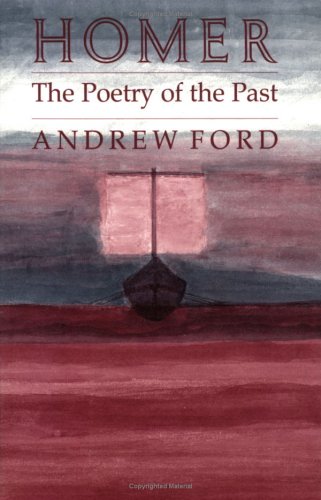
Imagen de portada de Amazon
Imagen de Amazon.com
Imagen de cubierta Syndetics
Portada de Syndetics
Imagen de OpenLibrary

Homer the poetry of the past Andrew Ford.

Por: Detalles de publicación: Ithaca London Cornell University Press 1992 (1994[printing])Descripción: xii, 225 p. 23 cmISBN:
  • 0801482372 (pbk)
Tema(s): Clasificación CDD:
  • 883.01 20
Valoración
    Valoración media: 0.0 (0 votos)
Existencias
Imagen de cubierta Tipo de ítem Biblioteca actual Biblioteca de origen Colección Ubicación en estantería Signatura topográfica Materiales especificados Info Vol URL Copia número Estado Notas Fecha de vencimiento Código de barras Reserva de ítems Prioridad de la cola de reserva de ejemplar Reservas para cursos
Libro Biblioteca de Mayagüez Colección General mb PA 4037 .F56 1992 (Navegar estantería(Abre debajo)) Disponible 50000001827863
Total de reservas: 0

Descripciones mejoradas de Syndetics:

Ford (classics, Princeton U.) addresses the perennial questions of what poetry is, how it came to be, and what it is for. Focusing on the critical moment in Western literature when the heroic tales of the Greek oral tradition began to be preserved in writing, he examines these questions in the light of Homeric poetry. Annotation copyrighted by Book News, Inc., Portland, OR

Bibliography: p. 203-216. - Includes indexes.

Reseñas proporcionadas por Syndetics

CHOICE Review

What did Homer think he was doing? In a strikingly original approach to the question, Ford derives the Homeric theory of poetry and of the poet's office from the Homeric poems themselves. In the first chapter, on genre, Ford argues that the Homeric epics and other archaic poems belong to a subclass of poetry whose function was to transmit the past accurately but impersonally, and that the poet was hence a kind of prophet or seer of the past. The second chapter defines the epic poem as a portion of a whole truth about the past whose unity only the Muses could comprehend completely, and to which they vouchsafe the bard a limited access. In Chap. 3 Ford addresses the poet's sense of self, developed historically most probably in the context of public performances and contests, and formulated as the most vivid re-presentation of the tradition. Chap. 4 treats the relationship between the ephemeral process of song and the idea of the poetic text as a permanent memorial to the past, and Chap. 5 examines the conception of poetry as "divine singing." Ford's Homer is an ingenious and subtle inquiry into ancient poetics, innovative in conception, informed but not burdened by exhaustive scholarship, and executed in an accessible and elegant style. It is a mini-masterpiece that both the scholar and the informed general reader will devour with pleasure and profit. M. A. Katz; Wesleyan University
Compartir
logopucpr-y-vive

Contáctanos

¡Queremos saber de ti!

Tel. 787.841.2000 Ext. 1801

bibliotecavaldes@pucpr.edu

⁣Búscanos en las redes

© 2026 Desarrollado por Ignite Online • All Rights Reserved • Powered by Koha.