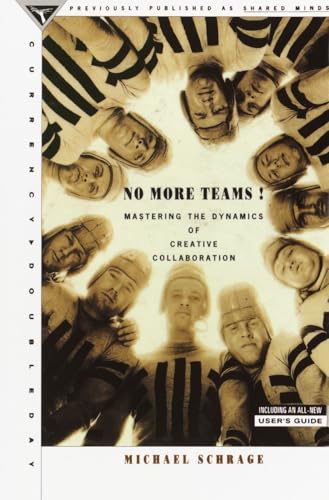
Imagen de portada de Amazon
Imagen de Amazon.com
Imagen de cubierta Syndetics
Portada de Syndetics
Imagen de OpenLibrary

No more teams! mastering the dynamics of creative collaboration Michael Schrage.

Por: Colaborador(es): Detalles de publicación: New York Currency Doubleday 1995.Edición: 1st Currency paperback edDescripción: xix, 241 p. illISBN:
  • 0385476035
Tema(s): Clasificación CDD:
  • 302.2/01 20
Clasificación LoC:
  • P90 .S3628 1995
Valoración
    Valoración media: 0.0 (0 votos)
Existencias
Imagen de cubierta Tipo de ítem Biblioteca actual Biblioteca de origen Colección Ubicación en estantería Signatura topográfica Materiales especificados Info Vol URL Copia número Estado Notas Fecha de vencimiento Código de barras Reserva de ítems Prioridad de la cola de reserva de ejemplar Reservas para cursos
Libro Biblioteca Encarnación Valdés Colección General bev 302.201 S377n (Navegar estantería(Abre debajo)) Disponible 80000001846180
Total de reservas: 0

Descripciones mejoradas de Syndetics:

For organizations that care about innovation,individual creativity isn't enough anymore -- peopleneed to be in creative, collaborativerelationships. But without the knowledge and tools forbuilding these relationships, innovation expert MichaelSchrage argues, one will not be successful in theoffices of today and even less so in the"virtual" offices of tomorrow. No MoreTeams gives readers the tools andtechniques to go beyond the lazy cliches of"teamwork" to the practical benefits ofcollaboration. When Schrage studied the world's greatestcollaborations -- including Wozniak and Jobs,Picasso and Braque, Watson and Crick -- he found thatinstead of relying on charisma, they all created"shared spaces" where they could play withtheir ideas. By effectively using technologicaltools available in most workplaces -- anything froma felt tip pen and a napkin to specializedcomputer software - -you can literally map yourdiscussion as it is happening, making it possible tokeep all the good ideas, cope with every objection,handle conflicts as they arise, and, ultimately,master the unknown.

Rev. and updated ed. of: Shared minds.

Includes bibliographical references (p. [230]-239).

Extracto provisto por Syndetics

Introduction:  No  More Teams!--An Organizational  Manifesto Why don*t teams make sense? What could  possibly be wrong with more and better teamwork? In an  ideal world, absolutely nothing. But we don't  live in an ideal world: we live in this one. At a job interview, a friend was asked if he was  a "team player." "Yes,"  he replied, "team captain." That  story--which happens to be true--invariably gets a good  laugh. But it is a cynical and knowing laugh.  Everyone in the room understands precisely what most  organizations mean by "team  players." Quite simply, the word team has been so  politicized, so ensnared in the pathology of the  organization, that we don't really know what it  means anymore. Is a team a medium to manage value? Or  a mechanism to play politics? It's easy to answer  "Both." Of course, in that case, a team means  whatever the organization wants it to mean. Which  means, of course, that it has no real meaning at  all. It is, however, the popular management  metaphor of the moment. But is it the right metaphor?  Is it a metaphor we should be building-- and  rebuilding--our organizations around? Does this  metaphor create more understanding than  confusion? The answer to all these questions,  unfortunately, is no. The concept of teams obscures,  rather than reveals, the real relationship challenges  our organizations face. Teams are a fiction, a  verbal convenience, rather than a useful  description of how people in a firm cooperate and  collaborate to create value. Even worse, teams make it too  easy for organizations to lie, cheat, and kid  themselves about the way they work. More often than  not, a "team" is as much a political  entity as a value creating one. The word is a  little too flexible, too malleable, too  manipulable. Are you on the team? . . . Or not? Is that  a question centered on creating value for  customers and clients or is it meant to satisfy the  insecurities of a manager checking on the loyalty of  his people? The answers reveal an awful  lot about what "teamwork" and  "team players" really mean in today's  organizations--and tomorrow's. No More  Teams! is a book that insists that organizations  literally can't afford to design themselves around  words that are dangerously ambiguous. The issue  isn't teams; it's what kind of relationships  organizations need to create and maintain if they want  to deliver unique value to their customers and  clients. That's what this book is about. No More Teams! is the revised,  updated, and improved version of Shared  Minds: The New Technologies of Collaboration.   The change of title is only the most obvious  difference. In fact, this is a fundamentally  different and better book than its predecessor. It's  crisper, smarter, and more relevant for managers. The  book's ideas have been sharpened and honed by a  marketplace that cares far more for results than  for academic cleverness. The essential themes of  shared creation, collaborative tools, and  productive relationships have become even more  significant. Organizations whose futures depend on  intelligent innovation will find the messages here just  as provocative but even more practical. To be sure, I had learned and observed a great  deal about collaboration and collaborative media.  Yes, I had studied successful collaboration in a  variety of fields and had invested months in the  people who had made them work. But I hadn't really  brought the collaborative concepts and techniques  I had identified to business organizations  struggling for better ways to create value. I had  observed more than I had participated. Since  the book was published, I have had the  opportunity to participate as well as observe. At one  global professional services firm, we helped build  networks that were really more like worknets--a  medium for collaboration, not just communication; a  virtual environment where shared creation is more  valued than mere information exchange. At another  professional services firm, we turned an on-line  information service into a medium to better  manage client relationships. At a financial services  firm, we crafted software that made it easier for  financial advisers and their clients to  collaboratively craft their investment portfolios. In each  case, my book offered a design sensibility that  sparked the kinds of conversations that got people  to experiment with innovation. I had the  opportunity to help turn those experiments into everyday  practice. The book brought me to organizations  around the country and around the world. People  inspired by the notion that managing creative  relationships could matter more than managing creative  individuals wanted to talk about their  concerns. Excerpted  from No More Teams! by Michael  Schrage. Copyright (c)1989 by Michael Schrage.  Excerpted by permission of Doubleday Currency, a  division of Bantam Doubleday Dell Publishing Group,  Inc. All rights reserved. No part of this excerpt  may be reproduced or reprinted without permission  in writing from the publisher. Excerpted from No More Teams by Michael Schrage All rights reserved by the original copyright owners. Excerpts are provided for display purposes only and may not be reproduced, reprinted or distributed without the written permission of the publisher.
Compartir
logopucpr-y-vive

Contáctanos

¡Queremos saber de ti!

Tel. 787.841.2000 Ext. 1801

bibliotecavaldes@pucpr.edu

⁣Búscanos en las redes

© 2026 Desarrollado por Ignite Online • All Rights Reserved • Powered by Koha.