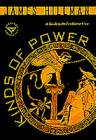

Kinds of power a guide to its intelligent uses James Hillman.
Detalles de publicación: New York Currency Doubleday 1995.Descripción: 260 pISBN:- 0385469640
- 303.3 20
- HM136 .H47 1995
| Imagen de cubierta | Tipo de ítem | Biblioteca actual | Biblioteca de origen | Colección | Ubicación en estantería | Signatura topográfica | Materiales especificados | Info Vol | URL | Copia número | Estado | Notas | Fecha de vencimiento | Código de barras | Reserva de ítems | Prioridad de la cola de reserva de ejemplar | Reservas para cursos | |
|---|---|---|---|---|---|---|---|---|---|---|---|---|---|---|---|---|---|---|
| Libro | Biblioteca Encarnación Valdés Colección General bev | 303.3 H647k (Navegar estantería(Abre debajo)) | Disponible | 80000001846172 |
Descripciones mejoradas de Syndetics:
In the boldest expose on the nature of power since Machiavelli, celebrated Jungian therapist James Hillman shows how the artful leader uses each of two dozen kinds of power with finesse and subtlety. Power, we often forget, has many faces, many different expressions. "Empowerment," writes best-selling Jungian analyst James Hillman, "comes from understanding the widest spectrum of possibilities for embracing power." If food means only meat and potatoes, your body suffers from your ignorance. When your idea of food expands, so does your strength. So it is with power. "James Hillman," says Robert Bly, "is the most lively and original psychologist we have had in America since William James." In Kinds Of Power, Hillman addresses himself for the first time to a subject of great interest to business people. He gives much needed substance to the subject by showing us a broad experience of power, rooted in the body, the rnind, and the emotions, rather than the customary narrow interpretation that simply equates power with strength. Hillman's "anatomy" of power explores two dozen expressions of power every artful leader must understand and use, including: the language of power, control, influence, resistance, leadership, prestige, authority, exhibitionism, charisma, ambition, reputation, fearsomeness, tyranny, purism, subtle power, growth, and efficiency. From the Hardcover edition.
Includes bibliographical references and index.
Tabla de contenidos provista por Syndetics
- Opening the Book(p. 1)
- Part 1 The Changing Heroics of Power(p. 25)
- Introduction(p. 27)
- Efficiency(p. 33)
- Growth(p. 45)
- Service(p. 66)
- Maintenance(p. 83)
- Part 2 Styles of Power(p. 93)
- The Language of Power(p. 95)
- Control(p. 109)
- Office(p. 116)
- Prestige(p. 120)
- Exhibitionism(p. 125)
- Ambition(p. 131)
- Reputation(p. 135)
- Influence(p. 141)
- Resistance(p. 144)
- Leadership(p. 148)
- Concentration(p. 156)
- Authority(p. 160)
- Persuasion(p. 167)
- Charisma(p. 172)
- Rising(p. 176)
- Decision(p. 180)
- Fearsomeness(p. 185)
- Tyranny(p. 189)
- Veto(p. 196)
- Purism(p. 199)
- Subtle Power(p. 204)
- Part 3 Myths of Power--Power of Myths(p. 217)
- Closing: On Power and Powers(p. 243)
- Index(p. 251)
Reseñas proporcionadas por Syndetics
Publishers Weekly Review
Power in business, politics and the world of work, to most people, implies competition, domination, control and reward. Rejecting this conventional notion of power as limited and stultifying, Jungian psychoanalyst and prolific author Hillman reconceptualizes power in terms of sustaining continuity, conserving, teaching, caring, bringing out the innate potential in each person or task. Growth, to corporations, means bottom-line results, bigger equals better. But to Hillman, growth is a process of shedding worn-out identities, cleaning up messes, pondering the implications of one's actions for the wider world and for future generations. The core of this highly reflective inquiry consists of short explorationsmythological, philosophical, etymological, psychologicalof concepts like influence, tyranny, ambition, office and decision. Readers seeking immediate practical guidance will be disappointed; others may find in this humane essay more subtle and long-lasting keys to empowerment. (Apr.) (c) Copyright PWxyz, LLC. All rights reservedBooklist Review
Power has been credited with being an aphrodisiac and blamed for being a corrupting force. Psychoanalyst Hillman points out that there are many different kinds of power and that the execution of power has many styles and nuances. Hillman has written 20 books in the fields of Jungian psychology, depth psychology, and psychotherapy, but here he targets business and organizational leaders with his analysis of 20 different kinds of power, including tyranny, charisma, veto, and prestige, among others. He considers the nature of each and suggests when, how, and why to wield each in turn. In the past, power has been used to increase growth and efficiency, but now, so Hillman explains, it should be used to accomplish the goals of service and maintenance. In contrast to the often simplistic managerial-advice books that are currently popular, this one, at times, is difficult to read, for it is filled with theoretical observations, mythical allusions, and complex ideas; it is also always thoughtful and thought provoking. --David RouseNotas de autor provistas por Syndetics
James Hillman was born in Atlantic City, New Jersey on April 12, 1926. He attended the School of Foreign Service at Georgetown University for two years before joining the Navy's Hospital Corps in 1944. He studied English literature in Paris at the Sorbonne and graduated with a degree in mental and moral science from Trinity College in Dublin. In 1953, he moved to Zurich and enrolled at the C. G. Jung Institute. In 1959, he became the director of studies at the institute and stayed in that position for the next 10 years. He wrote over 20 books including Suicide and the Soul, Re-Visioning Psychology, and The Soul's Code. He died due to complications of bone cancer on October 27, 2011 at the age of 85.(Bowker Author Biography)