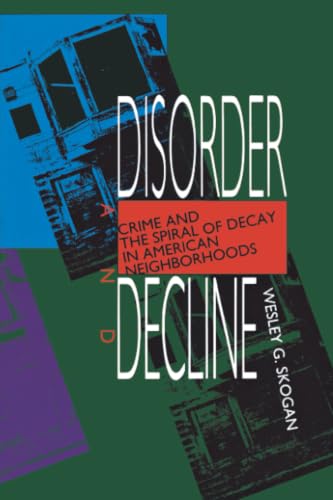
The purpose of this book is to add a new concern to the list of issues contending for position on the nation's urban policy agenda. By highlighting the relationship between disorder and neighborhood life, Disorder and Decline attempts to expand the scope of the traditionally popular "crime" agenda to encompass other pressing features of urban life. To do this, it was necessary to demonstrate that issus like vandalism and public drinking are somehow as "important" as burglary and drug abuse; thus the book's focus on the serious consequences of disorder for community stability. Because many disorder problems clearly are unresponsive to traditional criminal justice solutions, the book also called for thinking more expansively about what can be done to counter community decline, in particular by the police.
Originally published: New York : Free Press, c1990.
Includes bibliographical references (p. 199-214) and index.
Reseñas proporcionadas por Syndetics
Library Journal Review
Progressive police departments are adding to their crime-fighting, call-answering 911 functions an emphasis on problem-oriented community policing. They help to organize communities to deal with problems of housing, health, social service, disorganization, and disorder in general. Skogan summarizes five studies of disorder and community decline and concludes that there is no quick fix for disorder in urban neighborhoods. While Skogan's findings are generally disappointing, his book is not. Skogan is known in the field for his previous studies of crime and the urban environment, and this book will add to his reputation. Anyone interested in improving police-citizen relations and developing programs to control urban disorder will find insights here. --John Broderick, Stone hill Coll., North Easton, Mass. (c) Copyright 2010. Library Journals LLC, a wholly owned subsidiary of Media Source, Inc. No redistribution permitted.
Publishers Weekly Review
Skogan, Northwestern University professor of political science and urban affairs, defines disorder as those elements of urban life which merely border on crime or constitute crimes so minor that police tend to disregard them: public drinking, vandalism, littering, verbal harassment of passersby, panhandling and prostitution. In addition to these are sundry physical disorders, such as abandoned housing, ill-kept buildings, broken streetlights and garbage-filled lots and alleys. Perhaps minor in themselves, such disorders, the author claims, can and do spur serious crimes. Skogan details efforts to counter or reduce disorder in Houston, Newark, Chicago and Minneapolis, particularly through the use of so-called community policing, which has met with some small success. His book, though of interest to public officials and police brass, is closer to a sociology textbook than a work for general readers. (Aug.) (c) Copyright PWxyz, LLC. All rights reserved
CHOICE Review
Skogan reports on a study focused on disorder and decline, which was carried out in 40 inner-city neighborhoods in six cities. His methodology is excellent and the data collected are impressive. Both the findings and their interpretations hold few surprises for scholars of urban studies, but the information is fresh and up-to-date and the book should be required reading for those who wish to keep abreast of literature on urban neighborhood analysis. In brief, Skogan finds that the more affluent and homogeneous a neighborhood, the easier it is to maintain social order. The definition of order varies by class, race, ethnic group. Police are not a good vehicle for maintaining order at the neighborhood level but neighborhood organizations are no match for drug pushers who are well armed and well financed. Some programs were successful in reducing disorder but these were in neighborhoods with modest affluence and relative homogeneity. Skogan has done the field a service with this first-rate book. It is clearly written, devoid of jargon, and long on insight. All levels. -J. R. Hudson, Pennsylvania State University, Harrisburg
Notas de autor provistas por Syndetics
Wesley Skogan is Professor of Political Science and Urban Affairs at Northwestern University and directs the Program in Law and the Social Sciences.
Disorder and decline
APA
Skogan W. G., . (1992). Disorder and decline: crime and the spiral of decay in American neighborhoods. Berkeley: University of California Press.
Chicago
Skogan Wesley G, . 1992. Disorder and decline: crime and the spiral of decay in American neighborhoods. Berkeley: University of California Press.
Harvard
Skogan W. G., . (1992). Disorder and decline: crime and the spiral of decay in American neighborhoods. Berkeley: University of California Press.
MLA
Skogan Wesley G, . Disorder and decline: crime and the spiral of decay in American neighborhoods. Berkeley: University of California Press. 1992.