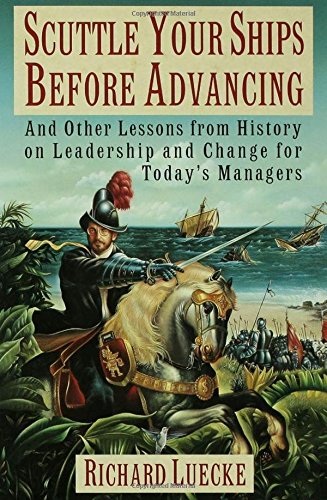

Scuttle your ships before advancing and other lessons from history on leadership and change for today's managers Richard A. Luecke.
Detalles de publicación: New York Oxford University Press 1994.Descripción: x, 199 p. ill., mapsISBN:- 019508408X (alk. paper)
- 658 20
- HD30.5 .L83 1994
| Imagen de cubierta | Tipo de ítem | Biblioteca actual | Biblioteca de origen | Colección | Ubicación en estantería | Signatura topográfica | Materiales especificados | Info Vol | URL | Copia número | Estado | Notas | Fecha de vencimiento | Código de barras | Reserva de ítems | Prioridad de la cola de reserva de ejemplar | Reservas para cursos | |
|---|---|---|---|---|---|---|---|---|---|---|---|---|---|---|---|---|---|---|
| Libro | Biblioteca Encarnación Valdés Colección General bev | 658 L948s (Navegar estantería(Abre debajo)) | Disponible | 80000001874133 |
Descripciones mejoradas de Syndetics:
In the spring of 1942, Japan's Admiral Yamamoto devised an ingenious strategy to attack Midway Island and deliver the knockout punch of the war in the Pacific. His elegant operational plan--which involved elaborate traps and diversions and required clockwork coordination--was founded on complete faith that he could predict the Americans' every move. But the perfect plan went wrong, and Japan's elite Strike Force was crushed, losing four carriers, over three hundred aircraft, and 2,500 men. What can today's business managers learn from Yamamoto's stunning defeat at the Battle of Midway? A great deal, according to Richard Luecke, and in Scuttle Your Ships Before Advancing, he illuminates lessons to be learned from Yamamoto and other leaders who have faced memorable crises. We find, for instance, the epitome of decisiveness and entrepreneurialism in Hernan Cortes, as he and a small band of 16th-century adverturers risked everything in a bold gamble for the Aztec empire (the book's title, Scuttle Your Ships, refers to Cortes' strategy that kept his men moving forward). Underdogs who would challenge the status quo can look to France's Louis XI, the "Spider King," and learn how he undermined entrenched rivals through patience and cunning. The Emperor Hadrian, in his consolidation of the sprawling Roman Empire, provides a brilliant model for managing today's multinational corporation. And attitudes toward technology and innovation are vividly illustrated by the 15th-century Battle of Agincourt, in which the stubborn refusal of the French to adopt their English enemy's weapon--the longbow--led to their massacre. From these and other historical episodes, Luecke shows how leadership, daring, and artful administration meant the difference between success and failure. He draws explicit lessons for managers from these long-ago events, and he also reveals parallels in the recent experiences of major corporations from GM to Shearson Lehman. And along the way, he evokes portraits of Martin Luther, W. Edwards Deming, and other visionaries as they struggled with the timeless challenges of authority, change, and human conflict. Those who do not learn from the past are doomed to repeat it. Skillfully narrated, inspiring yet down-to-earth, Scuttle Your Ships Before Advancing serves up powerful historical lessons for all who would manage and lead in the twenty-first century.
Includes bibliographical references (p. 191-195) and index.
Tabla de contenidos provista por Syndetics
- 1. Introduction(p. 3)
- 2. Entrepreneurs and Opportunitists: Cortes Takes Mexico(p. 13)
- 3. Challenging the Status Quo: The Spider King Unifies France(p. 34)
- 4. The Power of Ideas: Two Reformers Change the World(p. 57)
- 5. Strategy and Fate: Yamamoto Overplans at Midway(p. 82)
- 6. Global Management: Hadrian Consolidates the Roman Empire(p. 105)
- 7. Managing in Turbulent Times: Hutchinson Misreads the Revolution(p. 126)
- 8. Revitalizing Enterprise Through Innovation: English Arrows Defeat the Iron Men(p. 146)
- 9. The Lessons and Limits of History(p. 167)
- Notes(p. 183)
- A Guide to Further Reading(p. 191)
- Index(p. 197)