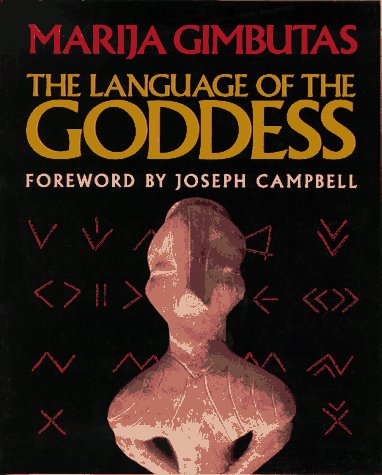
Imagen de portada de Amazon
Imagen de Amazon.com
Imagen de cubierta Syndetics
Portada de Syndetics
Imagen de OpenLibrary

The language of the goddess unearthing the hidden symbols of western civilization Marija Gimbutas; foreword by Joseph Campbell.

Por: Detalles de publicación: [New York] Harper c1991.Descripción: 388 p. ill. (some col.)ISBN:
  • 0062512439
Tema(s): Clasificación CDD:
  • 291/.042/0936 20
Clasificación LoC:
  • BL473.5 .G55 1989
Valoración
    Valoración media: 0.0 (0 votos)
Existencias
Imagen de cubierta Tipo de ítem Biblioteca actual Biblioteca de origen Colección Ubicación en estantería Signatura topográfica Materiales especificados Info Vol URL Copia número Estado Notas Fecha de vencimiento Código de barras Reserva de ítems Prioridad de la cola de reserva de ejemplar Reservas para cursos
Libro Biblioteca Encarnación Valdés Colección General bev 291.042 G491l (Navegar estantería(Abre debajo)) Disponible 80000001735037
Total de reservas: 0

Descripciones mejoradas de Syndetics:

The purpose of this book is to present the pictorial 'script' for the religion of the Old European Great Goddess, consisting of signs, symbols, and images of divinities. These are our primary sources for reconstructing this prehistoric scene and are vital to any true understanding of Western religion and mythology.

Includes index.

Bibliography: p.

Reseñas proporcionadas por Syndetics

Library Journal Review

Bringing together archaeological evidence, comparative mythology and folklore, and symbolic interpretations, Gimbutas's work asserts the existence in prehistoric Europe of a widespread culture centered on the Goddess, lifegiver and sustainer, as well as death-wielder. Through the examination of hundreds of Paleolithic and mostly Neolithic pieces, the author traces cross-cultural and cross-chronological symbolic parallels, some of which are quite broad and open to several types of inference. The central and venerated position of women in the unconscious of early European people seems probable; this order of things changed with the incursions by Kurgan groups (4300-2800 B.C.) and the European world moved ``from matrilineal to patrilineal.'' Whether or not one agrees with these archaeomythological interpretations, Gimbutas offers a thought-provoking symbolic reading of hundreds of selected pieces, beautifully reproduced in this sizeable compendium.-- Winnie Lambrecht, Brown Univ., Providence, R.I. (c) Copyright 2010. Library Journals LLC, a wholly owned subsidiary of Media Source, Inc. No redistribution permitted.

Booklist Review

This gorgeous book is a vivid visual dictionary of goddess imagery--snakes and spirals, bears and birds, eyes and eggs. Gimbutas, the most revered scholar in the feminist spirituality movement, has brought together a lifetime of work in neolithic symbolism in what she has named Old Europe--the matriarchal, pre-Indo-European era of some 6,000 years ago. Excellent design melds hundreds of illustrations depicting symbolic artifacts and their lengthy descriptions with a definitive text that summarizes Gimbutas' ground-breaking theories involving the existence of a goddess religion in Neolithic Europe with roots in the Paleolithic era. This will surely be a classic in its field. Sources, extensive bibliography, and index. --Pat Monaghan
Compartir
logopucpr-y-vive

Contáctanos

¡Queremos saber de ti!

Tel. 787.841.2000 Ext. 1801

bibliotecavaldes@pucpr.edu

⁣Búscanos en las redes

© 2026 Desarrollado por Ignite Online • All Rights Reserved • Powered by Koha.