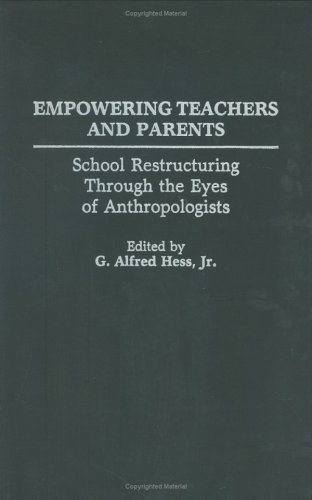

Empowering teachers and parents school restructuring through the eyes of anthropologists edited by G. Alfred Hess, Jr.
Detalles de publicación: Westport, Conn. Bergin & Garvey 1992.Descripción: vi, 265 p. 24 cmISBN:- 0897892755 (alk. paper)
- 0897892763 (pbk. : alk. paper)
- 371.2 20
- LB2806.45 .E49 1992
| Imagen de cubierta | Tipo de ítem | Biblioteca actual | Biblioteca de origen | Colección | Ubicación en estantería | Signatura topográfica | Materiales especificados | Info Vol | URL | Copia número | Estado | Notas | Fecha de vencimiento | Código de barras | Reserva de ítems | Prioridad de la cola de reserva de ejemplar | Reservas para cursos | |
|---|---|---|---|---|---|---|---|---|---|---|---|---|---|---|---|---|---|---|
| Libro | Biblioteca Encarnación Valdés Colección General bev | 371.2 E55 (Navegar estantería(Abre debajo)) | Disponible | 80000001733636 |
Descripciones mejoradas de Syndetics:
A much-needed examination of the impact on teachers and parents of the effort to improve our schools through restructuring, this book looks at professionalization and parent empowerment programs from the ground level rather than from the large-scale policy level. The editor, active in both policy setting and monitoring implementation, approaches the subject with an overarching view that weaves together a set of diverse case studies that examine some of the most notable efforts in this area of school reform.
The first section demonstrates the tremendous difficulties involved in attempting to reshape the culture of public school teaching, noting both institutional resistance to change and the personal resistance of the professionals who are, in theory, being empowered through this approach. The second section details the problems of launching parent empowerment opportunities, in a large urban setting, and a contrasting case examines the choice of enrollment option. Here, too, these studies examine the effectiveness of these programs. The conclusion reflects on the opportunities such innovations provide for researchers and assesses the importance of such research in shaping the innovations themselves through evaluations while they are in process.
Includes bibliographical references (p. [245]-255) and index.
Tabla de contenidos provista por Syndetics
- Introduction: Examining School Restructuring Efforts
- Empowering Teachers Work That Is Real: Why Teachers Should Be Empowered
- Rural Science and Mathematics Education: Empowerment Through Self-Reflection and Expanding Curricular Alternatives
- The Dangers of Assuming a Consensus for Change: Some Examples from the Coalition of Essential Schools
- Empowerment of Teachers in Dade County's School-Based Management Pilot
- Conflict in Restructuring the Principal-Teacher Relationship in Memphis
- Etheridge and Thomas W. Collins Rural Responses to Kentucky's Education Reform Act
- Empowering Parents The Case for Parent and Community Involvement
- Who's Making What Decisions: Monitoring Authority Shifts in Chicago School Reform
- School Reform in East Harlem: Alternative Schools vs. "Schools of Choice"
- Anthropological Perspectives The Role of Anthropologists in Restructuring Schools
- Critical Friends in the Frey: An Experiment in Applying Critical Ethnography to School Restructuring
- Through the Eyes of Anthropologists
- Bibliography
- Index