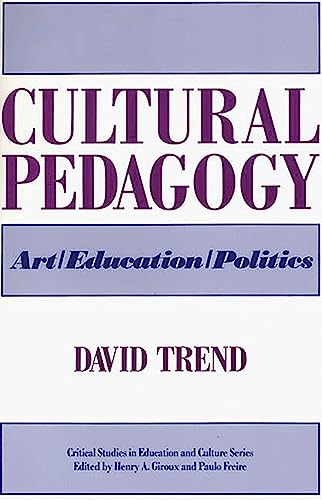

Cultural pedagogy art, education, politics David Trend.
Series Critical studies in education and culture seriesDetalles de publicación: New York Bergin & Garvey 1992.Descripción: xi, 178 p. illISBN:- 0897892569 (alk. paper)
- 0897892577 (pbk. : alk. paper)
- 700/.1/03 20
- NX180.S6 T7 1992
| Imagen de cubierta | Tipo de ítem | Biblioteca actual | Biblioteca de origen | Colección | Ubicación en estantería | Signatura topográfica | Materiales especificados | Info Vol | URL | Copia número | Estado | Notas | Fecha de vencimiento | Código de barras | Reserva de ítems | Prioridad de la cola de reserva de ejemplar | Reservas para cursos | |
|---|---|---|---|---|---|---|---|---|---|---|---|---|---|---|---|---|---|---|
| Libro | Biblioteca Encarnación Valdés Colección General bev | 700.103 T794c (Navegar estantería(Abre debajo)) | Disponible | 80000001733644 |
Descripciones mejoradas de Syndetics:
In recent years, debates over culture and education have entered the public consciousness as never before. Politicians, bureaucrats, and scholars have credited these endeavors with the capacity to influence matters ranging from public morality to national productivity. Trend examines points at which art and learning intersect in both traditional and nontraditional settings and offers a variety of alternatives for the construction of a new cultural pedagogy. He argues that we need to redefine concepts like art, literature, and education, to integrate them more fully into our lives.
On one hand, Trend uses a critical approach to examine how cultural work and pedagogy intersect within a range of discourses such as Marxist, feminist, deconstructionist and postcolonial. Yet on the other, he focuses on the use of specific examples of cultural practice within and outside the classroom to emphasize the importance of action as well as philosophy to bring about social change. Trend provides a theoretical overview of the ideological battles over texts and their discursive contexts and then analyzes how cultural education has evolved in such settings as the school, the university, and the community. He concludes with a discussion of pedagogy and democracy which suggests a range of possible resolutions.
Includes bibliographical references (p. [159]-171) and index.
Tabla de contenidos provista por Syndetics
- Critical Studies in Education and Culture Series(p. ii)
- Series Foreword: Education, Pedagogy, and the Politics of Cultural Work(p. vii)
- Notes(p. x)
- Acknowledgments(p. xiii)
- Introduction Radical Epistemologies(p. 1)
- Notes(p. 7)
- 1 Culture and Pedagogy: Theories of Oppositional Practice(p. 9)
- 2 Living in the Material World: Institutions and Economies(p. 31)
- 3 is There a Class in This Text? Writers, Readers, and the Contest of Meaning(p. 51)
- 4 Community and Agency: The Ties That Bind(p. 81)
- 5 New Discursive Spaces: Reinventing the Public Sphere(p. 105)
- 6 Changing the Subject: Pedagogy and Citizenship(p. 145)
- Selected Bibliography(p. 159)
- Index(p. 173)
- About the Author(p. 178)