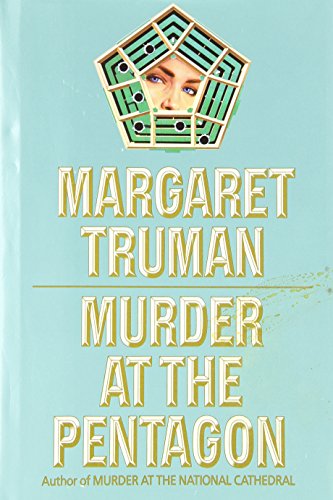
Imagen de portada de Amazon
Imagen de Amazon.com
Imagen de cubierta Syndetics
Portada de Syndetics
Imagen de OpenLibrary

Murder at the Pentagon by Margaret Truman.

Por: Detalles de publicación: New York Random House c1992.Edición: 1st edDescripción: 291 p. 24 cmISBN:
  • 0394576047
Tema(s): Género/Forma: Clasificación CDD:
  • 813/.54 20
Clasificación LoC:
  • PS3570.R82 M7544 1992
Información de serie: Haga clic para abrir en una nueva ventana
Valoración
    Valoración media: 0.0 (0 votos)
Existencias
Imagen de cubierta Tipo de ítem Biblioteca actual Biblioteca de origen Colección Ubicación en estantería Signatura topográfica Materiales especificados Info Vol URL Copia número Estado Notas Fecha de vencimiento Código de barras Reserva de ítems Prioridad de la cola de reserva de ejemplar Reservas para cursos
Libro Biblioteca Encarnación Valdés Colección General bev 813.54 T867m (Navegar estantería(Abre debajo)) Disponible 80000001811580
Total de reservas: 0

Descripciones mejoradas de Syndetics:

"Margaret Truman has become a first-rate mystery writer." LOS ANGELES TIMES BOOK REVIEW When a genius doctor is murdered and a desert madman gains the means to kill millions, Major Margit Falk, a helicopter pilot and Pentagon lawyer, is drawn into Project Safekeep--an antimissile scheme under congressional investigation. The alleged murderer has his share of secrets, but Falk smells conspiracy in the air. And although she turns to her mentor, law professor Mackenzie Smith for help, she's got to beat a cunning madman and a nuclear blast.... An Alternate Selection of the Literary Guild From the Paperback edition.

Extracto provisto por Syndetics

1   The upper quadrant of a sun that would scorch the desert blossomed on the horizon, livid red and rising fast into an inky sky. Black-browed, graceful bedouin in kaffiyehs and burnooses who had not received the warning--or who had chosen to ignore it--fed their feisty camels and prepared to serve the Prophet for yet another day.   In a bunker dug into the sand, men waited and watched, their attention focused on a steel skeleton six miles away that jutted up into the now-brightening sky. They wore special dark glasses, and powerful field glasses dangled on leather straps from (heir necks. A bank of electronic equipment was in front of them, LEDs fluttering, row upon row of red, green, and yellow lights blinking. A stocky man in a military uniform the color of earth counted down, his concentration on a digital clock that advanced silently--and incessantly. Other men aimed video cameras at the skinny metal aberration in the middle of the vast desert.   "Minus two," the clock-watcher said.   "Standby."   "Minus one," the keeper of the clock said, precisely one minute later.   "Cameras."   "Rolling."   "Glasses on."   "Thirty ... twenty-nine ... twenty-eight."   The bunker was pungent with anticipation. And fear.   "Three ... two ... one."   It started slowly, a barely discernible rumbling of the earth. Then a brilliant white light erupted from atop the metal stand, its intensity reaching those in the bunkers slightly ahead of the sound. And in a second, no more than two, the awesome potency of energy equivalent to twenty thousand tons of TNT drove down and up and out--sending smoke and fire and acres of the desert itself into the heavens, its courier and its cap a mushroom cloud of devastation.   The video cameras captured every perverse second of the sequence--from the rumble to the fulgent light to the grimly familiar mushroom. Monitoring stations around the globe registered it on their sensitive meters. The meters and accompanying apparatus told a striking story. The Russians immediately knew the first fact. A weapon with the approximate power of America's first atomic test had been detonated somewhere in the Middle East. Others knew, too. The Danes, the Japanese, the French ... and several select groups of Americans, who converged like smaller clouds.   In the Hybla Valley Federal Building on Telegraph Road, south of Alexandria, Virginia, members of the Defense Nuclear Agency's Operations Division gathered for an emergency meeting.   In the Pentagon the Joint Chiefs of Staff huddled in a closely guarded conference room within the National Military Command Center, across the hall on the E ring's third floor from the offices of the SecDef, the secretary of defense, who, at that moment, was in the White House conferring with his president, David Beardsley, and a dour Cabinet. The hastily drawn report by DOD's nuclear-monitoring section had been read to them in somber, flat tones.   "Then he's got it," Beardsley said.   "It appears that way." Secretary of State Warren Smith's face was expressionless.   "Jesus," said Vice President Joe Fletcher.   President Beardsley took in the other faces of his Cabinet. Then, in an uncharacteristic display, he slammed his fist on the table. "He's got it. That madman has got the bomb."   2   The desert test that had awakened the world to the renewed potentials of war had occurred in early July. Now, on a hot, sticky day in late August, air-force major Falk sat on one of many benches in the Pentagon's center court, a five-acre magnolia-lined park caught within the building's five walls. The morning sun did to her silken black hair what sunshine always does to such hair--brought out its underlying copper tones. She wore khaki Bermuda shorts, pristine white sneakers, and a pink T-shirt with green lettering on its front that said "I'M A WHIRLYBIRD ... AND PROUD OF IT." Margit Falk, named after her German-born mother who'd died when Margit was five, was usually called Margaret by those to whom she was introduced, and who did not listen carefully. There was a time when she considered changing her name to the American version, but got through that short period of insecurity and proudly, almost compulsively, spelled out Margit to the confused. Naturally, people were prone to call her Peg, or Peggy, but she unfailingly, and pleasantly, shifted them back to the name she preferred.   She was beautiful, no dissenting votes. Hers was the sort of beauty that warmed the winds of romance for certain men and fueled the fires, the sexual fantasies, of adolescent men of any age eagerly awaiting their next copy of Playboy. She was, in living color, what publisher Hugh Hefner had promised would be "the girl next door" and seldom was, unless you lived next door to a ... well, never mind. In fact, a Playboy photographer once had visited Lowry Air Force Base intent upon developing a photo feature about military women. When he spotted Margit, he knew he had his centerfold--until, spotting the flash in his eye, she politely told him that once past infancy, she took off her clothes for only a few human beings, most of them doctors or nurses; that her military career meant more than all the money Mr. Hefner had ever possessed or even had lost; and that she found the idea of standing around in the nude rather silly. Besides, she said, her smile an entire sunrise in itself, she had no apple to peddle.   No pox on the photographer's artistic judgment, however. Five feet seven inches tall, long-legged and nicely tanned in midyear, naturally melanous in other seasons, Margit Falk was, by strength of character, a more likely candidate for the cover of Prevention. "Tight" was a word sometimes used to describe her figure. "Athletic." "Healthy." All those things and more.   Sometimes, she was mistakenly assumed to be French. In fact, her paternal grandparents were French, and she'd spent much of her youth with them, resulting in a fair working knowledge of the language, at least conversationally. Her father had been a line-maintenance chief in the air force, which made Margit a military brat. She'd enjoyed her childhood despite the frequent moves. Her father worked as hard at raising her as he did at ensuring that the aircraft in his charge were safe for their pilots. He'd lived long enough to guide her into the early innings of her adult life. She missed him, sometimes painfully.   The large eyes were surprisingly blue for someone with such dusky skin tone, unexpectedly bright, direct eyes that exuded, at once, intelligence along with a natural friendliness.   She did not dress or walk provocatively, but no matter. Whatever Margit wore--a T-shirt that suggested nicely proportioned bosom and distinctly female hips, dress blues, or a pilot's fatigues--she turned heads. As she did that morning, swiveling not her hips but the heads of a dozen men who were also there for the Pentagon's T&E annual picnic. Those men from the Office of Test and Evaluation who weren't with wives or girlfriends were the most overt in their admiration. Those with short-term or long-running attachments were more furtive evaluating what they'd never test. Excerpted from Murder at the Pentagon by Margaret Truman All rights reserved by the original copyright owners. Excerpts are provided for display purposes only and may not be reproduced, reprinted or distributed without the written permission of the publisher.

Reseñas proporcionadas por Syndetics

Publishers Weekly Review

In characteristic unadorned and bloodless prose Truman ( Murder at the National Cathedral ) delivers this formulaic mystery bound in conspiracy, the 11th in her series of capital crimes. Air Force helicopter pilot and lawyer Major Margit Falk is assigned the defense of Robert Cobol, a CIA officer charged with the murder of Dr. Richard Joycelen. The victim, deputy director of a defense research project devoted to small nuclear devices, was shot inside the Pentagon, purportedly the most secure building in the world. While Margit works up Cobol's defense with the help of mentor Mackensiesic Smith, who has featured in earlier Truman mysteries, world powers adjust to the nuclear capability recently exhibited by a small Arab nation. Margit's boyfriend, Jeff Foxboro, is helping his boss, the senator who heads the committee investigating how the country's despotic leader got the bomb. Not surprisingly, the murder and the bomb are linked, a connection Margit must sacrifice her career to prove. Guidebook descriptions of Washington sights and lengthy discussions of federal agencies and departments provide copious background, but this simplistic tale generates little suspense. Literary Guild selection. (May) (c) Copyright PWxyz, LLC. All rights reserved

Booklist Review

Inside the high-security walls of the Pentagon, a civilian deputy director involved in a major defense program is killed. The accused is an army captain assigned to the CIA who also happens to be homosexual. The Pentagon's rumor mill, which seems to run with more efficiency than its regular operations, claims that the murder was the result of a lover's quarrel. Major Margit Falk, brand-new to the Pentagon and to the practice of law, is assigned the case. Just when she turns for help to her law professor, Mackensie Smith (a popular figure in Truman's mysteries), and proves quite capable of winning her case, the defendant is found dead in his cell. Pentagon officials claim suicide, but Falk's intuition and evidence claim otherwise. Even though her own military career is at stake, she won't rest her suspicions until there's a just verdict. Brimming with patriotism and only slightly less full of suspense and romance, Truman's newest is another winner. (Reviewed Mar. 1, 1992)0394576047Denise Perry Donavin

Notas de autor provistas por Syndetics

Mary Margaret Truman, daughter of President Harry S. Truman, was born on February 17, 1924 in Independence, Missouri. She graduated from George Washington University in 1946. She was also known as Margaret Truman or Margaret Daniel. She was an American singer who later became the successful author of a series of murder mysteries and a number of works on U.S. First Ladies and First Families, including a biography of her father, President Harry S. Truman. The only child of Harry Truman and First Lady Bess Truman; she was called "Margaret" for most of her life.

Truman made her concert debut with the Detroit Symphony Orchestra in 1947 and her first television appearance on Ed Sullivan's Toast of the Town. She substituted for Edward R. Murrow on Person to Person, and later had her own radio shows (Weekday in the 1950s and Authors in the News in the 1960s). She was active with organizations such as the Harry S. Truman Scholarship Foundation and the Truman Centennial Committee.

She published her first book, Souvenir: Margaret Truman's Own Story in 1956. She also wrote a series of mysteries set at historic locations in Washington, D. C. She died on January 29, 2008 following a brief illness.

(Bowker Author Biography)

Compartir
logopucpr-y-vive

Contáctanos

¡Queremos saber de ti!

Tel. 787.841.2000 Ext. 1801

bibliotecavaldes@pucpr.edu

⁣Búscanos en las redes

© 2026 Desarrollado por Ignite Online • All Rights Reserved • Powered by Koha.