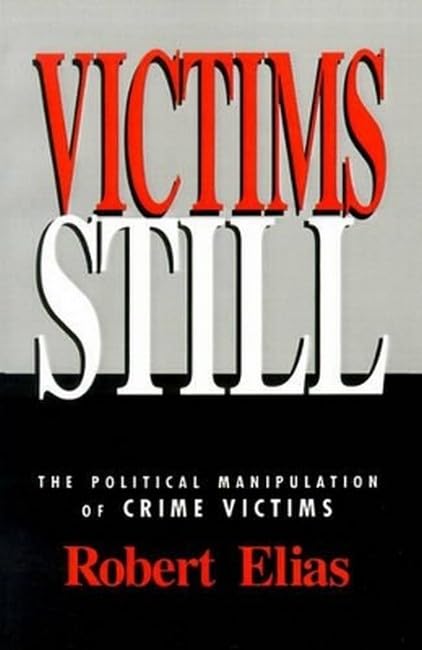

Victims still the political manipulation of crime victims Robert Elias.
Detalles de publicación: Newbury Park, Cali. Sage Publications 1993.Descripción: ix, 177 pISBN:- 0803950535
- 0803950527
- 362.8/8
Descripciones mejoradas de Syndetics:
Official crime policy shifted its focus from crime and criminals to victimization and victims in the 1980s and early 1990s. As a result, crime victims were the subject of extensive new legislation addressing victim needs, rights, and services. But did these initiatives really help victims, or did they help further Reagan and Bush administration "law and order" policies for curbing offender and public rights in favor of increasing police power? And has such power escalated incidents like the Rodney King case in Los Angeles? In this controversial and thought-provoking book, Robert Elias evaluates the effectiveness of the last decade′s victim policy and argues that victims have been politically manipulated for official objectives. As a result, little victim support has occurred, and victimization keeps escalating. He reaches these conclusions from a thorough examination of victim legislation, get-tough crime policies, media crime coverage, the victim movement, and the wars on crime and drugs. Finally, he proposes solutions that could lead to substantially less crime. Students and professionals of criminology, victimology, policy studies, and political science will find Victims Still an exceptionally stimulating resource. "In Victims Still, Elias demonstrates again that he is a preeminent scholar in the field of victimology. This work provides a unique, provocative, and elucidative account of the politicization of the victims′ movement as well as the social and political ramifications of the ′get tough′ crime policies and enforcement strategies of the 1980s. Dr. Elias raises serious and challenging questions about the currency of conventional responses to crime victims and offenders. Victims Still should be required reading for crime victim researchers and program practitioners. This book offers a thoughtful reconsideration of the causes of crime and violence in America. Professor Elias′s solutions to the crime problem are sweeping and progressive." --Arthur J. Lurigio, Ph.D., Loyola University of Chicago
Includes indexes.
Bibliography: p. 151-169.
Tabla de contenidos provista por Syndetics
- Still Victims After all These Years
- Media Amnesia
- Abetting Victimization
- Victims
- All Dressed Up But No Place To Go?
- Taking the Victims' Movement for a Ride
- Wars on Drugs as Wars on Victims
- Do Victims Want Revenge?
- Controlling Victimization
- War or Peace?
- New Culture, Less Victimization