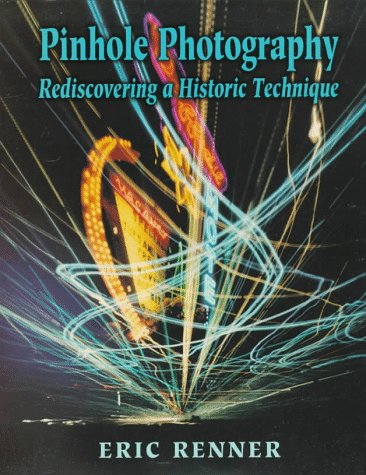

Pinhole photography rediscovering a historic technique Eric Renner.
Detalles de publicación: Boston Focal Press c1995.Descripción: xv, 174 p., [20] p. of plates ill. (some col.) 28 cmISBN:- 0240802314
- 771 20
- TR268 .R46 1995
| Imagen de cubierta | Tipo de ítem | Biblioteca actual | Biblioteca de origen | Colección | Ubicación en estantería | Signatura topográfica | Materiales especificados | Info Vol | URL | Copia número | Estado | Notas | Fecha de vencimiento | Código de barras | Reserva de ítems | Prioridad de la cola de reserva de ejemplar | Reservas para cursos | |
|---|---|---|---|---|---|---|---|---|---|---|---|---|---|---|---|---|---|---|
| Libro | Biblioteca Encarnación Valdés Colección General bev | 771 R414p (Navegar estantería(Abre debajo)) | Disponible | 80000001803264 |
Descripciones mejoradas de Syndetics:
* The definitive book on pinhole photograpyhy by one of the world's foremost authorities * Beautifully illustrated with more than 170 colour and black and white photographs and line art * Includes an invaluable source guide of suppliers In this digital age, more and more photographers are rediscovering traditional artistic methods, and Pinhole Photography is both an entertaining illustrated history and a practical how-to guide to this unique photographic genre. Detailed, easy-to-read chapters explain how to create pinhole cameras and images and how to manipulate pinhole images using a variety of photographic techniques. Eric Renner is the founder and director of Pinhole Resource, a non-profit organization dedicated to sharing information about pinhole photography. He is also founder and co-editor of The Pinhole Journal, published three times yearly. His work has been exhibited throughout the United States and in Central and South America and Europe. d in Central and South America and Europe.
Includes bibliographical references and index.
Tabla de contenidos provista por Syndetics
- Preface(p. ix)
- Acknowledgments(p. xv)
- 1 Pinhole's History in Science(p. 1)
- Holed Stones(p. 1)
- Early Pinhole Optics-Eclipses, Telling Time, and Optical Phenomena(p. 1)
- Noon-marks in Italian Renaissance Cathedrals(p. 8)
- The Pinhole in the Wave Theory of Light(p. 13)
- The Pinhole in Photography(p. 16)
- The Pinhole and the Eye(p. 18)
- Twentieth-century Pinhole Imaging in High-energy Physics(p. 20)
- 2 Pinhole's History in Art(p. 27)
- Brunelleschi's Pinhole Perspective Device(p. 27)
- Alberti's First Diffraction Camera(p. 30)
- Alberti's Intersector(p. 33)
- Leonardo da Vinci(p. 35)
- Anamorphosis-The Deception of the Eye(p. 39)
- The First Pinhole Photographs(p. 42)
- Pinhole's Popularity in Early "Pictorialism"(p. 46)
- August Strindberg(p. 49)
- Pinhole's Demise in the Early Twentieth Century(p. 51)
- 3 Pinhole's Revival in Art: The 1960s and 1970s(p. 55)
- Rebirth-The Late 1960s(p. 55)
- The 1970s(p. 63)
- 4 Pinhole's Revival in Art: The 1980s(p. 73)
- The Peter Pan Principle, or "I Can Fly"(p. 73)
- The Body as Camera(p. 74)
- Camera and Photograph as One(p. 78)
- Cameras and Images in the 1980s(p. 82)
- 5 The How-to of Pinhole Photography(p. 109)
- Making a Simple Pinhole Camera(p. 109)
- Loading the Pinhole Camera(p. 115)
- Making a Photograph(p. 116)
- Additional Mistakes(p. 119)
- Additional Possibilities(p. 121)
- Optimal Pinhole Formulas(p. 123)
- Making a Pinhole Turret(p. 128)
- Pinhole Camera Geometries(p. 131)
- Exposure Times(p. 143)
- Additional Technical Information(p. 145)
- Additional Hints for Building Pinhole Cameras(p. 149)
- 6 Zone Plates, Slits, and Other Apertures(p. 151)
- Zone Plates(p. 151)
- Zone Plate Cameras, Images, and Methods(p. 154)
- Pinhead Mirrors and Pinspeck(p. 160)
- Slit Apertures(p. 162)
- Other Aperture Alterations(p. 164)
- 7 Eye, Image, Camera, Mind: The 1990s(p. 167)
- The Shifting Image of Reality?(p. 167)
- 1990s Images(p. 169)
- List of Suppliers(p. 183)
- Index(p. 185)