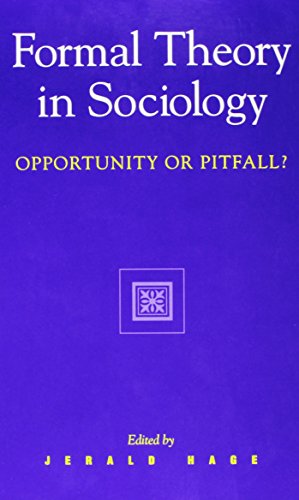

Formal theory in sociology opportunity or pitfall? edited by Jerald Hage.
Series SUNY series, the new inequalitiesDetalles de publicación: Albany State University of New York Press c1994.Descripción: ix, 204 p. 24 cmISBN:- 0791419517 (acid-free)
- 0791419525 (pbk. : acid-free)
- 301/.01 20
- HM24 .F672 1994
| Imagen de cubierta | Tipo de ítem | Biblioteca actual | Biblioteca de origen | Colección | Ubicación en estantería | Signatura topográfica | Materiales especificados | Info Vol | URL | Copia número | Estado | Notas | Fecha de vencimiento | Código de barras | Reserva de ítems | Prioridad de la cola de reserva de ejemplar | Reservas para cursos | |
|---|---|---|---|---|---|---|---|---|---|---|---|---|---|---|---|---|---|---|
| Libro | Biblioteca Encarnación Valdés Colección General bev | 301.01 F723 (Navegar estantería(Abre debajo)) | Disponible | 80000001803710 |
Descripciones mejoradas de Syndetics:
A group of renowned sociological theorists analyze why the attempts to make sociological theory formal in the 1960s and early 1970s failed. This becomes not only an unusual and interesting analysis in the sociology of knowledge, but several of the articles move to the level of analyzing the entire discipline, explaining why positivism did not take hold and what are the distinctive characteristics of sociology as a discipline. Anyone interested in sociology as a discipline and more specifically sociological theory will find interesting analytical models.
Includes bibliographical references (p. 181-195) and indexes.
Tabla de contenidos provista por Syndetics
- Introduction
- Part 1 The Demise of Theory Construction
- 1 Did Social Science Break Down in the 1970s?
- 2 The Failure of Sociology to Institutionalize Cumulative Theorizing
- 3 Sociological Theory: Complex, Fragmented, and Politicized
- 4 Sociological Theory: The Half-full Cup
- Part 2 Alternative Strategies for Developing Formal Theory
- 5 Resistance in Sociology to Formal Theory Construction
- 6 Sociological Theory: What Has Gone Wrong and How to Put It Right: A View from Britain
- 7 What Have We Failed to Systematize Reality's Complexities?
- 8 Formal Theory Construction in Gender Sociology: An Unexploited Gold Mine of Possibilities
- 9 Constructing Bridges between Sociological Paradigms and Levels: Trying to Make Sociological Theory More Complex, Less Fragmented, and Less Politicized
- Part 3 Implications for the Discipline
- 10 Recommendations from Jerald Hage
- 11 Recommendations from Jonathan Turner
- References
- Index
Reseñas proporcionadas por Syndetics
CHOICE Review
In this book consisting of papers from a special conference supported by the American Sociological Association, organizer and editor Hage (Univ. of Maryland) has assembled a formidable array of sociological theorists, including Randall Collins, Jonathan Turner, Bernard Cohen, and Hubert Blalock. They provide a retrospective on the death of the short-lived formal theory movement in sociology, which developed during the late 1960s and early 1970s, and also discuss the advisability and possibility of its resurrection. In general, the contributors highlight sociological as opposed to epistemological factors, for example Collins and Waller's identification of sociology as an antipositivist battleground and Turner's attention to how sociology is organized. Although no consensus emerges, several sociological insights into this chapter in the history of sociology are offered that not only are relevant to the fate of formal theory but reflect on the current status and future of the discipline as well. The work also serves as a collective case study in the sociology of sociology. Recommended for graduate students and scholars, especially those with a particular interest in formal theory. M. F. Keen; Indiana University at South BendNotas de autor provistas por Syndetics
Jerald Hage is at the Center for Innovation in the Department of Sociology at the University of Maryland at College Park.