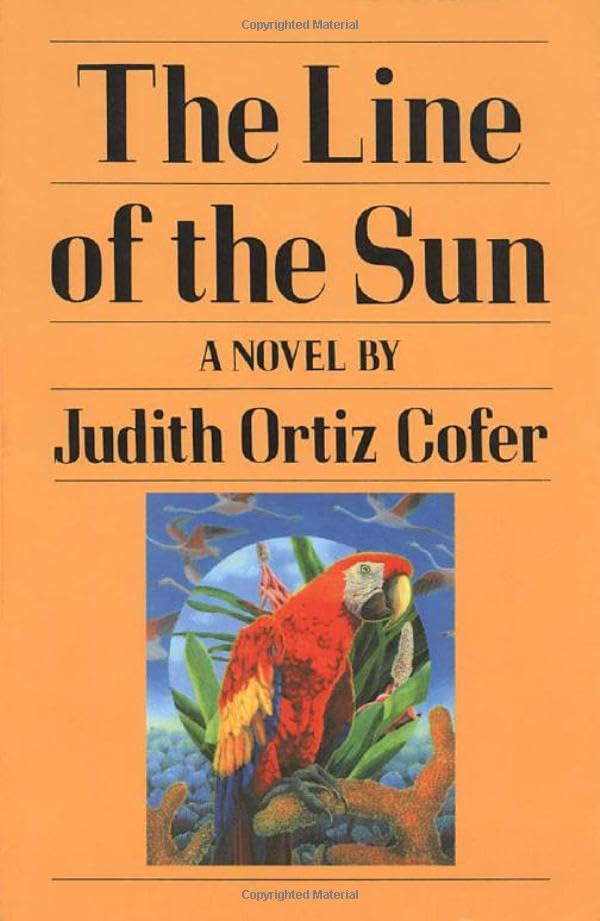
Imagen de Amazon.com

Portada de Syndetics
Imagen de OpenLibrary
The line of the sun a novel by Judith Ortiz Cofer.
Detalles de publicación: Athens, Ga. University of Georgia Press c1989.Descripción: 291 p. 23 cmISBN:- 0820311065 (alk. paper)
- 813/.54 19
- PS3565.R7737 L56 1989
| Imagen de cubierta | Tipo de ítem | Biblioteca actual | Biblioteca de origen | Colección | Ubicación en estantería | Signatura topográfica | Materiales especificados | Info Vol | URL | Copia número | Estado | Notas | Fecha de vencimiento | Código de barras | Reserva de ítems | Prioridad de la cola de reserva de ejemplar | Reservas para cursos | |
|---|---|---|---|---|---|---|---|---|---|---|---|---|---|---|---|---|---|---|
| Libro | Biblioteca Encarnación Valdés Colección General bev | 813.54 O77l (Navegar estantería(Abre debajo)) | Disponible | 80000001767436 |
Total de reservas: 0
Descripciones mejoradas de Syndetics:
Set in the 1950s and 1960s, The Line of the Sun moves from a rural Puerto Rican village to a tough immigrant housing project in New Jersey, telling the story of a Hispanic family's struggle to become part of a new culture without relinquishing the old. At the story's center is Guzmán, an almost mythic figure whose adventures and exile, salvation and return leave him a broken man but preserve his place in the heart and imagination of his niece, who is his secret biographer.
Reseñas proporcionadas por Syndetics
Library Journal Review
This first novel by an accomplished poet flavors the U.S. immigrant experience with a hint of magical realism. The story of Guzman, black sheep of a Puerto Rican village, is here told by his assimilited niece. Adventurous from childhood, the wild youth is ostracized because of an affair with a notorious older woman whose reputation as a spiritist does not save her from the wrath of righteous neighbors. Heading for New York and the American dream, Guzman wanders for more than a decade until he confronts his island roots in a violent, resonant denouement. A shaky transition between the novel's two main sections is offset by well-realized characters and vibrant depictions of Puerto Rican folk culture. Recommended.-- Starr E. Smith, Georgetown Univ. Lib., Washington, D.C. (c) Copyright 2010. Library Journals LLC, a wholly owned subsidiary of Media Source, Inc. No redistribution permitted.Publishers Weekly Review
The vivid opening of this first novel, in which the hero, Guzman, kicks lustily in Mama Cielo's womb, abates somewhat before the first chapter ends. Even the doughty, tyrannical Cielo succumbs to the trials of Puerto Rican life--her older son's death in battle, Guzman's wild passion for the local whore, the late birth of a sickly daughter. After Guzman leaves for New York, the narrative is taken up by his young niece Marisol, daughter of his sister, who has moved to Paterson, N.J. Through Marisol's eyes we understand the clash of conflicting values endured by Puerto Rican emigres. Though exposed to the U.S. mainstream in school, Marisol remains rooted in the island culture stubbornly maintained by her mother and others in the Spanish-speaking tenement community. When Guzman suddenly appears in Paterson, the adoring Marisol finds a spiritual mentor. But the neighbors inexplicably detest Guzman, and other events--a factory strike, a fire, a seance--lead to the family's separation. Unfortunately, the rest of the novel never lives up to the excitement generated by Guzman in the opening pages. But though weakened by clumsy plotting, arbitrary shifts in points of view and sometimes pedestrian prose, prize-winning poet Cofer's novel paints a colorful, revealing portrait of Puerto Rican culture and domestic relationships. (June) (c) Copyright PWxyz, LLC. All rights reservedBooklist Review
The little town of Salud, Puerto Rico, forms the backdrop for this rich tale of a culture enmeshed in the past and struggling with the present. Guzman, a lost soul, a nino del diablo, is the story's protagonist, but it is his 15-year-old niece, Marisol, who tells his story--unobtrusively and mostly through narrative--from Guzman's rebellious childhood, turbulent adolescence (he moves in with the town witch, La Cabra), and eventual disappearance to America. The passion of youth, now stilled in her parents, flares in Marisol as she lies awake in bed in New Jersey, listening to her parents talk about life then, in Puerto Rico, and now, in El Building, the crowded tenement where they live. They talk, too, about her uncle, Guzman, at least until the day he appears on their doorstep. Author Cofer writes simple, honest prose, drenched in the sweat and choked in the dust of poverty; the characters are good people, well drawn, and Cofer's style is the perfect complement to the complexity of their lives. A colorful, multigenerational story. --Eloise KinneyNotas de autor provistas por Syndetics
Judith Ortiz Cofer was born in Puerto Rico in 1952. She was a Franklin Professor of English and creative writing at the University of Georgia from 1984 until she retired in 2013. She was also a poet and author. Her collections of poetry include Terms of Survival, Reaching for the Mainland, and A Love Story Beginning in Spanish: Poems. Her novels include Call Me Maria, The Meaning of Consuelo, and The Line of the Sun. She won an O. Henry Prize for the story A Latin Deli, which appeared in The Latin Deli: Prose and Poetry. Her other books include Silent Dancing: A Partial Remembrance of a Puerto Rican Childhood, An Island Like You: Stories of the Barrio, If I Could Fly, and Woman in Front of the Sun: On Becoming a Writer. She died from cancer on December 30, 2016 at the age of 64.(Bowker Author Biography)