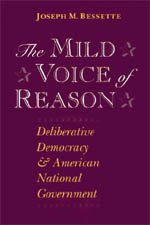

The mild voice of reason deliberative democracy and American national government Joseph M. Bessette.
Series American politics and political economyDetalles de publicación: Chicago University of Chicago Press c1994.Descripción: xvi, 289 p. 24 cmISBN:- 0226044238 (alk. paper)
- 328.73/077 20
- JK1001 .B47 1994
| Imagen de cubierta | Tipo de ítem | Biblioteca actual | Biblioteca de origen | Colección | Ubicación en estantería | Signatura topográfica | Materiales especificados | Info Vol | URL | Copia número | Estado | Notas | Fecha de vencimiento | Código de barras | Reserva de ítems | Prioridad de la cola de reserva de ejemplar | Reservas para cursos | |
|---|---|---|---|---|---|---|---|---|---|---|---|---|---|---|---|---|---|---|
| Libro | Biblioteca de Mayagüez Colección General mb | JK1001 .B47 1994 (Navegar estantería(Abre debajo)) | Disponible | 50000001830339 | ||||||||||||||
| Libro | Biblioteca Encarnación Valdés Colección General bev | 328.73077 B558m (Navegar estantería(Abre debajo)) | Disponible | 80000001766016 |
Descripciones mejoradas de Syndetics:
In recent years, many Americans and more than a few political scientists have come to believe that democratic deliberation in Congress--whereby judgments are made on the merits of policies reflecting the interests and desires of American citizens--is more myth than reality. Rather, pressure from special interest groups, legislative bargaining, and the desire of incumbents to be reelected are thought to originate in American legislative politics. While not denying such influences, Joseph M. Bessette argues that the institutional framework created by the founding fathers continues to foster a government that is both democratic and deliberative, at least to some important degree.
Drawing on original research, case studies of policymaking in Congress, and portraits of American lawmakers, Bessette demonstrates not only the limitations of nondeliberative explanations for how laws are made but also the continued vitality of genuine reasoning on the merits of public policy. Bessette discusses the contributions of the executive branch to policy deliberation, and looks at the controversial issue of the proper relationship of public opinion to policymaking.
Informed by Bessette's nine years of public service in city and federal government, The Mild Voice of Reason offers important insights into the real workings of American democracy, articulates a set of standards by which to assess the workings of our governing institutions, and clarifies the forces that promote or inhibit the collective reasoning about common goals so necessary to the success of American democracy.
"No doubt the best-publicized recent book-length work on Congress is columnist George Will's diatribe in praise of term limits in which the core of his complaint is that Congress does not deliberate in its decision-making. Readers who are inclined to share that fantasy would do well to consult the work of Joseph M. Bessette. He turns up massive amounts of material attesting to the centrality of deliberation in congressional life."--Nelson W. Polsby, Presidential Studies Quarterly
Includes bibliographical references (p. 247-276) and index.
Tabla de contenidos provista por Syndetics
- Preface
- 1 Introduction
- 2 The Creation of Deliberative Democracy in the United States
- 3 Deliberation, Democracy, and Policymaking
- 4 Bargaining and Collective Decisions: The Limits of Explanation
- 5 Interest, Ambition, and the Character of Lawmakers
- 6 Deliberation and the Lawmaking Process
- 7 The President's Contribution to Congressional Deliberations
- 8 Public Opinion and Democratic Statesmanship
- Appendix: Case Studies of Congress: Domestic Legislation, 1946-1970
- Notes
- Index