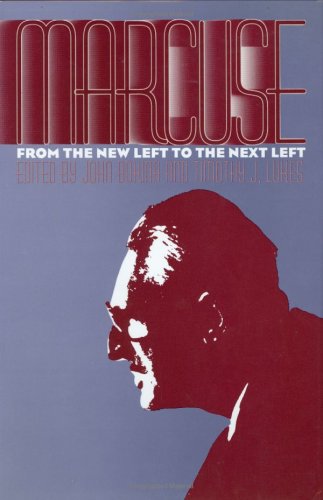
Imagen de portada de Amazon
Imagen de Amazon.com
Imagen de cubierta Syndetics
Portada de Syndetics
Imagen de OpenLibrary

Marcuse from the New Left to the next left edited by John Bokina and Timothy J. Lukes.

Colaborador(es): Detalles de publicación: Lawrence, Kan. University Press of Kansas c1994.Descripción: vi, 281 pISBN:
  • 0700606580 (hardcover : alk. paper)
  • 0700606599 (pbk. : alk. paper)
Tema(s): Clasificación CDD:
  • 300/.1 20
Clasificación LoC:
  • JC251.M25 M37 1994
Valoración
    Valoración media: 0.0 (0 votos)
Existencias
Imagen de cubierta Tipo de ítem Biblioteca actual Biblioteca de origen Colección Ubicación en estantería Signatura topográfica Materiales especificados Info Vol URL Copia número Estado Notas Fecha de vencimiento Código de barras Reserva de ítems Prioridad de la cola de reserva de ejemplar Reservas para cursos
Libro Biblioteca Encarnación Valdés Colección General bev 300.1 M322 (Navegar estantería(Abre debajo)) Disponible 80000001801730
Total de reservas: 0

Descripciones mejoradas de Syndetics:

In this reassessment of Marcuse, the controversial New Left philosopher of the 1960s, 15 contributors consider his ideas in the radically different theoretical and political contexts of the 1990s.

Includes bibliographical references and index.

Reseñas proporcionadas por Syndetics

CHOICE Review

This collection of essays revives and rehabilitates one of the best-known left intellectuals of the 1960s. The contributors generally seek to apply the critical, self-consciously political spirit of Marcuse's Freudian-Heideggerian-Neomarxism in the context of post-Soviet, postmodern 1990s radical relativisms. Contributors were invited to write on topics of their choice, which the editors have divided, with inevitably mixed success, into five sections: on trends in radicalism, on psychoanalysis and feminism, on reconciling subjectivity and critical political theory, on technology's domination of nature and its relation to the domination of humans, and on the relevance of Marcuse to future radicalism. The 14 essays and useful introduction are notably free of the jargon that characterizes contemporary theorizing, but they also rely on the reader's prior familiarity with that theoretical literature. Moreover, this collection's unconcealed longing for intellectual and social revolution, as well as the often nostalgic view of '60s radicalism (which includes, interestingly, disdain for political correctness as antipolitical and frivolous), may restrict its appeal to readers already of renascent New Left inclinations. Graduate; faculty. B. Pencek; formerly, Northern Arizona University
Compartir
logopucpr-y-vive

Contáctanos

¡Queremos saber de ti!

Tel. 787.841.2000 Ext. 1801

bibliotecavaldes@pucpr.edu

⁣Búscanos en las redes

© 2026 Desarrollado por Ignite Online • All Rights Reserved • Powered by Koha.