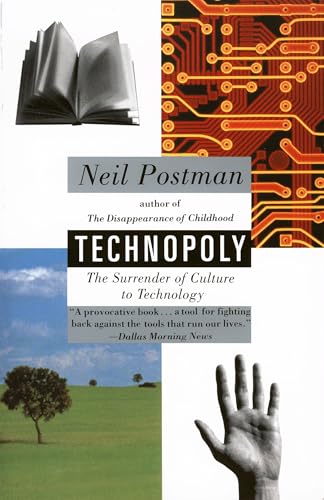
A witty, often terrifying that chronicles our transformation into a society that is shaped by technology-from the acclaimed author of Amusing Ourselves to Death.
"A provocative book ... A tool for fighting back against the tools that run our lives."- Dallas Morning News
The story of our society's transformation into a Technopoly: a society that no longer merely uses technology as a support system but instead is shaped by it-with radical consequences for the meanings of politics, art, education, intelligence, and truth.
Originally published: 1st ed. New York : Knopf, 1992.
Includes bibliographical references (p. [207]-210) and index.
Reseñas proporcionadas por Syndetics
Library Journal Review
Postman continues his plea to analyze physical culture in our society which he discussed in earlier books such as Amusing Ourselves to Death (Viking, 1985). He claims that our social institutions have, in effect, become dominated by the technologies that permeate our society. People, including researchers in science and social science, have allowed the use of technology to substitute for their own thinking. Earlier societies in history were tool-using but retained a sense of wholeness and a center of morality that is missing from our society. Postman asserts that there is a technological determinism pervading America that can be restrained, for example, by giving courses in the history and philosophy of technology and in comparative religion. However, his evidence for this critique is narrowly selected, and his discussion is often anecdotal. An optional purchase.-- Christopher R. Jocius, Illinois Mathematics & Science Acad., Aurora (c) Copyright 2010. Library Journals LLC, a wholly owned subsidiary of Media Source, Inc. No redistribution permitted.
Publishers Weekly Review
Mixing provocative insights and cliched criticisms, Postman defines the U.S. as a society in which technology is deified to a near-totalitarian degree. (Apr.) (c) Copyright PWxyz, LLC. All rights reserved
CHOICE Review
Postman presents a view found in literature from Siegfried Giedion's Mechanization Takes Command (1948) through the writings of Jacques Ellul. One might trace back to Mark Twain's A Connecticut Yankee. . . (1889). That technology and the rest of culture are integrated has been recognized for decades. Postman's proposition is that technology has provided an informational overload, making the recipient almost a voyeur and unable to discriminate among data. The apotheosis of indiscriminate accumulation is the game of Trivial Pursuit. The result, he says, is the unquestioning acceptance of technological offerings to the point that technology "takes command." To which observation he adds the deification of "science" (and technology), trivialization of symbols, and loss of morals and values. People, through growing dependence on technology, have lost autonomy, replacing inner-directedness with other- (techno-) directedness. The author balances his criticisms with recommendations: study history of technology to understand its underlying assumptions and study comparative religion to gain a view of morals and values that are being overridden or ignored in the present world. For a literate general readership. R. F. G. Spier; University of MissouriDSColumbia
Booklist Review
/*STARRED REVIEW*/ A summary masterwork by one of our best social critics, though not a summary of his particular themes so much as of themes that have been in the air for at least a half-century. To wit: Every technological change alters the culture that adopts it. The contemporary predicament is that we are controlled by rather than control our technologies. Technology induces us to see ourselves as expressions of it, as in our speaking of the brain as a bunch of "hard-wiring" that can be "programmed," from which we "retrieve data," etc. Our technologized, statistics-mad social sciences are a sham, neither scientific nor socially relevant. Our infatuation with technologically enabled material progress has led us to trivialize our religious, philosophical, and artistic heritages. These are arguments familiar at least since the 1950s, when the likes of Paul Goodman--whose maxim, "technology is a branch of moral philosophy, not of science," Postman uses as this book's epigraph--voiced them. What Postman has done that is distinctive is to characterize the cumulated effects those arguments critique as a cultural gestalt he dubs "Technopoly" and to state them all more elegantly, wittily, and aptly than they've ever been stated. And finally, in the manner of Goodman, who felt obliged to append practical proposals to his carpings, Postman suggests what to do to ameliorate the damage technologized society has done. He suggests we become "loving resistance fighters" who keep "epistemological and psychic distance from any technology" and that we place history--not dates and names and events, but the development of knowledge in all areas--at the center of education. (Reviewed Dec. 1, 1991)0394582721Ray Olson
Notas de autor provistas por Syndetics
Born in Brooklyn, New York, and educated at the State University of New York and Columbia University, Neil Postman is a communications theorist, educator, and writer who has been deeply involved with the issue of the impact of the media and advanced communications technology on American culture. In his many books, Postman has strongly opposed the idea that technology will "save" humanity. In fact, he has focused on the negative ways in which television and computers alter social behavior. In his book Technopoly, Postman argues that the uncontrolled growth of technology destroys humanity by creating a culture with no moral structure. Thus, technology can be a dangerous enemy as well as a good friend. Postman, who is married and has three children, currently is a professor of media ecology at New York University and editor of Et Cetera, the journal of general semantics. In addition to his books, he has contributed to various magazines and periodicals, including Atlantic and The Nation. He has also appeared on the television program Sunrise Semester. Postman is the holder of the Christian Lindback Award for Excellence in Teaching from New YorkUniversity. (Bowker Author Biography)
Technopoly
APA
Postman N., . (1993). Technopoly: the surrender of culture to technology. New York: Vintage Books.
Chicago
Postman Neil, . 1993. Technopoly: the surrender of culture to technology. New York: Vintage Books.
Harvard
Postman N., . (1993). Technopoly: the surrender of culture to technology. New York: Vintage Books.
MLA
Postman Neil, . Technopoly: the surrender of culture to technology. New York: Vintage Books. 1993.