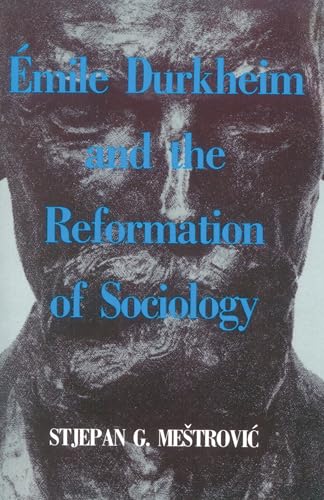
Imagen de portada de Amazon
Imagen de Amazon.com
Imagen de cubierta Syndetics
Portada de Syndetics
Imagen de OpenLibrary

Emile Durkheim and the reformation of sociology Stjepan G. Mestrovic.

Por: Detalles de publicación: Lanham, Md. Rowman & Littlefield 1993.Descripción: xxiii, 156 p. 24 cmISBN:
  • 0847678679 (pbk. : alk. paper)
Tema(s): Clasificación CDD:
  • 301/.092 B 20
Clasificación LoC:
  • HM22.F8 D854 1993
Valoración
    Valoración media: 0.0 (0 votos)
Existencias
Imagen de cubierta Tipo de ítem Biblioteca actual Biblioteca de origen Colección Ubicación en estantería Signatura topográfica Materiales especificados Info Vol URL Copia número Estado Notas Fecha de vencimiento Código de barras Reserva de ítems Prioridad de la cola de reserva de ejemplar Reservas para cursos
Libro Biblioteca Encarnación Valdés Colección General bev 301.092 M586e (Navegar estantería(Abre debajo)) Disponible 80000001765562
Libro Biblioteca Encarnación Valdés Colección General bev 301.092 M586e c.2 (Navegar estantería(Abre debajo)) Disponible 80000001728594
Total de reservas: 0

Descripciones mejoradas de Syndetics:

This book proposes a new representation of Emile Durkheim, as the philosopher and moralist who wanted to renovate rationalism, challenge positivism, reform sociology, and extend Schopenhauer's philosophy to the new domain of sociology. Above all, it highlights Durkheim's vision of sociology as the 'science of morality' that would eventually replace moralities based on religion.

Includes bibliographical references (p. 143-152) and index.

Reseñas proporcionadas por Syndetics

CHOICE Review

An important contribution to the understanding of the sociology of Emile Durkheim. This is not an introduction to Durkheim; for that, readers are still best advised to go to Steven Lukes's Emile Durkheim, His Life and Work (1985). Rather, Mestrovic's work is a very unorthodox and very significant reevaluation. The conventional view is to see Durkheim as a man trapped between the 19th and 20th centuries, with his philosophical foundation in the former, and his epistemology and scientific methodology in the latter. Mestrovic argues that this is a misreading of the philosophical bases of Durkheim's work. His largest philosophical debt is to Arthur Schopenhauer, one of the predecessors of modern existentialism. Durkheim's understanding of the relationship between the individual and the collective is shown to closely parallel Schopenhauer's homo duplex--the inherent conflict in the meaning of knowledge and will. Durkheim's approach to representations, anomie, and the condition of morality in contemporary society borrow heavily from Schopenhauer. Thus, Durkheim is connected to both Freud and critical theory, each owing the same debts to Schopenhauer. For those with a good reading knowledge of Durkheim, Mestrovic casts this major figure in modern social thought in a very original light. Clear and lucid; sparsely but adequately documented. Strongly recommended for academic libraries. -S. M. Soiffer, University of Rochester

Notas de autor provistas por Syndetics

Stjepan G. Mestrovic is Professor at Texas A&M University and author of Durkheim and Postmodern Culture .
Compartir
logopucpr-y-vive

Contáctanos

¡Queremos saber de ti!

Tel. 787.841.2000 Ext. 1801

bibliotecavaldes@pucpr.edu

⁣Búscanos en las redes

© 2026 Desarrollado por Ignite Online • All Rights Reserved • Powered by Koha.