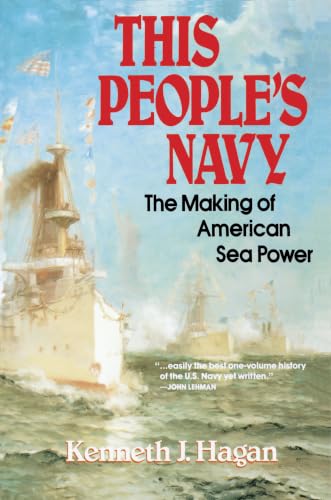
Kenneth J. Hagan pulls the curtain back for American civilians as he shares a sweeping account of the country's naval experience.
Including the wooden Continental Navy to contemporary projections of the service's high-tech mission in the next century, The People's Navy shares the complete making and growth of America's sea power.
"...provides a clear, interesting, and through-provoking introduction to the history of the American sea power and should be read by all historians of the United States... This book will provide standard interpretation for a long time to come." - Reviews in American History
Includes bibliographical references (p. 391-411) and index.
Tabla de contenidos provista por Syndetics
Acknowledgments(p. ix)
Introduction(p. xi)
1 The American Way of War at Sea, 1775-1783(p. 1)
2 "A Good Occasion to Begin a Navy," 1783-1800(p. 21)
3 "Strength and Bravery in Every Sea," 1801-1815(p. 54)
4 Extending the Empire of Commerce, 1815-1846(p. 91)
5 Brown-Water War for a Blue-Water Empire, 1846-1860(p. 125)
6 A Navy Divided Against Itself, 1861-1890(p. 161)
7 "Not Merely a Navy for Defense," 1890-1898(p. 193)
8 "Incomparably the Greatest Navy in the World," 1898-1918(p. 228)
9 Facing the Island Empires, 1919-1933(p. 259)
10 Guerre de Course Once Again, 1933-1945(p. 281)
11 The Navy's War in the Pacific, 1941-1945(p. 305)
12 In Search of a Mission, 1945-1962(p. 333)
13 Toward a Six-Hundred-Ship Navy, 1963-1990(p. 362)
Epilogue(p. 389)
Bibliographical Essay(p. 391)
Index(p. 412)
Reseñas proporcionadas por Syndetics
Library Journal Review
Hagan (history, U.S. Naval Academy) has written a highly detailed and opinionated survey of American sea power from the naval deliberations of the Continental Congress in 1775 to the maritime strategy of the Secretary of the Navy, John Lehman, in the 1980s. Concentrating on policy and strategy, or what the author calls ``the external political and economic environment,'' this history takes issue with traditional naval historians to present a view of American sea power that recognizes the interaction of many variables, e.g., politics, personalities, and technology. Edward L. Beach's The United States Navy: 200 Years ( LJ 3/1/86) provides a technological view of naval history and Edwin B. Hooper's United States Naval Power in a Changing World (Praeger, 1988) gives a more limited political survey. For complementary views of American naval history, choose Hagan and Beach.-- Harold N. Boyer, Marple P.L., Broomall, Pa. (c) Copyright 2010. Library Journals LLC, a wholly owned subsidiary of Media Source, Inc. No redistribution permitted.
Publishers Weekly Review
Hagan, a professor of history at the U.S. Naval Academy, here ably traces the military, political and technological evolution of the Navy from the days of sail into the nuclear era, and reveals how the Gorbachev administration has called into question the premises of U.S. naval policy and strategy. He describes how the writings of Alfred Thayer Mahan (whose doctrines he considers outdated), combined with geopolitical realignments around the turn of the century, led to the Navy's transformation from a modest hit-and-run unit to a capital-ship force whose mission is to command the seas through decisive engagements between battlefleets. In the latter part of the study, the author analyzes the influences of three figures in the reshaping of the modern Navy: Admiral Hyman Rickover and the creation of the nuclear-powered navy; Admiral Elmo Zumwalt's attempt to reduce the large number of expensive ships; and Navy Secretary John Lehman's reinforcement of Mahanian doctrine with his ``carrier as panacea'' views. Hagan argues that ``the American destiny is rooted in continental North America, and that political concerns with the transoceanic world are fundamentally marginal.'' (Dec.) (c) Copyright PWxyz, LLC. All rights reserved
CHOICE Review
Hagan's book would best fit the category of text for a general course in naval and maritime history. Hagan covers events from the American Revolution up to but not including Desert Storm. There are 16 pages of ordinary illustrations and a very good 20-page bibliography. The bibliography has few annotations, however, and there are no notes or footnotes. The author, an instructor at the Naval Academy, has a tendency to emphasize personalities and the politics of strategy and skimps on descriptions of the actual battles. For example, the politics guiding the command decisions of Admiral Nimitz in the Pacific Theater of WW II are well covered, but the important battle of the Bismarck Sea and the Bougainville landings are totally ignored. The vital Battle of Midway is only lightly treated. Statistics are few and far between. In general, however, the broad picture of naval history is correct, with historical details only occasionally in error. -B. H. Groene, Southeastern Louisiana University
Booklist Review
Hagan, a professor of history at the U.S. Naval Academy, has synthesized the results of 17 years of teaching U.S. naval history into an outstanding one-volume treatment of the subject. His emphasis is on the changing orientation of the U.S. Navy's governing strategy, from privateering in the Revolution to blue-water fleet engagements in World War II and after. Hagan covers an enormous amount of territory in clear prose and also provides a superior bibliography. One of the notable works of military science to be published this year. Highly recommended. To be indexed. ~--Roland Green
Notas de autor provistas por Syndetics
Kenneth J. Hagan is a distinguished American naval historian and a retired faculty member of the United States Naval Academy. Hagan graduated from the University of California, Berkeley, and served in the United States Navy for five years.
This people's Navy
APA
Hagan K. J., . (19921991). This people's Navy: the making of American sea power. New York: Free Press.
Chicago
Hagan Kenneth J, . 19921991. This people's Navy: the making of American sea power. New York: Free Press.
Harvard
Hagan K. J., . (19921991). This people's Navy: the making of American sea power. New York: Free Press.
MLA
Hagan Kenneth J, . This people's Navy: the making of American sea power. New York: Free Press. 19921991.