Imagen de Amazon.com

Portada de Syndetics
Imagen de OpenLibrary
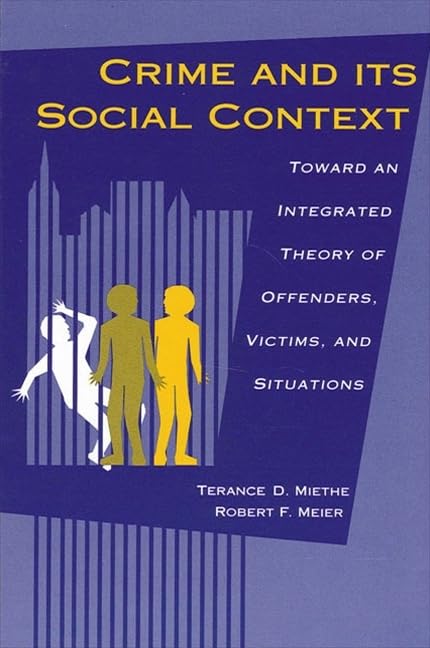
Crime and its social context toward an integrated theory of offenders, victims, and situations Terance D. Miethe, Robert F. Meier.
Series SUNY series in deviance and social controlDetalles de publicación: Albany State University of New York Press c1994.Descripción: xiv, 209 p. ill. 24 cmISBN:- 0791419010 (HC : acid-free paper)
- 0791419029 (PB : acid-free paper)
- 364 20
- HV6018 .M54 1994
| Imagen de cubierta | Tipo de ítem | Biblioteca actual | Biblioteca de origen | Colección | Ubicación en estantería | Signatura topográfica | Materiales especificados | Info Vol | URL | Copia número | Estado | Notas | Fecha de vencimiento | Código de barras | Reserva de ítems | Prioridad de la cola de reserva de ejemplar | Reservas para cursos | |
|---|---|---|---|---|---|---|---|---|---|---|---|---|---|---|---|---|---|---|
| Libro | Biblioteca Encarnación Valdés Colección General bev | 364 M632c (Navegar estantería(Abre debajo)) | Disponible | 80000001809261 | ||||||||||||||
| Libro | Biblioteca Mons. Iñaki Mallona (Arecibo) Colección General ab | 364 M632c (Navegar estantería(Abre debajo)) | Disponible | 60000003081285 |
Total de reservas: 0
Descripciones mejoradas de Syndetics:
Theories of criminality and theories of victimization have traditionally been discussed as though they bore no relationship to one another. Yet, a complete explanation for crime must examine both the decision to engage in crime by an offender and the everyday actions of ordinary citizens that increase vulnerability to criminals. The integration of these approaches yields testable models that have greater predictive power than could be obtained by looking only at models of offenders or models of victim behavior. A more general perspective that accounts for both the decision to engage in crime and the selection of particular crime targets is developed and tested.
Includes bibliographical references (p. [189]-201) and indexes.
Tabla de contenidos provista por Syndetics
- Tables and Figures
- Preface
- 1 Introduction to the Study of Crime
- What Is It To Be Integrated?
- Linking Theory to Data
- The Current Study
- 2 Theories of Criminality
- Theoretical Legacies
- The Criminal as a Unifying Concept
- Two Major Problems, Some Exceptions, and New Directions
- Crime and Community
- Some Hypotheses
- Summary and Conclusions
- 3 Theories of Victimization and Criminal Opportunities
- Historical Foundations for Current Victimization Theories
- The Lifestyle-Exposure Theory of Victimization
- The Routine Activity Theory
- Alternative Theorectical Models
- Contextual Effects in Models of Victimization
- Major Concepts in Victimization Theories
- Problems with Previous Evaluations of Victimization Theories
- Summary and Research Hypothesis
- 4 An Integrated Perspective
- Compatibility of Theories of Criminality and Victimization
- A Heuristic Model
- Summary
- 5 Data Sources for Evaluating Criminological Theories
- UCR Data and Census Reports
- National Crime Surveys
- Seattle Telephone Survey
- Measures of Major Concepts
- Analytic Procedures
- Summary and Conclusions
- Measures of Concepts and Descriptive Statistics
- 6 The Empirical Distribution of Crime and Victimization
- Victim-Offender Relationship
- Physical Location of Crime
- Time of Occurrence of Crime
- Social Characteristics of Offenders and Victims
- Summary and Conclusions
- 7 Predicting Crime Rates
- Crime Rates and Theoretically Derived Variables
- Variation in the Predicators of Crime Rates
- The Value of Theoretical Integration
- Conclusions and Implications
- 8 Predicting Individuals' Risks of Victimization
- Explaining the Victimization Experience
- Conclusions and Implications
- 9 Crime and Context
- Types of Contextual Effects
- The Importance of Contextual Effects
- Main and Mediational Effects of Contextual Factors
- Interactions between Contextual and Individual Factors
- Conclusions and Implications
- 10 Summary and Implications
- Summary Results
- Implications for Macro-Level Theories of Criminality
- Implications for Theories of Victimization
- Implications for a General Theory of Crime
- Implications of Data Limitations for Testing Theories
- Implications for Crime Control Policy
- Criminal Propensities and the Social Context
- Conclusions
- Notes
- Bibliography
- Author Index
- Subject Index