Descripciones mejoradas de Syndetics:
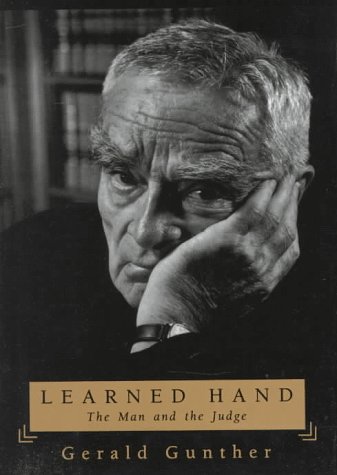
A Masterful, moving account of the life and work of one of the great judges of the twentieth century, whose work has left a profound mark on our legal, intellectual, and social landscape. The greatest judge never to be appointed to the Supreme Court, Learned Hand is widely considered the peer of Justices Holmes, Brandeis, and Cardozo. In his more than fifty years on the bench, he left an unequaled legacy of lastingly influential writings. This distinctive biography goes well beyond Hand's official work, however, to depict both a complex human being and the times in which he lived. The first to draw on the enormous collection of the judge's private papers, the eminent constitutional scholar Gerald Gunther vividly portrays a public man consumed by private doubts. Gunther's lively account moves from Hand's childhood in a formidable (and anxiety-producing) family of lawyers to his years at Harvard as a studious outsider, his frustrating experience in private law practice, his felt inadequacies in marriage, and his work as a federal judge. Throughout his life, Hand believed himself unworthy of the accolades bestowed upon him; self-doubt permeated all aspects of his life. Gunther subtly explores the ties between the modest, uncertain man -- a liberal skeptic who was never "too sure [he was] right" -- and his public record, and suggests that Hand's personal traits shaped his modest approach to judging: the questioning human being could not help acting that way as a judge. Hand's most enduring legacy is his advocacy of judicial restraint: repeatedly he sounded the dangers of excessive activism in unelected judges. Yet he mustered the courage to support such basic values as freedom of expression -- from his personally costly defense of dissenters amid the hysteria of World War I to his strong affirmation of free speech in his rulings on obscenity and his outspoken attacks on McCarthyism in the 1950s. This biography also offers the perspective of one of this era's most sensitive public figures on the rich political and social history of the first six decades of the twentieth century. By examining Hand's voluminous correspondence with such acquaintances as Walter Lippmann, Felix Frankfurter, and Herbert Croly (with whom he was a founding contributor to The New Republic), Gunther illuminates Hand's intense involvement with the public issues of his times, such as his enthusiastic support of Theodore Roosevelt's Progressive party. Gunther gives us a graphic portrait of a complex and uncommon man whose thoughts and words inspired generations of Americans and continue to do so today.
Includes bibliographical references (p. [681]-785) and index.
Reseñas proporcionadas por Syndetics
Library Journal Review
Gunther, professor of law at Stanford University Law School and a former law clerk to Judge Learned Hand and Chief Justice Earl Warren, has given us something long overdue-a treasure trove of information and insight into arguably the greatest jurist never to be named to the U.S. Supreme Court. Based in large measure on his access to Hand's private papers, this work provides a critical analysis and evaluation of this ``skeptical liberal'' who helped shape U.S. law and society for a good portion of this century. Gunther proves convincingly that the demise of first-rate, brilliant judicial biography is exaggerated: in his hands, Judge Hand vividly comes to life not only as an American jurist but as an American philosopher probing the human condition. Critical, comprehensive, and objective, this is scholarship at its finest; it belongs in every scholar's library. Highly recommended.-Stephen Shaw, Northwest Nazarene Coll., Nampa, Id. (c) Copyright 2010. Library Journals LLC, a wholly owned subsidiary of Media Source, Inc. No redistribution permitted.
Publishers Weekly Review
Stanford Law School professor Gunther, a former clerk to Hand (1872-1961) with exclusive access to his mentor's papers, ably portrays the man, perhaps the most important jurist not to serve on the Supreme Court, and explains his work. Christened Billings Learned Hand (the product of family surnames), the teenaged Learned studied philosophy at Harvard, and came by his long-held belief in judicial restraint as a Harvard Law student. Becoming a federal district judge in 1909, Hand in 1917 wrote an unpopular but ultimately influential opinion supporting free speech in a case involving the Masses , a revolutionary organ. Rising to the Second Circuit Court of Appeals in 1924, Hand helped improve judicial procedures, wrote numerous worthy opinions, gained respect as a skeptical liberal and helped found the prestigious American Law Institute, an organization aimed at improving the law. Besides describing Hand's cases, Gunther tells of the judge's personal life, his political dabblings and his popularity. The book's only drawback is its length; an abridged version could still assay Hand and reach many more readers. Photos not seen by PW. History Book Club alternate. (May) (c) Copyright PWxyz, LLC. All rights reserved
CHOICE Review
Gunther has written an outstanding biography of Learned Hand, the federal circuit judge whom many considered the greatest jurist of his time. Gunther, a former law clerk of the judge, had full access to the Hand family papers and has used them to craft a masterful, compelling biography of a man whose work was distinguished by its powerful, uncompromising support of constitutional principles while avoiding dogmatism and "absolutes," a term and notion Hand refused to employ in his thought and writings. Of his own work Hand said, "It all comes down, I believe, to whether we have the guts to face the Universe with a consciousness that it is a perpetual question-mark." Gunther succeeds remarkably well in showing how Hand, whose "almost masochistic penchant for self-doubt and self-criticism" never left him, was nevertheless able to be powerfully persuasive on the value of free speech and the spirit of liberty while alertly dubious about the place of judicial review in the American constitutional system. The man, the judge, the American citizen; all are vividly portrayed. In addition, Gunther's account is a history of the US from the perspective of the Second Circuit. Altogether a great judicial biography. All levels. L. Weinstein; Smith College
Booklist Review
Contrary to what many voters may think, federal judges make more important decisions than do politicians, and these volumes deal with two of the fairest. Jeffries has written a reverent but honest biography of Justice Powell. Powell, who voted most consistently with the five-to-four majority in Supreme Court decisions in the 1970s and 1980s, was appointed by President Nixon to be a conservative bellwether for the Burger Court. But the highly introspective Powell has since been hailed by liberals as the deciding conscience vote in vital cases of the 1970s. Powell's Court contemporaries universally respected the man and his innate sense of fairness. His overriding honesty was showcased in the famous Bakke affirmative action case, when he admonished Bakke's attorney for trying the case traditionally instead of constitutionally; later, during a homosexuality case, the 78-year-old justice insisted he'd never met a gay person. Powell himself provides a glowing foreword to Gunther's exhaustive investigation into the life of Billings Learned Hand (1872-1961), perhaps the most famous and deserving federal jurist never to serve on the Supreme Court. Gunther traces Hand's early idolization of judicial restraint guru Oliver Wendell ~Holmes, but Hand remained quite active, in politics as a Bull Moose Progressive and also through correspondence with friends such as Justice Felix Frankfurter and New Republic founder Walter Lippmann. Powell will interest contemporary law students more, but Hand's 50-year career on the bench will give insights to those seeking knowledge on litigation throughout both world wars, the New Deal, and McCarthyism. ~--Joe Collins