Imagen de Amazon.com

Portada de Syndetics
Imagen de OpenLibrary
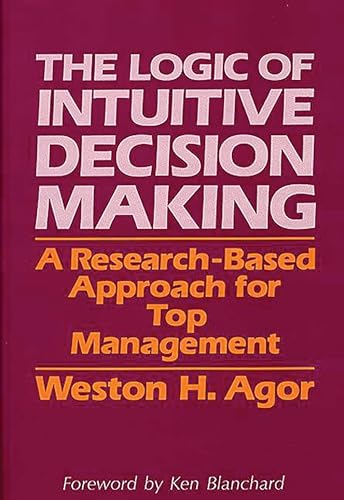
The logic of intuitive decision making a research-based approach for top management Weston H. Agor.
Detalles de publicación: New York Quorum Books c1986.Descripción: xviii, 182 p. ill. 25 cmISBN:- 0899301770 (lib. bdg. : alk. paper)
- 658.4/03 19
- HD30.23 .A35 1986
| Imagen de cubierta | Tipo de ítem | Biblioteca actual | Biblioteca de origen | Colección | Ubicación en estantería | Signatura topográfica | Materiales especificados | Info Vol | URL | Copia número | Estado | Notas | Fecha de vencimiento | Código de barras | Reserva de ítems | Prioridad de la cola de reserva de ejemplar | Reservas para cursos | |
|---|---|---|---|---|---|---|---|---|---|---|---|---|---|---|---|---|---|---|
| Libro | Biblioteca de Mayagüez Colección General mb | HD30.23 .A35 1986 (Navegar estantería(Abre debajo)) | Disponible | 50000001964385 |
Total de reservas: 0
Descripciones mejoradas de Syndetics:
Weston Agor has with scholarly thoroughness taken intuition out of the classroom and out of the business closet. He shows how it can be used as a powerful business tool. Roy Rowan, Author of The Intuitive Manager
The Message of The Logic of Intuitive Decision Making is: `Actively seek input and advice from all sources you possibly can before making a key decision,' according to the author. What follows is an outline of how to use intuition--an often-overlooked source--to make key management and personal decisions, a discussion of how to develop your intuition, and case studies of intuitive decision-making. Association Management
Includes index.
Bibliography: p. [149]-177.
Reseñas proporcionadas por Syndetics
CHOICE Review
Agor, an academic and business consultant, attempts to describe intuition, report its measurement, indicate how to develop it, and praise its utility. First, intuition is ``a quick or ready apprehension,'' or the ``capacity to integrate information.'' Used this way, it is ``a highly rational decision making skill.'' Fine so far, but how does one measure this skill? Since the author is reluctant to reveal the instrument, it is impossible to assess the measure. Thus the various findings cannot be evaluated (for example, top managers score higher on intuition than middle or lower managers, women score higher than men, and whites score higher than blacks or hispanics). It is probably true that some persons grasp ``whole'' situations more easily and quickly than others, and that this is an advantage-but can this skill be taught, as the author claims? In a book organized around the measurement of a trait, the almost total lack of information about that measure is a serious concern. Students of business administration or organizational behavior may find this book interesting but not compelling.-C. Tausky, University of Massachusetts at AmherstNotas de autor provistas por Syndetics
or /f Weston /i H.