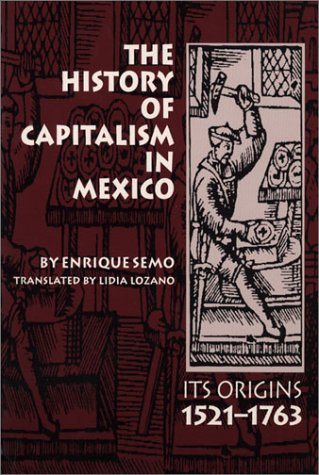

The history of capitalism in Mexico its origins, 1521-1763 Enrique Semo ; translated by Lidia Lozano.
Series Translations from Latin America seriesDetalles de publicación: Austin University of Texas Press 1993.Descripción: xxviii, 201 pISBN:- 0292730691 (alk. paper)
- 0292776691 (pbk.)
- 330.12/2/0972 20
- HC135 .S36513 1993
| Imagen de cubierta | Tipo de ítem | Biblioteca actual | Biblioteca de origen | Colección | Ubicación en estantería | Signatura topográfica | Materiales especificados | Info Vol | URL | Copia número | Estado | Notas | Fecha de vencimiento | Código de barras | Reserva de ítems | Prioridad de la cola de reserva de ejemplar | Reservas para cursos | |
|---|---|---|---|---|---|---|---|---|---|---|---|---|---|---|---|---|---|---|
| Libro | Biblioteca de Mayagüez Colección General mb | HC135 .S36513 1993 (Navegar estantería(Abre debajo)) | 1 | Disponible | 50000001842839 |
Descripciones mejoradas de Syndetics:
What lies at the center of the Mexican colonial experience? Should Mexican colonial society be construed as a theoretical monolith, capitalist from its inception, or was it essentially feudal, as traditional historiography viewed it? In this pathfinding study, Enrique Semo offers a fresh vision: that the conflicting social formations of capitalism, feudalism, and tributary despotism provided the basic dynamic of Mexico's social and economic development.Responding to questions raised by contemporary Mexican society, Semo sees the origin of both backwardness and development not in climate, race, or a heterogeneous set of unrelated traits, but rather in the historical interaction of each social formation. In his analysis, Mexico's history is conceived as a succession of socioeconomic formations, each growing within the "womb" of its predecessor. Semo sees the task of economic history to analyze each of these formations and to construct models that will help us understand the laws of its evolution. His premise is that economic history contributes to our understanding of the present not by formulating universal laws, but by studying the laws of development and progression of concrete economic systems.The History of Capitalism in Mexico opens with the Conquest and concludes with the onset of the profound socioeconomic transformation of the last fifty years of the colony, a period clearly representing the precapitalist phase of Mexican development. In the course of his discussion, Semo addresses the role of dependency--an important theoretical innovation--and introduces the concept of tributary despotism, relating it to the problems of Indian society and economy. He also provides a novel examination of the changing role of the church throughout Mexican colonial history. The result is a comprehensive picture, which offers a provocative alternative to the increasingly detailed and monographic approach that currently dominates the writing of history.Originally published as Historia del capitalismo en Mexico in 1973, this classic work is now available for the first time in English. It will be of interest to specialists in Mexican colonial history, as well as to general readers.
Translation of : Historia del capitalismo en México.
Includes bibliographical references (p. [179]-193) and index.
Tabla de contenidos provista por Syndetics
- Preface to the English Edition
- Acknowledgments
- Introduction
- 1 The Forces of Production
- 2 Tributary Despotism
- 3 Empire and the International Market
- 4 The República de los Españoles (Structure)
- 5 The República de los Españoles (Labor)
- 6 The Dynamics of the System
- Notes
- Bibliography
- Index