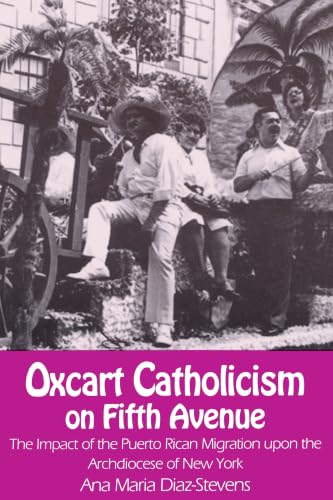

Oxcart Catholicism on Fifth Avenue the impact of the Puerto Rican migration upon the Archdiocese of New York Ana María Díaz-Stevens.
Series Notre Dame studies in American CatholicismDetalles de publicación: Notre Dame University of Notre Dame Press c1993.Descripción: vi, 295 p. ill. 24 cmISBN:- 0268015090 (alk. paper)
- 282/.7471/089687295 20
- BX1417.N4 D53 1993
| Imagen de cubierta | Tipo de ítem | Biblioteca actual | Biblioteca de origen | Colección | Ubicación en estantería | Signatura topográfica | Materiales especificados | Info Vol | URL | Copia número | Estado | Notas | Fecha de vencimiento | Código de barras | Reserva de ítems | Prioridad de la cola de reserva de ejemplar | Reservas para cursos | |
|---|---|---|---|---|---|---|---|---|---|---|---|---|---|---|---|---|---|---|
| Libro | Biblioteca Encarnación Valdés Colección de Puerto Rico | 282.7471 D542o (Navegar estantería(Abre debajo)) | Disponible | 80000001713919 |
Descripciones mejoradas de Syndetics:
Today Puerto Ricans are the largest single ethnic group in the city boroughs of the Archdiocese of New York. Oxcart Catholicism on Fifth Avenue presents a fascinating exploration and analysis of the Catholic church's efforts in New York City to meet the needs of migrant Puerto Ricans. Ana Maria Diaz-Stevens combines socio-historical methods and the insights of her personal participation in this process to create the first book-length assessment of this important event in twentieth-century American Catholic history.
Diaz-Stevens begins by tracing the historical development of Catholicism in Puerto Rico, first under Spain and then after 1898 under the United States. She suggests the ways in which Puerto Ricans differed from the Irish, Italian, Polish, or other Catholic groups that came to New York. At the same time, she breaks new ground by describing significant differences between Puerto Ricans and Mexican-Americans in the practice of religion.
After examining how institutional Catholicism in New York had grown from a loose mix of early nineteenth-century village parishes into a centralized cosmopolitan institution by the middle of the twentieth century, Diaz-Stevens presents a brief review of three historical periods of Puerto Rican migration to the city. She details the development of the "basement church" among Puerto Ricans as a specialized means of maintaining continuity with island traditions within a big city environment. She also discusses key church leaders, such as Francis Cardinal Spellman, Ivan Illich, Robert Fox and Robert Stem, describing how their attempts to deal with a people who presented "problems" evolved into an innovative ministry to Puerto Ricans. In the process, the Spanish-speaking Apostolate moved beyond existing models of ethnic assimilation into a post-Vatican activism, oriented towards social and community needs.
Includes bibliographical references (p. 269-283) and index.
Reseñas proporcionadas por Syndetics
Publishers Weekly Review
Between 1946 and 1964 more than a half-million Puerto Ricans left their island home for New York City in a politically and economically driven migration that, as this study shows, forever changed both places. It was the largest ethnic migration to the Roman Catholic archdiocese of New York. Diaz-Stevens, assistant professor of Puerto Rican and Hispanic Caribbean studies at Rutgers University, describes the various phases of the migration and the major role played by the Catholic Church in the socio-cultural adaptation of the newcomers, who were mainly from rural areas. Early church leaders are seen as focusing on ``Americanization'' at the parish level. Later, some members of the clergy tried to soften the impact of institutional rigidity, but ecclesiastical bureaucracy prevailed. The shifts in control of the Spanish apostolate reflect the changing attitudes in leadership, which are well-documented in this interesting social history. The author bolsters her account with strong sociological background material. (Aug.) (c) Copyright PWxyz, LLC. All rights reservedCHOICE Review
Immigrants' religion serves them in their relationships with the host population by providing a core of stability in maintaining their ethnicity, and their church is a center of social and material resources in the process of assimilation. In this book that story is told again, but the emphasis is put on how the migrants can affect the religion of the host population. Because of features in its history, Puerto Rican Catholicism was characterized by a social distance between the parish and the clerical hierarchy. The migration of large numbers of Puerto Ricans to New York City following WW II posed problems for the New York Catholic hierarchy, which was formed in the Irish immigration experience. D'iaz-Stevens reports and analyzes these tensions and the processes of change that the New York archdiocese went through in response to the Puerto Ricans. It is a sociological study, placed in historical context, grounded in the experience of participants, and with appropriate theoretical sophistication. The work contributes to our understanding of migration/assimilation processes and assesses some of the internal dynamics of church organization. It is well written and has good notes, bibliography, index, and a glossary for Spanish and other specialized terms. Advanced undergraduate; graduate; faculty. R. L. Herrick; Teikyo Westmar UniversityNotas de autor provistas por Syndetics
Ana Maria Diaz-Stevens is Associate Professor of Church and Society studies at Union Theological Seminary. She has published extensively on religion and Latino studies.