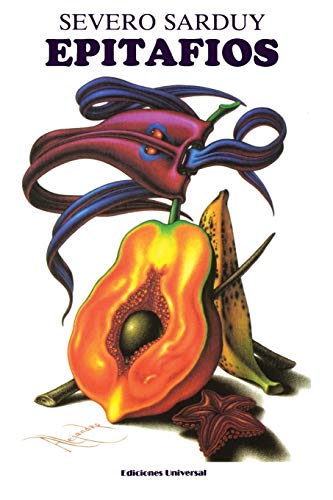
Imagen de portada de Amazon
Imagen de Amazon.com
Imagen de cubierta Syndetics
Portada de Syndetics
Imagen de OpenLibrary

Epitafios imitación : aforismos Severo Sarduy.

Por: Series Colección Clásicos cubanosDetalles de publicación: Miami, Fla. Ediciones Universal 1994.Descripción: 85 p. illISBN:
  • 0897296788
Tema(s):
Valoración
    Valoración media: 0.0 (0 votos)
Existencias
Imagen de cubierta Tipo de ítem Biblioteca actual Biblioteca de origen Colección Ubicación en estantería Signatura topográfica Materiales especificados Info Vol URL Copia número Estado Notas Fecha de vencimiento Código de barras Reserva de ítems Prioridad de la cola de reserva de ejemplar Reservas para cursos
Libro Biblioteca Encarnación Valdés Colección General bev Cu 861 S244e (Navegar estantería(Abre debajo)) Disponible 80000001849275
Total de reservas: 0

Descripciones mejoradas de Syndetics:

Severo Sarduy was born in Camaguey, Cuba, in 1937 and died in Paris, France, in 1993. Without a doubt, he was internationally recognized as one of the most important writers of his generation. Shortly before his death, he wrote and collected these poems that constitute a farewell full of humor for a death he knows is nearby. The book includes illustrations (black & white) by Cuban painter, Ramon Alejando. Also included are studies on the author and his literary work by professors Concepcion T. Alzola and Gladys Zaldivar.

Includes bibliographical references (p. 83-84).

Notas de autor provistas por Syndetics

Sarduy has written primarily in exile and under the aegis of contemporary French intellectual and cultural movements. His essays are dense speculations about the complex structure of contemporary culture, a line of inquiry that forms the basis of his highly wrought fiction. He explores individuals and situations as the intersection of multiple levels of cultural formation enacted (unconsciously by the characters) in even the most menial actions and events. Stripped down to their narrative core, Sarduy's novels typically deal with the quotidian, but the quotidian figured in a richly textured language that is as difficult to read as his cultural formations are to understand. Moreover, Sarduy has been especially audacious both in depicting taboo (panerotic sexualism, homosexuality, transvestism, and transgressive "gender bending" in general) and in demonstrating taboo's irrelevance to daily life. In Sarduy's vision, the lines drawn between taboo and transgression, the conventional and the deviant, are not real. In one sense, Sarduy's writing is quintessentially Cuban in themes and tone, while at the same time one of the best examples of Latin American late modernism. (Bowker Author Biography)
Compartir
logopucpr-y-vive

Contáctanos

¡Queremos saber de ti!

Tel. 787.841.2000 Ext. 1801

bibliotecavaldes@pucpr.edu

⁣Búscanos en las redes

© 2026 Desarrollado por Ignite Online • All Rights Reserved • Powered by Koha.