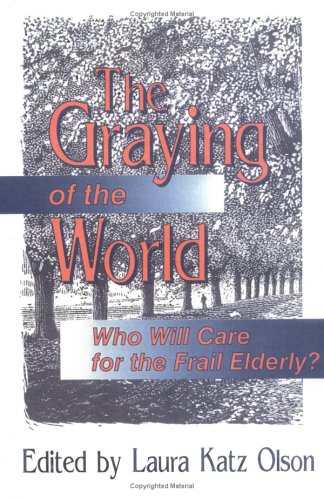

The Graying of the world who will care for the frail elderly? Laura Katz Olson, editor.
Detalles de publicación: New York Haworth Press 1994.Descripción: p. cmISBN:- 1560243635 (acid-free paper)
- 1560243643 (pbk. : acid-free paper)
- 362.6/1 20
- HV1451 .G725 1994
| Imagen de cubierta | Tipo de ítem | Biblioteca actual | Biblioteca de origen | Colección | Ubicación en estantería | Signatura topográfica | Materiales especificados | Info Vol | URL | Copia número | Estado | Notas | Fecha de vencimiento | Código de barras | Reserva de ítems | Prioridad de la cola de reserva de ejemplar | Reservas para cursos | |
|---|---|---|---|---|---|---|---|---|---|---|---|---|---|---|---|---|---|---|
| Libro | Biblioteca Encarnación Valdés Colección General bev | 362.61 G778 (Navegar estantería(Abre debajo)) | Disponible | 80000001746307 |
Descripciones mejoradas de Syndetics:
This unique book studies America's frail older population relative to the elderly in ten other nations. It contains a cross-national assessment of approaches to long-term care for the elderly and explains the nature and extent of current and future problems related to caring for the functionally impaired elderly. By studying and analyzing the ongoing struggles of other nations in their attempts to cope with growing populations of frail elderly, readers in the U.S. can expand the parameters of their own national debate on the subject. The Graying of the World shows the political, economic, and social context in which decisions on elder-care are based and evaluates how successful various countries'programs have been. Chapters outline alternative approaches taken by disparate types of national systems, highlighting unique and creative solutions to provide useful information on new and alternative ways to respond to personal and public issues related to elder-care.
The elderly and their care in Finland, France, Germany, Great Britain, Israel, Japan, People's Republic of China, Sweden, and Yugoslavia are discussed, as are the elderly in Canada and the United States. Chapters cover the following topics for each country: the increasing number of frail elderly and their costly health needs the current and future role of the state in elder-care the current and future role of the family in elder-care types of support services offered for the elderly, including in-home care, community-based care, and institutional care the relationship of a nation's political economy to its attitude and policy on long-term care innovative approaches to elder-care
Practitioners, decision makers, and the concerned general public will all find The Graying of the World an interesting and informative book that expands the discussion of health care options available for the elderly. As such, the book is also a helpful text for undergraduate and beginning graduate students of gerontology, public policy, and comparative politics, as well as for social service practitioners. It provokes much-needed conversation on developing a healthcare plan for the future that meets the needs of a large elderly population.
Includes bibliographical references and index.