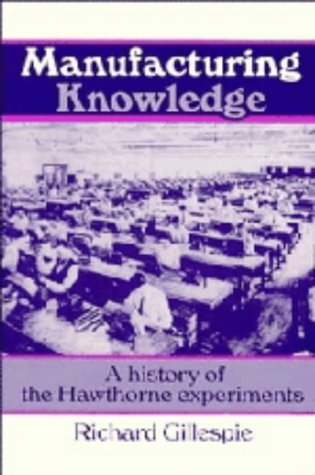
Imagen de portada de Amazon
Imagen de Amazon.com
Imagen de cubierta Syndetics
Portada de Syndetics
Imagen de OpenLibrary

Manufacturing knowledge a history of the Hawthorne experiments Richard Gillespie.

Por: Series Studies in economic history and policyDetalles de publicación: Cambridge Cambridge University Press 1991.Descripción: 1 vISBN:
  • 0521403588
Tema(s): Clasificación CDD:
  • 658 20
Valoración
    Valoración media: 0.0 (0 votos)
Existencias
Imagen de cubierta Tipo de ítem Biblioteca actual Biblioteca de origen Colección Ubicación en estantería Signatura topográfica Materiales especificados Info Vol URL Copia número Estado Notas Fecha de vencimiento Código de barras Reserva de ítems Prioridad de la cola de reserva de ejemplar Reservas para cursos
Libro Biblioteca Encarnación Valdés Colección General bev 658 G478m (Navegar estantería(Abre debajo)) Disponible 80000001678633
Total de reservas: 0

Descripciones mejoradas de Syndetics:

What motivates workers to work harder? What can management do to create a contented and productive workforce? Discussion of these questions would be incomplete without reference to the Hawthorne experiments, one of the most famous pieces of research ever conducted in the social and behavioural sciences. Drawing on the original records of the experiments and the personal papers of the researchers, Richard Gillespie has reconstructed the intellectual and political dynamics of the experiments as they evolved from the tentative experimentation to seemingly authoritative publications. Manufacturing Knowledge raises fundamental questions about the nature of scientific knowledge, and about the assumptions and evidence that underlay debates on worker productivity.

Includes bibliography and index.

Tabla de contenidos provista por Syndetics

  • Editor's preface
  • Glossary of manuscript collections
  • Introduction
  • 1 The management of work
  • 2 The T room
  • 3 Interpreting the relay test
  • 4 Elton Mayo and the research network
  • 5 The psychopathology of industrial life
  • 6 The anthropology of work
  • 7 Manufacturing the Hawthorne experiments
  • 8 Human relations in industry
  • 9 Human relations in the social sciences
  • Conclusion: manufacturing knowledge
  • Acknowledgements
  • Bibliography of the Hawthorne experiments
  • Index

Reseñas proporcionadas por Syndetics

Library Journal Review

This is a scholarly, detailed, historical analysis of the famous 1924-1933 Hawthorne experiments and the literature of criticism and commentary that followed the initial accounts. Gillespie argues that numerous interpretations of the experiments and their relevance for management theory evolved because ``scientific knowledge is produced in specific social, institutional, and ideological contexts and that these contexts leave their imprint on the knowledge claims made by scientists.'' Since the findings of the Hawthorne experiments continue to influence personnel management, this work will be of interest to those concerned with worker motivation and productivity. Highly recommended for academic libraries, particularly those with graduate collections.-- Jane M. Kathman, Coll. of St. Benedict Lib., St. Joseph, Minn. (c) Copyright 2010. Library Journals LLC, a wholly owned subsidiary of Media Source, Inc. No redistribution permitted.

CHOICE Review

Gillespie's account of the Hawthorne experiments is highly informative and delightfully written. Enormous effort went into preparing the book, and it shows. Readers will gain a solid understanding of the Hawthorne studies, the ensuing heated controversies among the researchers in finalizing conclusions, and social scientists' continuing debate over the "correct" interpretation. Gillespie persuasively argues that the Hawthorne researchers' conclusions ultimately rested on findings from the now-famous Bank Wiring Room with its five young female workers. The interpretation of productivity increases could have stressed incentive pay, but instead emphasized social factors a cohesive, congenial work group and friendly supervision. Thus was born "human relations," and we have been quarrelling about the productivity of "happy workers" ever since. Gillespie heavily underscores that the "findings" of the Hawthorne researchers were constructed from puzzling data that might have been viewed quite differently. For teachers of organization theory, and their graduate students, this book is in the must-read category.-C. Tausky, University of Massachusetts at Amherst
Compartir
logopucpr-y-vive

Contáctanos

¡Queremos saber de ti!

Tel. 787.841.2000 Ext. 1801

bibliotecavaldes@pucpr.edu

⁣Búscanos en las redes

© 2026 Desarrollado por Ignite Online • All Rights Reserved • Powered by Koha.