
| Imagen de cubierta | Tipo de ítem | Biblioteca actual | Biblioteca de origen | Colección | Ubicación en estantería | Signatura topográfica | Materiales especificados | Info Vol | URL | Copia número | Estado | Notas | Fecha de vencimiento | Código de barras | Reserva de ítems | Prioridad de la cola de reserva de ejemplar | Reservas para cursos | |
|---|---|---|---|---|---|---|---|---|---|---|---|---|---|---|---|---|---|---|
| Libro | Biblioteca Encarnación Valdés Colección General bev | 302.2345 M158a (Navegar estantería(Abre debajo)) | Disponible | 80000001709651 |
Descripciones mejoradas de Syndetics:
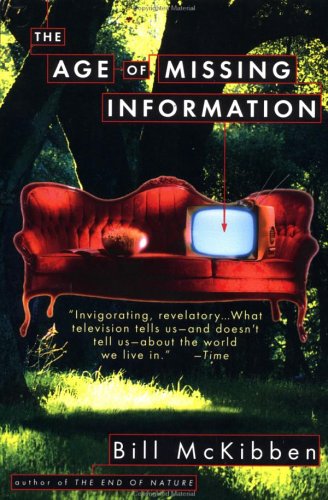
The author of The End of Nature asks an intriguing question: Which provides more information, 103 cable channels showering us with beguiling factoids--or a weekend in the woods? McKibben's work will forever alter our view of TV and the world.
Originally published: New York : Random House, c1992.
Includes index.
Extracto provisto por Syndetics
Reseñas proporcionadas por Syndetics
Publishers Weekly Review
In this worthy but belabored attack on television, McKibben compares his experience watching 1700 hours of videotaped TV unfavorably to that of contemplating nature in the Adirondacks. Author tour. (May) (c) Copyright PWxyz, LLC. All rights reservedBooklist Review
McKibben's dramatically titled, dramatically pessimistic End of Nature made quite a splash among devotees of the New Yorker. The same crowd may fall for this opus, so make sure it's on hand for them. But really, it's a tiresome clich{{‚}}e of a book--a diatribe against TV that just rewhines arguments that have been around for 20 years or more. At least it's got a gimmick: McKibben watched a day's worth of the programs a citizen of Fairfax, Virginia, which has the most voluminous cable service in the country, might but actually never could watch unless, of course, he or she had more heads than a hydra or, like McKibben, had friends taping them all for later viewing. He contrasts his watcher's report, which basically stresses how much can't be shown, or shown interestingly, on TV, with another report, spottily spread between thick hunks of TV-carping, on a walk up and around an Adirondack he lives near. Guess which is the more meaningful experience--the tube gazing or the hike? A book full of foregone conclusions as well as some gaps in logic that suggest perhaps McKibben's been watching too much TV. (Reviewed Feb. 15, 1992)0394589335Ray OlsonNotas de autor provistas por Syndetics
Bill McKibben grew up in Lexington, Massachusetts. He was president of the Harvard Crimson newspaper in college. Immediately after college he joined the New Yorker magazine as a staff writer, and wrote much of the "Talk of the Town" column from 1982 to early 1987. After quitting this job, he soon moved to the Adirondack Mountains of upstate New York.His first book, The End of Nature, was published in 1989 by Random House after being serialized in the New Yorker. It is regarded as the first book for a general audience about climate change, and has been printed in more than 20 languages. Several editions have come out in the United States, including an updated version published in 2006.
His next book, The Age of Missing Information, was published in 1992. It is an account of an experiment: McKibben collected everything that came across the 100 channels of cable tv on the Fairfax, Virginia system (at the time among the nation's largest) for a single day. He spent a year watching the 2,400 hours of videotape, and then compared it to a day spent on the mountaintop near his home. This book has been widely used in colleges and high schools, and was reissued in 2006. McKibben's latest book is entitled, Eaarth: Making a Life on a Tough New Planet.
Bill currently resides with his wife, writer Sue Halpern, and his daughter, Sophie in Ripton, Vermont. He is a scholar in residence at Middlebury College. 030 (Bowker Author Biography)