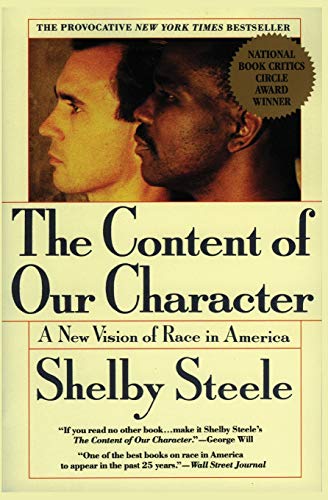
Imagen de portada de Amazon
Imagen de Amazon.com
Imagen de cubierta Syndetics
Portada de Syndetics
Imagen de OpenLibrary

The content of our character a new vision of race in America Shelby Steele.

Por: Detalles de publicación: New York, NY HarperPerennial 1991.Edición: 1st HarperPerennial edDescripción: 175 pISBN:
  • 006097415X (pbk.)
Tema(s): Clasificación CDD:
  • 305.896/073 20
Clasificación LoC:
  • E185.615 .S74 1991
Premios: Haga clic para abrir en una nueva ventana
Valoración
    Valoración media: 0.0 (0 votos)
Existencias
Imagen de cubierta Tipo de ítem Biblioteca actual Biblioteca de origen Colección Ubicación en estantería Signatura topográfica Materiales especificados Info Vol URL Copia número Estado Notas Fecha de vencimiento Código de barras Reserva de ítems Prioridad de la cola de reserva de ejemplar Reservas para cursos
Libro Biblioteca Encarnación Valdés Colección General bev 305.896073 S814c (Navegar estantería(Abre debajo)) Disponible 80000001792525
Total de reservas: 0

Descripciones mejoradas de Syndetics:

In this controversial essay collection, award-winning writer Shelby Stelle illuminates the origins of the current conflict in race relations--the increase in anger, mistrust, and even violence between black and whites. With candor and persuasive argument, he shows us how both black and white Americans have become trapped into seeing color before character, and how social policies designed to lessen racial inequities have instead increased them. The Content of Our Character is neither "liberal" nor "conservative," but an honest, courageous look at America's most enduring and wrenching social dilemma.

Reseñas proporcionadas por Syndetics

Library Journal Review

This volume is a collection of nine of Steele's essays, some of which have been recently published in Harper's , which he frames with an introduction and an epilog. He presents his own perspective on the current state of race relations in the United States, noting problems but purveying a generally optimistic message. He offers introspection, a dash of autobiography, and a hint of social psychology. The danger with such a mixture is, of course, that social diagnoses and prescriptions drawn from necessarily idiosyncratic experiences, while thought-provoking, can be often only serendipitously correct and sometimes just plain wrong. Still, the value of this work is that it should spark similar introspection on the part of literate lay readers.-- Joseph Stewart Jr., Univ. of Texas at Dallas, Richardson (c) Copyright 2010. Library Journals LLC, a wholly owned subsidiary of Media Source, Inc. No redistribution permitted.

Publishers Weekly Review

Steele, seeking to improve strained race relations, demonstrates how social policies intensify rather than lessen racial differences, how blacks and whites tend to see color before character, and how blacks are often oppressed more by doubt in their abilities than by racism. This won a National Book Critics Circle award. (Sept.)no PW (c) Copyright PWxyz, LLC. All rights reserved

Booklist Review

This must have been a hard book to write, speaking as it does such unpopular truths. It may well be a hard book to read, especially for those deeply invested in a vision of black oppression and white guilt. Steele strikes out at the racism that disguises itself as liberalism or even radicalism but permits blacks to be only blacks and not fully human. He questions why black students call for segregated departments while decrying apartheid, damns those who'd blame all inner-city crime on poor policing, and attacks those who reject successful blacks as abandoning their heritage. He gives names to behaviors: "race-holding," for blaming every discomfort on racism; "grandiosity," for compensatory excellence in permitted areas like entertainment and sports; "subjective correlatives," for the recasting of problems (drugs, teenage pregnancy) as symbols of black oppression; "integration shock," for the self-doubt that comes with access to groups and experiences previously forbidden. Because this brave book stands so far outside the patterns of current discourse--for instance, he isn't certain affirmative action works--the easy reaction will be to accuse Steele of Uncle Tomism. But is that fair? Expect controversy, but read this book and talk about it. --Pat Monaghan
Compartir
logopucpr-y-vive

Contáctanos

¡Queremos saber de ti!

Tel. 787.841.2000 Ext. 1801

bibliotecavaldes@pucpr.edu

⁣Búscanos en las redes

© 2026 Desarrollado por Ignite Online • All Rights Reserved • Powered by Koha.