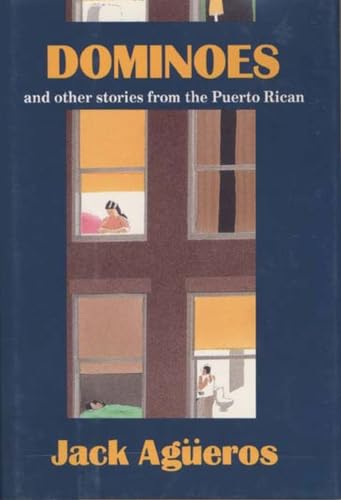

Dominoes & other stories Jack Agüeros.
Detalles de publicación: Willimantic, CT Curbstone Press East Haven, CT Distributed in the U.S. by InBook 1993.Edición: 1st edDescripción: p. cmISBN:- 188068411X
- 813/.54 20
- PS3551.G845 D66 1993
| Imagen de cubierta | Tipo de ítem | Biblioteca actual | Biblioteca de origen | Colección | Ubicación en estantería | Signatura topográfica | Materiales especificados | Info Vol | URL | Copia número | Estado | Notas | Fecha de vencimiento | Código de barras | Reserva de ítems | Prioridad de la cola de reserva de ejemplar | Reservas para cursos | |
|---|---|---|---|---|---|---|---|---|---|---|---|---|---|---|---|---|---|---|
| Libro | Biblioteca Encarnación Valdés Colección General bev | 813.54 A282d (Navegar estantería(Abre debajo)) | Disponible | 80000001709545 |
Descripciones mejoradas de Syndetics:
Dominoes & Other Stories from the Puerto Rican, the long-awaited debut collection of fiction from playwright and poet Jack Agüeros, is a unique window on the untold stories of the lives of Puerto-Rican Americans.
With a phenomenal richness of detail, Jack Agüeros brings the reality of Puerto Rican experience in New York fully to life. In stories that span the decades of the 1940s through 1990s he recreates the barrio in all its multi-faceted immensity, with its candy stores, plaster saints, numbers collectors, tropical fruit vendors and sidewalk games of dominoes, its knife fights and junkies' raps and its succesful stories of craftsmen and entrepeneurs.
These stories convey hard, sometimes brutal, often bittersweet experiences, but throughout, Jack Agüeros writes with artistry and unyielding compassion that gloriously affirm quiet moments of grace and triumph in common and ordinary struggles--the real stuff of literature.
Reseñas proporcionadas por Syndetics
Publishers Weekly Review
In this debut collection of eight stories, poet, playwright and television writer Agueros creates intimate portraits of New York City's Puerto Rican community, revealing the complexities of people whose indigenous culture often conflicts with their new urban life. Though his prose is spare, the tales brim with telling details that define the time and place with indelibly vivid images. The title story describes a routine game of dominoes that erupts in violence because machismo rules the behavior of the players. ``Men who are real men can live their lives anyway they like . . . To be macho is the destiny,'' one of the players tells one teenage onlooker before her uncle is murdered. ``Malig; Malig & Sal; Sal'' shows the problems of being on the distaff side of machismo--especially when a woman tries to step out of a man's shadow. These violent dramas notwithstanding, Agueros's focus is on the simpler joys and pains of ordinary life, all expressed in a clear, colloquial voice. A small boy delights in ritual visits to his devoted godmother in ``One Sunday Morning''; another teenager rebels against his stingy stepfather in ``Johnny United''; and in ``Horologist'', a clock restorer chooses to concentrate on the inner workings of antique timepieces rather than on material gain, speed and narcissism. Ultimately, this book celebrates the nurturing spirit of the human heart. (Sept.) (c) Copyright PWxyz, LLC. All rights reservedCHOICE Review
Eight short stories written by one of the truthful chroniclers of New York's Spanish Harlem. Although "Dominoes" is the first story in the collection, the best story is the one that follows--"Horologist (By Appointment Only)." This and the story "Santos Negron" are very unusual in that both are focused on the lives of members of the Puerto Rican working class, people whose stories are seldom told. In "Horologist," Gary Garcia is trying to do a television series that explores unusual occupations of minority people who are proud of their accomplishments. When a prospective subject for his series, an expert Puerto Rican horologist, refuses, Garcia asks him, "How will the people who are full of prejudices toward Latinos ever get to see us as decent and contributing citizens? ... We are making America great, so why are we hiding it?" "Santos Negron" chronicles the daily routine of a group of Puerto Rican men working in the laundry room of the Plaza Hotel. Ag"ueros knows intimately the Puerto Rican community, and such stories as "One Sunday Morning," "Johnny United," or "Malig; Malig & Sal; Sal," some of which also contain some autobiographical elements, effectively reveal this knowledge. A welcome addition to the excellent and growing body of literature by Puerto Ricans in the diaspora writing in English. General; undergraduate (all levels). L. L. Pinto; Bronx Community College, CUNYBooklist Review
In these eight vivid stories that both shock and delight, the language is colloquial, the themes the difficult realities of an immigrant's experience. Agueros wants to let us know something about life in the U.S. for a Puerto Rican. In "Dominoes," a pleasant story takes a bloody turn after a game of dominoes goes horribly wrong. In "Malig; Malig & Sal; Sal," a woman's internal dialogue is wrapped in a single night's drama; it is a story of survival. "Horologist" stands out as a story that captures the universality of what devotion can be--in this instance, devotion to one's craft: fixing clocks. Agueros wants to let us in on a secret--quite simply, Puerto Ricans' experiences in this country are no different from those of any other immigrant group. Yet his small book also conjures up the special texture of the culture from which it stems. ~--Raul NinoNotas de autor provistas por Syndetics
Jack Ruben Agüeros was born on September 2, 1934 in East Harlem, New York. After graduating from high school, he spent four years in the Air Force. He graduated from Brooklyn College and received a master's degree in urban studies at Occidental College in Los Angeles in 1970. He worked at a Lower East Side antipoverty program until 1977 and then as director of El Museo del Barrio. He later earned a living as a grant writer and wrote poetry. His first collection of poetry, Correspondence between the Stone Haulers, was published in 1991. His other works include Sonnets from the Puerto Rican and Lord, Is This a Psalm? He also translated the complete works of Julia de Burgos. He died from complications of Alzheimer's disease on May 4, 2014 at the age of 79.(Bowker Author Biography)