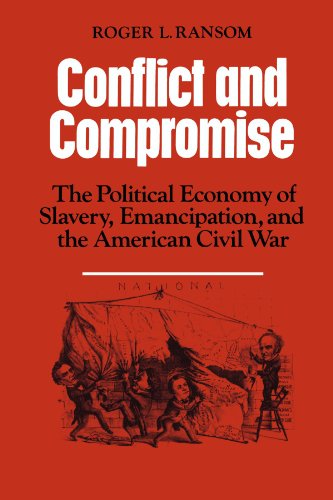
Imagen de portada de Amazon
Imagen de Amazon.com
Imagen de cubierta Syndetics
Portada de Syndetics
Imagen de OpenLibrary

Conflict and compromise : the political economy of slavery, emancipation, and the American Civil War / Roger L. Ransom.

Por: Detalles de publicación: Cambridge [England] : New York, Cambridge University Press, 1989.Descripción: xv, 317 p. : ill. ; 23 cmTipo de contenido:
Tipo de medio:
Tipo de soporte:
ISBN:
  • 0521311675
Tema(s): Clasificación CDD:
  • 937.7/112 19
Clasificación LoC:
  • E441 .R3 1990
Valoración
    Valoración media: 0.0 (0 votos)
Existencias
Imagen de cubierta Tipo de ítem Biblioteca actual Biblioteca de origen Colección Ubicación en estantería Signatura topográfica Materiales especificados Info Vol URL Copia número Estado Notas Fecha de vencimiento Código de barras Reserva de ítems Prioridad de la cola de reserva de ejemplar Reservas para cursos
Libro Biblioteca de Mayagüez Colección General mb E441 .R3 1990 (Navegar estantería(Abre debajo)) Disponible 50000001970911
Total de reservas: 0

Descripciones mejoradas de Syndetics:

No series of events has had a more dramatic impact on the course of American history than the Civil War and the emancipation of four million black slaves. In this book Professor Roger Ransom examines the economic and political factors that led to the attempt by Southerners to dissolve the Union in 1860, and the equally determined effort of Northerners to preserve it. Drawing on recent research in economic, political, and social history, Ransom argues that the system of capitalist slavery in the South not only 'caused' the Civil War by producing tensions that could not be resolved by compromise; it also played a crucial role in the outcome of that War by crippling the southern war effort at the same time that emancipation became a unifying issue for the North.

Includes bibliographical references (p. 289-304).

dic/90

Tabla de contenidos provista por Syndetics

  • List of tables and illustrations
  • Preface
  • 1 Historical puzzles
  • 2 Slavery and freedom
  • 3 The economics of slavery
  • 4 The politics of slavery
  • 5 The politics of compromise
  • 6 Slavery and the war
  • 7 The impact of emancipation
  • 8 After the war
  • Bibliography
  • Index

Reseñas proporcionadas por Syndetics

Library Journal Review

In his detailed examination of the political and economic factors that brought about the secession crisis, economist-turned-historian Ransom places the institution of slavery squarely at center stage. To Ransom, slavery not only ``caused'' the Civil War, it also determined its outcome by crippling the Confederate war effort. An irony, of sorts, characterized the long sectional conflict over slavery. The North, as Ransom describes it, fought a costly war to abolish slavery even as most northerners had little interest in emancipating the slaves. The South failed in a devastating war to protect its peculiar institution even as the 1860 U.S Constitution offered it the best protection for a slave system. Ransom's work, somewhat cumbersome in places, still makes for interesting reading. Recommended for colleges and universities with upper-division courses in the South and the Civil War.-- Jason H. Silverman, Winthrop Coll., Rock Hill, S.C. (c) Copyright 2010. Library Journals LLC, a wholly owned subsidiary of Media Source, Inc. No redistribution permitted.

CHOICE Review

Ransom, a major figure in the study of the cliometrics of New South sharecropping and tenant farming systems, here draws on his own primary research into the political economy of slavery, freeholding, and antebellum small industries. He also makes use of secondary sources and family ethnography provided by modern social history. The result is an image of an irrepressible conflict, an inevitable fight between a southern way of life and a northern way of life; both "ways" begin as economics but become much more. With a deft twist of the ironist's hand, Ransom also demonstrates that the southern antebellum life style was possible only in the very union attacked by the most militant defenders of the "peculiar institution" of the region but that "the presence of slavery in the United States represented a contradiction that eventually could only be removed by armed conflict." None of Ransom's conclusions is unique, and no single component of Conflict and Compromise is really new; but the sum of all these parts is brilliant. Useful, in different ways, for any level of student. J. Roper Emory and Henry College
Compartir
logopucpr-y-vive

Contáctanos

¡Queremos saber de ti!

Tel. 787.841.2000 Ext. 1801

bibliotecavaldes@pucpr.edu

⁣Búscanos en las redes

© 2026 Desarrollado por Ignite Online • All Rights Reserved • Powered by Koha.