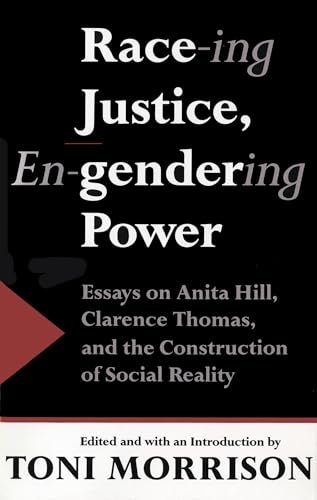

Race-ing justice, en-gendering power essays on Anita Hill, Clarence Thomas, and the construction of social reality edited and with an introduction by Toni Morrison.
Detalles de publicación: New York Pantheon Books 1992.Edición: 1st edDescripción: xxx, 475 p. ill. 21 cmISBN:- 0679741453
- 347.73/2634 347.3073534 20
- KF8745.T48 R33 1992
| Imagen de cubierta | Tipo de ítem | Biblioteca actual | Biblioteca de origen | Colección | Ubicación en estantería | Signatura topográfica | Materiales especificados | Info Vol | URL | Copia número | Estado | Notas | Fecha de vencimiento | Código de barras | Reserva de ítems | Prioridad de la cola de reserva de ejemplar | Reservas para cursos | |
|---|---|---|---|---|---|---|---|---|---|---|---|---|---|---|---|---|---|---|
| Libro | Biblioteca Encarnación Valdés Colección General bev | 347.73 R118 (Navegar estantería(Abre debajo)) | Disponible | 80000001662298 |
Descripciones mejoradas de Syndetics:
It was perhaps the most wretchedly aspersive race and gender scandal of recent times: the dramatic testimony of Anita Hill at the Senate hearings on the confirmation of Clarence Thomas as Supreme Court Justice. Yet even as the televised proceedings shocked and galvanized viewers not only in this country but the world over, they cast a long shadow on essential issues that define America.
In Race-ing Justice, En-gendering Power, Nobel Prize winner Toni Morrison contributes an introduction and brings together eighteen provocative essays, all but one written especially for this book, by prominent and distinguished academicians--Black and white, male and female. These writings powerfully elucidate not only the racial and sexual but also the historical, political, cultural, legal, psychological, and linguistic aspects of a signal and revelatory moment in American history.
With contributions by:
Homi K. Bhabha, Margaret A. Burnham, Kimberlé Crenshaw, Paula Giddings, A. Leon Higginbotham, Jr., Claudia Brodsky Lacour, Wahneema Lubiano, Manning Marable, Nellie Y. McKay, Toni Morrison, Nell Irvin Painter, Gayle Pemberton, Andrew Ross, Christine Stansell, Carol M. Swain, Michael Thelwell, Kendall Thomas, Cornel West, Patricia J. Williams
Includes bibliographical references.
Extracto provisto por Syndetics
Reseñas proporcionadas por Syndetics
Publishers Weekly Review
As Morrison (Jazz) writes in her pointed opening essay, the Thomas controversy last year both raised and buried issues of profound national significance. This collection of 19 essays, mostly by academics, powerfully advances the debate, though Thomas's defenders will find little solace. Most telling is federal judge A. Leon Higgonbotham's open letter to Thomas, cordially but relentlessly laying out the legal history of the civil rights movement and showing how Thomas's own public and private life has benefited. Manning Marable, describing the crisis in the response by black organizations, skillfully skewers the neoaccommodationist support of Thomas among black liberals. Gayle Pemberton writes that Hill exemplifies James Baldwin's observation that white Americans don't know how to deal with a black who falls outside of their expectations. Christine Stansell notes Catharine MacKinnon's initial embrace of Thomas for his life experience while ignoring his ideas as an example of how even militant feminists can be snookered when the issue is racial identity. Some essays cover the same ground, and a few are jargon-heavy, but the collection remains valuable. (Oct.) (c) Copyright PWxyz, LLC. All rights reservedCHOICE Review
Published on the first anniversary of the Clarence Thomas Supreme Court confirmation hearings, this remarkable collection includes an exquisitely written introduction by Toni Morrison, in which she frames the discourse contained in the 18 essays that follow. The Thomas hearings forced onto center stage the interrelated issues of race, gender, and multiculturalism. The essays, contributed by African Americans a federal judge, novelists, and scholars of history, literature, law, philosophy, women's studies and African American studies address these issues. The quality of the essays is amazingly consistent; they are all well written and original. Especially impressive are Leon Higginbotham's evaluation of Thomas's qualifications and capabilities; Michael Thelwell's indictment of Yale's decision to concentrate on recruitment and integration of only the brightest and most promising black students in lieu of establishing a course of study in African American culture and history; Cornel West's review of the failure of black leadership and racialist reasoning; and Paula Giddings's historical insights into African American sexism. This is an important volume on a timely subject. Highly recommended for all libraries and all readers. F. J. Hay; Harvard UniversityBooklist Review
The circumstances surrounding the Clarence Thomas confirmation hearings, with Anita Hill's subsequent testimony concerning sexual harassment, continue to stir up painful sentiments. The televised spectacle and its aftermath are reflected upon in Toni Morrison's clearly articulated preface and in 18 thought-provoking essays by learned contributors. Although there are redundancies (for instance, mention is made a number of times of Thomas' insensitive and inaccurate 1980 speech mentioning his sister's welfare dependency), the essays serve to illuminate the riveting event itself while constructing a framework in which to view Thomas' life, issues of gender, and the ramifications of the hearings. The fact, as Morrison states, that "it is now possible to speak about these matters [of race and gender] without the barriers" makes this an essential addition for collections. ~--Alice JoyceNotas de autor provistas por Syndetics
Toni Morrison was born in Lorain, Ohio on February 18, 1931. She received a B.A. in English from Howard University in 1953 and a master's degree in English from Cornell University in 1955 with her thesis on the theme of suicide in modern literature. She taught at several universities including Texas Southern University, Howard University, and Princeton University.Her first novel, The Bluest Eye, was published in 1970. Her other works include Sula, Tar Baby, Jazz, Paradise, Love, A Mercy, Home, and God Help the Child. She has won several awards including the National Book Critics Circle Award for Song of Solomon in 1977, the Pulitzer Prize for Beloved in 1988, the Nobel Prize in Literature in 1993, the Presidential Medal of Freedom in 2012, the Edward MacDowell Medal for her outstanding contribution to American culture in 2016, and the PEN/Saul Bellow Award for Achievement in American Fiction in 2016. She also co-wrote children's books with her son, Slade Morrison, including The Big Box, The Book of Mean People, and Peeny Butter Fudge.
Toni Morrison passed away on August 5, 2019 at the age of 88, after a short illness.
(Bowker Author Biography)