Imagen de Amazon.com

Portada de Syndetics
Imagen de OpenLibrary
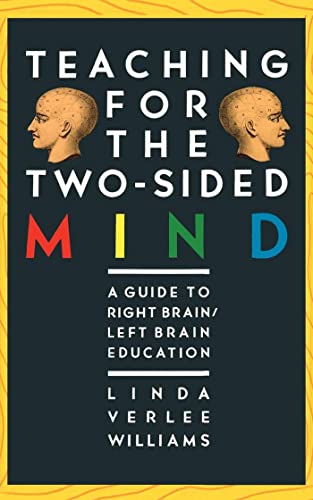
Teaching for the two-sided mind a guide to right brain/left brain education Linda Verlee Williams.
Series A Touchstone bookDetalles de publicación: New York Simon & Schuster 1986, c1983.Edición: 1st Touchstone edDescripción: p. cmISBN:- 0671622390 (pbk.)
- 370.15/23 19
- LB1060 .W54 1986
| Imagen de cubierta | Tipo de ítem | Biblioteca actual | Biblioteca de origen | Colección | Ubicación en estantería | Signatura topográfica | Materiales especificados | Info Vol | URL | Copia número | Estado | Notas | Fecha de vencimiento | Código de barras | Reserva de ítems | Prioridad de la cola de reserva de ejemplar | Reservas para cursos | |
|---|---|---|---|---|---|---|---|---|---|---|---|---|---|---|---|---|---|---|
| Libro | Biblioteca Encarnación Valdés Colección General bev | 370.1523 W724t (Navegar estantería(Abre debajo)) | Disponible | 80000001662751 |
Total de reservas: 0
Descripciones mejoradas de Syndetics:
In Teaching for the Two-Sided Mind Linda VerLee Williams explores the application of this important research to the classroom, summarizing current knowledge, discussing its implications, and providing practical teaching techniques that draw upon the right side of the brain.
Teachers, parents and all those interested in education will find Teaching for the Two-Sided Mind a fascinating exploration of how the most recent psychological findings can be put to use in the classroom
"Originally published by Prentice-Hall"--T.p. verso.
Includes index.
Bibliography: p.
Tabla de contenidos provista por Syndetics
- Preface(p. xi)
- 1 Learning with the Whole Brain(p. 1)
- The Two-Sided Mind and Education
- 2 Scientific Theory and Educational Practice(p. 13)
- Differences Between the Hemispheres
- A Model of Specialization
- Implications for Education
- Learning Styles and the Hemispheres
- Teaching Techniques for the Right Hemisphere
- 3 How Do You Think?(p. 39)
- Strategies and Modes of Thinking
- Teaching Students Process Awareness
- Solutions to Exercises
- 4 Metaphor(p. 54)
- Advantages of Metaphorical Teaching
- Using Metaphor in the Classroom
- 5 Visual Thinking(p. 84)
- Training Perception
- Graphic Representation
- Visualization
- 6 Fantasy(p. 115)
- Experiencing Fantasy
- Observation Fantasies
- Identification Fantasies
- Fantasy as a Basis for Self-Expression
- Evaluating the Products of Fantasy
- Using Fantasy in the Classroom
- Further Applications
- 7 Multisensory Learning(p. 143)
- Sensory Learning in the Early Primary Grades
- Sensory-Motor Integration
- Kinesthetic and Tactile Learning
- Kinesthetic Learning in Academic Subjects
- Kinesthetic Perception in Physical Learning
- Smell and Taste
- Nonverbal Auditory Learning (Music)
- 8 Direct Experience(p. 168)
- Laboratory Experiments
- Field Trips
- Real Objects and Primary Source Material
- Simulation
- Role Playing
- 9 How to Start(p. 180)
- Planning for Change
- Starting Now
- Intangibles
- Rediscovering Your Subject
- Personal Growth
- Working Together
- Support Groups
- 10 Conclusion(p. 191)
- Bibliography(p. 197)
- Index(p. 209)