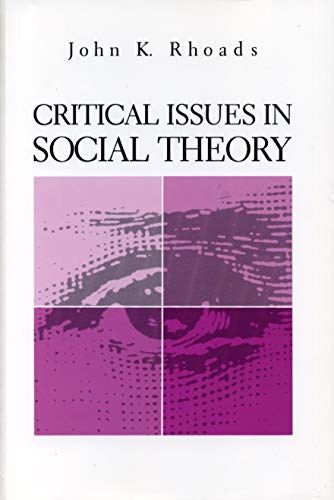

Critical issues in social theory John K. Rhoads.
Detalles de publicación: University Park, Pa. Pennsylvania State University Press c1991.Descripción: x, 374 p. 24 cmISBN:- 0271007095
- 301 20
- HM24 .R485 1990
| Imagen de cubierta | Tipo de ítem | Biblioteca actual | Biblioteca de origen | Colección | Ubicación en estantería | Signatura topográfica | Materiales especificados | Info Vol | URL | Copia número | Estado | Notas | Fecha de vencimiento | Código de barras | Reserva de ítems | Prioridad de la cola de reserva de ejemplar | Reservas para cursos | |
|---|---|---|---|---|---|---|---|---|---|---|---|---|---|---|---|---|---|---|
| Libro | Biblioteca Encarnación Valdés Colección General bev | 301 R474c (Navegar estantería(Abre debajo)) | Disponible | 80000001662330 |
Descripciones mejoradas de Syndetics:
Critical Issues in Social Theory is an analytical survey of persistent controversies that have shaped the field of sociology. It defines, clarifies, and proposes solutions to these "critical issues" through commentary on the writings of such influential social theorists as Hobbes, Marx, Durkheim, Weber, Mead, Merton, Parsons, and Schutz.
Instead of being just another history, or another classification of theories, Rhoads's four-part model allows him to focus attention on issues that remain at the core of sociological theory today. First, Rhoads analyzes the controversy over positivism as the proper methodological model for the study of human society. Is there one science, of which sociology is a branch, or do the peculiarities of sociology's subject matter require a modification of the scientific method borrowed from the natural sciences? Rhoads next considers the relationship of individuals to society and its structures. Does society have a mode of existence distinct from its members, or is it merely an abstraction derived from the characteristics of individuals? Third, a discussion of social order raises the question of whether social order is the consequence of rules and their underlying moral values, or the product of continuous construction based on self-interest. Finally, the relative importance of consensus and conflict in social relationships is addressed. Is society better understood as a community united by beliefs, values, and rules, or is the social dynamic of continual conflict over beliefs, values, and rules more fundamental? In coming to grips with these issues, the author in some instances takes sides and in others arrives at a synthesis of diverse perspectives. In the final chapter he points to the limitations on the possibility of rational action that come to light in the clashes over these basic issues.
Includes bibliographical references (p. [323]-366) and index.
Reseñas proporcionadas por Syndetics
CHOICE Review
Rhoads offers a lengthy exposition of a number of mainstream classical and modern sociological theorists. He pursues some very well trod paths in sociological thought in his focus on " and " In doing so, Rhoads reviews many of the usual thinkers from Comte, Weber, and Durkheim to Parsons and Schutz. His book has the virtue of being clearly written and has the look of a textbook in its " approach to traditional issues. Apart from limited treatment of Habermas, Rhoads ignores modern theorists outside the US and confines recognition of the Marxist tradition to a few lines about Marx. The so-called " view is represented by Dahrendorf. What Rhoads omits is a decade or more of " developed by poststructuralists, semiologists, feminists, and neo-Marxists, not to mention a vast set of vibrant debates in Europe and internationally. Well referenced. Good index. Undergraduate readers. B. D. Adam University of WindsorNotas de autor provistas por Syndetics
John Rhoads is Professor of Sociology at Northern Illinois University.