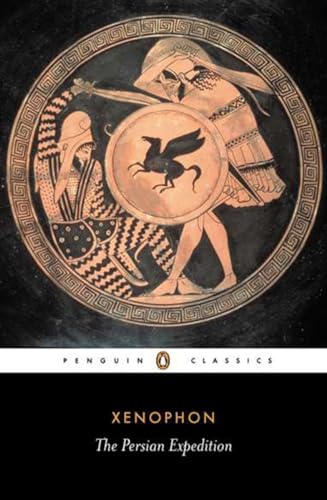
Imagen de portada de Amazon
Imagen de Amazon.com
Imagen de cubierta Syndetics
Portada de Syndetics
Imagen de OpenLibrary

The Persian expedition translated by Rex Warner.

Por: Colaborador(es): Idioma: Series The Penguin classics, L7Detalles de publicación: [Harmondsworth, Eng.] Penguin Books [1957]Descripción: 309 p. 18 cmISBN:
  • 0140440070
Títulos uniformes: Tema(s): Clasificación CDD:
  • 938/.06
Valoración
    Valoración media: 0.0 (0 votos)
Existencias
Imagen de cubierta Tipo de ítem Biblioteca actual Biblioteca de origen Colección Ubicación en estantería Signatura topográfica Materiales especificados Info Vol URL Copia número Estado Notas Fecha de vencimiento Código de barras Reserva de ítems Prioridad de la cola de reserva de ejemplar Reservas para cursos
Libro Biblioteca Encarnación Valdés Colección General bev 938 X5 (Navegar estantería(Abre debajo)) Disponible 80000001407462
Total de reservas: 0

Descripciones mejoradas de Syndetics:

In The Persian Expedition, Xenophon, a young Athenian noble who sought his destiny abroad, provides an enthralling eyewitness account of the attempt by a Greek mercenary army - the Ten Thousand - to help Prince Cyrus overthrow his brother and take the Persian throne. When the Greeks were then betrayed by their Persian employers, they were forced to march home through hundreds of miles of difficult terrain - adrift in a hostile country and under constant attack from the unforgiving Persians and warlike tribes. In this outstanding description of endurance and individual bravery, Xenophon, one of those chosen to lead the retreating army, provides a vivid narrative of the campaign and its aftermath, and his account remains one of the best pictures we have of Greeks confronting a 'barbarian' world.

Translation of Anabasis.

Notas de autor provistas por Syndetics

Xenophon's life and personality is better known to us, perhaps, than that of any other Greek who lived before Alexander the Great. Much of his considerable output of historical writing and essays is frankly or implicitly autobiographical. He reveals himself as one of those many Athenians and other Greeks who turned to autocratic political models, including admiration of Persia, after the excesses of the Athenian democracy led to disaster in the Peloponnesian War. He also reveals himself as much more than a literary man and a critic of his times. A gentleman adventurer and something of a professional soldier, he followed in turn the philosopher Socrates, the Persian prince Cyrus the Younger, and the Spartan king Agesilaus, all of whom he wrote about with an air of close personal knowledge. His works include the autobiographical Anabasis, an account of his service with a mercenary Greek army that marched from Mesopotamia to the Black Sea after the defeat and death of the younger Cyrus. It provides the most detailed single perspective on the military practices and military mentality of Xenophon's age. His Hellenica, by contrast, is an impersonal continuation to the end of the Peloponnesian War of the work of Thucydides and a patchy memoir that concentrates on Sparta's fortunes until the definitive end of its power in 362 b.c. Xenophon's other major works are the Cyropaedia and the rambling Socratic dialogues known as the Memorabilia. The Cyropaedia is a fictional idealization of the career of Cyrus the Great, the only great conqueror known to the Greeks before Alexander. Often regarded merely as a novel, it is a species of a priori historical reconstruction. A retrojection of the military science and political values of the day into a largely unknown Persia of the past, it is intended to explain Cyrus's success on rational principles. The Memorabilia and the Socratic Apology that comes down with them contain nothing of philosophical value but are thought by some scholars to offer a possible corrective to Plato's altogether too Platonic Socrates. Xenophon had a conventional and second-rate mind, but he is a valuable resource because of his mediocrity. He enables us to make contact with an ordinary intellect from a world that often seems dominated by geniuses. (Bowker Author Biography)
Compartir
logopucpr-y-vive

Contáctanos

¡Queremos saber de ti!

Tel. 787.841.2000 Ext. 1801

bibliotecavaldes@pucpr.edu

⁣Búscanos en las redes

© 2026 Desarrollado por Ignite Online • All Rights Reserved • Powered by Koha.